Baking with two trays
You want to use both muffin trays in one go and swap their positions if needed. Check whether the manual recommends multi-level baking with your chosen setting and at the shelf positions you plan to use.


If you want to bake both muffin trays in one go and swap their positions if needed, a built-in oven with a multi-level setting recommended in its instruction manual is an obvious choice – provided the oven cavity, shelf positions and tins are suitable. A countertop oven may be enough for smaller batches or baking in stages, without the need for a built-in space. However, having several shelf positions does not in itself mean that two muffin tins will fit at the same time or bake evenly. Before buying, check the dimensions of your tins, what’s included and the clearances required for installation or positioning.
You want to use both muffin trays in one go and swap their positions if needed. Check whether the manual recommends multi-level baking with your chosen setting and at the shelf positions you plan to use.
You need an appliance for your worktop and are happy to bake in stages if necessary. What matters is the usable space for your tins and the safe clearances required when positioning the oven – not just its capacity.
You want to use the oven for other baking, too. With built-in models, you can compare energy use per cycle for the same heating setting, and also consider the cleaning method and accessories.
A good fit if: You want to bake both trays at the same time and have a suitable built-in space.
Keep in mind: A manufacturer's claim about multiple shelf levels does not confirm that muffin trays are included or that the oven has been tested for baking carrot muffins.
A good fit if: You don't have a built-in space and are happy to use smaller tins or bake in stages.
Keep in mind: Several shelf positions do not mean that there is enough room for two muffin tins at once. You’ll also need to make sure the worktop space and required clearances are suitable.
| Priority | What to check when buying | Who it matters most to |
|---|---|---|
| Baking two trays at once | Instruction manual for the heating setting and shelf positions; tin height and space between the shelves. | If you want to bake both trays in one go, check the manual’s advice on multi-level baking first; around 36% of consumers are likely to consider this a priority. |
| Tins and changing tray positions | Compare the dimensions of your tins with the usable space and height; check what’s included and which accessories are compatible. | If I want to manage both trays while baking, I look for tins that fit and shelves I can reach. Around 29% of consumers are likely to put accessories and changing tray positions first. |
| Built-in space or worktop space | Check the installation dimensions or appliance width, as well as the required clearances, against the space available. | If you don’t have a suitable built-in space, check whether a countertop appliance can be positioned safely. Around 21% of consumers are likely to prioritise available space and appliance type. |
| Energy use and cleaning | For ovens with an energy label, compare energy use per cycle for the same heating setting; consider the cleaning method for the specific model. | If I bake often, I want to consider energy use and cleaning as well as baking performance. Around 14% of consumers are likely to see these ongoing factors as their main concern. |
The stated number of usable shelf levels and the items included are two different things. For example, the Bosch HBA571BB4 is listed with a wire shelf and a universal pan.
Check exactly which shelves and trays are included, and whether any extra accessories are compatible with your model.
Baking in stages requires extra oven cycles.
The EU oven label gives standardised kWh figures per cycle for different heating settings; these do not measure the actual energy used for a batch of muffins baked on two trays.
For labelled appliances, compare the same setting. Small ovens cannot necessarily be included in the same label comparison.
The HBA571BB4 built-in oven is a specific example offering 3D Hotair on up to three levels.
For the HB578GBS3 built-in oven, Siemens lists 3D Hotair for up to three levels.
According to the manufacturer, the B2CCJ7AK3 built-in oven combines CircoTherm hot air for up to three levels with a 71-l capacity.
The freestanding BG 1805/E countertop oven is an option if you don’t have a built-in space, for example for smaller batches or baking in stages.
Electrolux’s usage guidance can help you understand claims about multi-level baking.
This selection includes built-in ovens with multi-level fan cooking, as well as freestanding countertop and mini ovens for smaller baking jobs. For each model, check that your muffin tins will fit and see which heating setting the manual recommends for baking on multiple levels.
 No image available
This model may suit baking on multiple levels at the same time, provided the manual, shelf positions and tins are all compatible.
71 l capacity; 3D Hotair for up to three levels; pyrolytic cleaning. A wire shelf and a universal pan are listed, not three muffin trays.
 No image available
A built-in option to consider if you have an existing space; check the dimensions against the available space before buying.
60 cm; 70 l capacity.
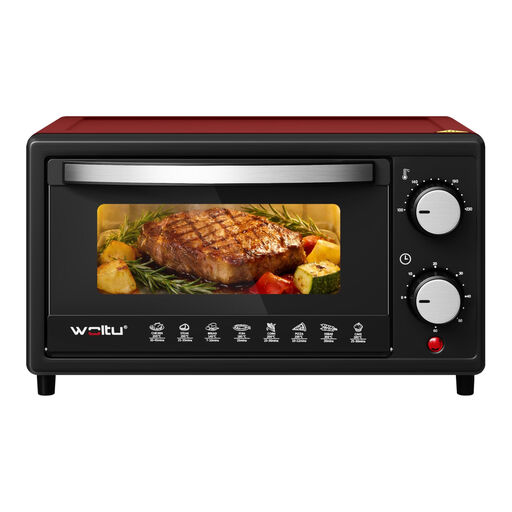 No image available
For smaller baking jobs when you need a compact mini oven. Check the usable space for your muffin tins beforehand.
10 l; temperature range 100–230 °C; pizza function.
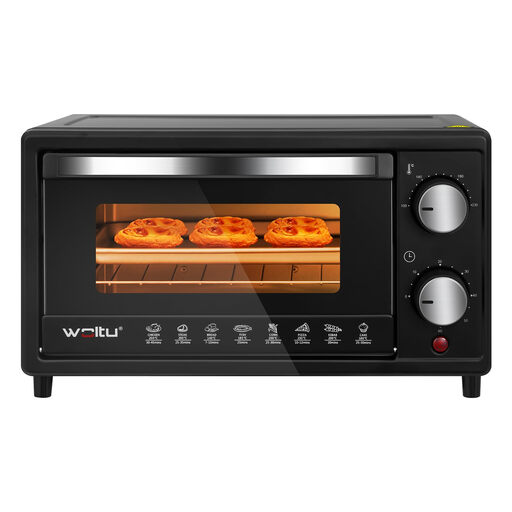 No image available
A compact option for smaller baking jobs; check your tins’ dimensions against the space available inside the appliance.
10 l; temperature range 100–230 °C; pizza function.
 No image available
For anyone considering a mini oven with dual zone; check that your tins’ dimensions and the instructions suit your muffin-baking plans.
23 l; dual zone.
No, swapping trays is not always necessary. Follow your model’s instructions on the heating setting, shelf positions and baking time, and keep an eye on both trays. For multi-level baking, Electrolux recommends removing a tray earlier if it finishes baking first.
Follow the clearances and guidance in the instruction manual. For the BG 1805/E, Rommelsbacher highlights that the casing can get hot and that safety clearances are required. Also check what’s actually included and how the specific model should be cleaned.
Not necessarily. For household ovens covered by the EU oven label, energy use is shown in kWh per cycle for different heating settings, among other details; only compare the same setting. The European Commission lists small ovens as an example of appliances outside the stated ecodesign scope. So, the absence of a comparable label figure does not automatically mean lower energy use.
Your statutory rights against the seller and a voluntary guarantee are separate forms of protection. Disused electrical appliances must be disposed of separately. The German Environment Agency lists local collection points, which generally accept old appliances free of charge; additional take-back options depend on the relevant conditions.