
Lieferung heute & morgen

Qualitätsgarantie

Willkommens-Angebote freischalten: KOSTENLOSE Lieferung | Bis zu 80 % RABATT | Kostenlose 30-Tage-JoyPlus-Testphase
App herunterladen
Limited storage space in the hallway, bags left on the floor and keys that regularly go missing: wall hooks and over-door hooks can create extra storage in a small area. However, not every hook is suitable for every wall, door or load.
Three common buying mistakes are particularly likely to lead to disappointment:
For rented homes, no-drill hooks and over-door racks are practical because they do not require wall plugs or drill holes. With adhesive models, the surface should be cleaned and allowed to dry completely before installation. According to the manufacturer’s instructions for the JORDAN&JUDY adhesive hooks, heavy items should not be hung up during the first 24 hours.
A self-adhesive hook is particularly suitable for smooth, solid surfaces. On painted or delicate surfaces, however, removing it can still leave marks. If you want to hang heavy coats permanently, consider a screw-mounted wall rack with suitable fixings.
Over-door hooks, on the other hand, simply hang over the top of the door. Before buying, you should check the door thickness, clearance from the frame and freedom of movement. A model that is too thick may prevent the door from closing fully.
Check whether the maximum load is clearly stated. The “5-Hook Coaty Metal Over-Door Rack”, for example, is specified as holding up to 10 kg. The weight should be distributed evenly across the five hooks. The manufacturer also states that the model is not intended for glass doors, unstable doors or certain hollow-core doors.
The “3-Hook White Natureo Over-Door Hook” has a specified maximum load of 6 kg. Values like these are not an invitation to load every hook to its limit. Bags with metal fittings, wet towels or several winter coats can quickly increase the weight.
With adhesive hooks, the load capacity should only be relied on when it is clearly specified for the particular surface and installation instructions. Terms such as “strong” or “damage-free” are no substitute for checking the technical details.
Stainless steel is a good choice for bathrooms, kitchens and hallways where a moisture-resistant surface is required. Iron or steel hooks are suitable for coats and bags, provided the construction is sufficiently robust. Wood and bamboo add a more decorative touch; in areas with high humidity, follow the care instructions.
You should also consider:
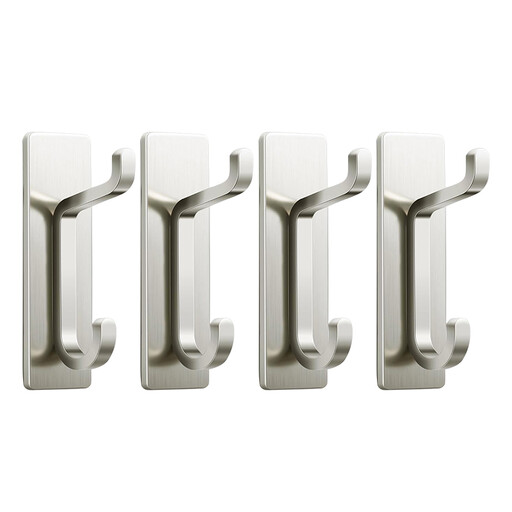
Why this product suits this profile: Four adhesive hooks allow you to organise your hallway, bedroom or bathroom flexibly, without needing a drill or wall plugs.
The mounting method and stainless-steel material are clearly stated. Before use, check the surface, load and suitability for the intended substrate.
Four hooks, a silver stainless-steel finish and tool-free adhesive installation.
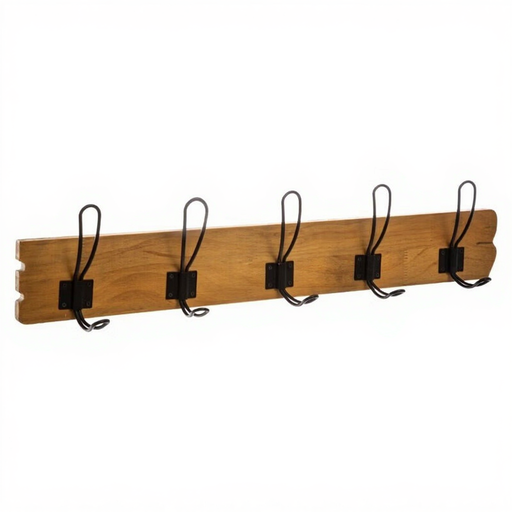
Why this product suits this profile: The combination of a pinewood frame and iron hooks combines a sturdy wall-mounted rack with a clean, homely look for the family hallway.
The dimensions of approximately 63.6 × 14 × 9.5 cm and the material details make it easier to check suitability before installation. The wall fixings must be chosen to match the masonry.
Five hooks, double hooks on the front and a pinewood frame.

Why this product suits this profile: This over-door model provides five hanging points without altering the wall and is designed for hallways, bedrooms or bathrooms.
The maximum load of 10 kg, hook depth of 4.5 cm and suitability for standard internal doors are clearly specified.
Five hooks, a steel construction with a chrome-plated finish and tool-free installation on suitable doors.
We have put together a complete, regularly updated list of products that fully meet these strict selection criteria and the safety regulations applicable in the EU.
When choosing a hook rail for clothes and bags, first assess the condition of the wall. Wall plugs and screws must be suitable for the surface. Plasterboard walls have different fixing requirements from concrete or brick.
For over-door racks, we recommend carrying out the following checks:
For key holders and small storage hooks, a compact wall-mounted solution is often sufficient. In the kitchen, slide-on or S-hooks on suitable cupboard doors can provide space for lightweight pots, measuring cups, mugs or kitchen utensils. Here too, check the door thickness and permitted load.
For rented homes, self-adhesive hooks and over-door hooks are particularly suitable, as they can usually be installed without drilling. However, suitability depends on the surface. On delicate wallpaper or unstable paint, even low-residue adhesive may not be completely damage-free. Before installation, read the manufacturer’s instructions and test the surface in an inconspicuous area.
Their lifespan depends on the surface, humidity, temperature, adhesive and load. It is therefore not possible to give one general durability estimate for every application. Clean and dry the surface before installation, wait for the recommended curing time and avoid exceeding the specified load.
Wall hooks and wall-mounted racks provide a fixed position and are suitable for regularly used clothes, bags and coats. Over-door hooks are more flexible and save you from drilling, but they can affect how the door closes. For keys in the entrance area, a small key holder is often enough, while families can benefit from several hooks with sufficient spacing.