
Lieferung heute & morgen

Qualitätsgarantie

Willkommens-Angebote freischalten: KOSTENLOSE Lieferung | Bis zu 80 % RABATT | Kostenlose 30-Tage-JoyPlus-Testphase
App herunterladen
Wet bedding, pressure marks on the legs or a pull-up that twists during the night: when choosing overnight diapers for babies and children, a familiar brand is not the only factor that matters. Weight, fit and construction must suit both the child and their individual sleeping habits.
Product descriptions often sound very similar. Terms such as “all-night protection,” “maximum dryness” or “up to 12 hours of protection” should therefore not be considered in isolation. What matters is whether the pull-up fits correctly, offers sufficient absorbency and is easy to use in everyday life.
An age recommendation such as “from 4 months” or “for ages 4–7” is intended only as a guide. Children of the same age can have very different body shapes. For this reason, the weight range stated on the packaging is more important than age when choosing a size.
Examples from the product range:
A pull-up that is too large may leak around the legs and back. A size that is too small can dig into the skin and limit absorbency because of its poor fit.
The claim diapers with up to 12 hours of protection refers to a manufacturer specification under certain conditions. Fluid intake, sleep duration, movement and fit all affect the result. A heavily saturated pull-up should also be changed promptly.
According to the product information for Pampers Night Pants and Pampers Baby-Dry Pants, models with absorbency for up to 12 hours are available. This is a comparison value within the product description, not a guarantee of a completely dry night in every individual case.
Reliable protection depends on several elements working together:
For active babies, overnight pull-ups are practical because they are pulled on over the legs like underwear. For older children who wet the bed at night, discreet pyjama pants are often more comfortable than traditional adhesive diapers.
Body weight is the first filter. If the child is at the upper end of the stated range and leaks occur repeatedly, moving up to the next size may be worthwhile. If the pull-up sits loosely around the legs, however, a smaller size may provide a better fit.
The waistband should fit snugly without leaving pressure marks. For pyjama pants designed for older children, a 360° stretch waistband is practical because it can accommodate movement during sleep.
An absorbent core often consists of cellulose fibres and superabsorbent material such as sodium polyacrylate. It absorbs liquid and locks it inside the core. Additional leakage barriers around the legs help prevent liquid from escaping at the sides. A back pocket or reinforced back panel can provide extra protection for children who sleep on their backs.
Do not focus solely on the advertised number of hours. Also consider:
According to the respective product information, Pampers Night Pants, Pampers Baby-Dry Pants and Ninjamas Pyjama Pants are dermatologically tested and, according to the manufacturers, contain no intentionally added EU fragrance allergens as defined by the EU Cosmetics Regulation. Several of the models mentioned are also certified or tested according to OEKO-TEX STANDARD 100.
This information does not replace monitoring your child’s individual skin condition. If redness, a rash or persistent discomfort occurs, discontinue use of the product and seek medical advice if necessary. Certification does not mean that every possible skin reaction is ruled out.
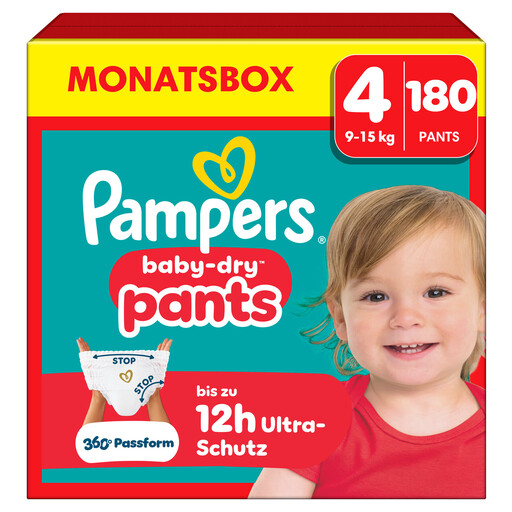
Why they are a good fit: For babies and toddlers weighing 9–15 kg who move around a lot during changing and need a larger pack for regular use.
The 9–15 kg weight range makes it easier to choose by body weight rather than age. The fit should still be checked individually.
According to the product information: 360° waistband, leg cuffs, Stop-&-Protect back pocket and up to 12 hours of protection.
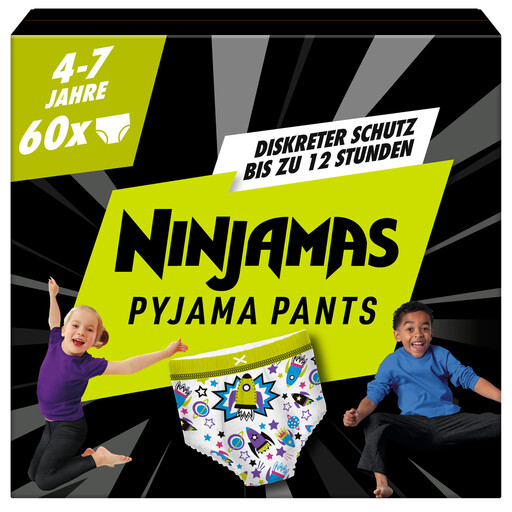
Why they are a good fit: For children aged approximately 4–7 who need a discreet solution with an underwear-like fit.
The 17–30 kg size range is clearly stated. This reduces the risk of choosing pyjama pants based solely on age.
According to the product information: 360° FormFit waistband, quieter QuietCloth material and fast-absorbing technology.
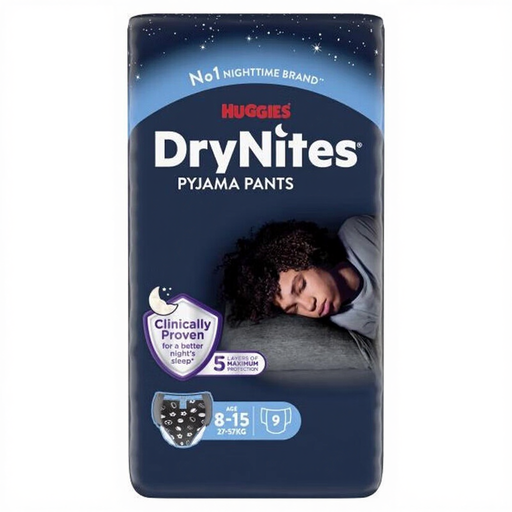
Why they are a good fit: For older children aged approximately 8–15 who need discreet protection against bedwetting.
The broad weight range and age-appropriate design help prevent choosing products intended for younger children.
According to the product information: five layers of protection, quiet material and gender-specific absorbency zones.
Pull the pants on over the legs and hips like underwear. Then check that the leg cuffs are positioned on the outside and that the waistband sits evenly. To remove the pants, tear open the side seams. They can then be rolled up, sealed with the adhesive strip and disposed of in general household waste. They are not suitable for flushing down the toilet.
For ongoing costs, use the following formula: price per piece = pack price divided by the number of pieces. A larger pack may reduce the unit price, but it is only worthwhile once the size and fit have been established. When trying a new model, start with a smaller pack if one is available.
Anyone looking for alternatives to Pampers Night Pants, Pampers Baby-Dry Pants, Ninjamas Pyjama Pants or Huggies DryNites can filter the selection by weight, pack size and intended use. The full category for incontinence underwear for children provides a useful overview.
We have compiled an up-to-date selection of products that can be compared by weight, fit, absorbency and relevant safety information.
The exact wearing time depends on the product and the amount of fluid. According to manufacturer information, some models are advertised as offering up to 12 hours of protection. Change the diaper immediately if it is soiled or visibly overfilled. A diaper is a single-use product and must not be washed or reused.
For diapers for 9–15 kg, options include Pampers Night Pants Size 4 and Pampers Baby-Dry Pants Size 4. Both product descriptions specify 9–15 kg. What matters is whether the waistband and leg cuffs fit without gaps or pressure marks.
First check the size, the fit around the back and the position of the leg cuffs. If the child’s weight is close to the upper limit of the size range, the next size up may be more suitable. If nighttime bedwetting continues despite using a properly fitting pull-up, it may be worth discussing the situation with your child’s paediatrician.