Quick cooks after work
If you want to prepare a small portion of pak choi with minimal fuss after a shift, an easy-to-set cooking time and a suitably sized basket are important. Good Food notes that the leaves cook faster than the stems.


For a single side of pak choi, look for an easy-to-set cooking time, enough room in one basket and straightforward cleaning. If you’re cooking another side at the same time, extra tiers help keep the food separate; for different cooking times, though, you’ll need independently controlled compartments. The total capacity alone won’t tell you whether whole or halved pak choi heads will fit.
If you want to prepare a small portion of pak choi with minimal fuss after a shift, an easy-to-set cooking time and a suitably sized basket are important. Good Food notes that the leaves cook faster than the stems.
If you often serve pak choi with rice or another dish, multiple tiers help keep the food separate. For different cooking times, independently controlled compartments are essential; Tefal and WMF describe different solutions for this.
If you need to put the appliance away after eating, cleaning and storage dimensions matter just as much as having enough room to use it. The Steba DG 2 manual requires at least 10 cm of clearance all around; this requirement does not automatically apply to other models.
A good fit if: You steam pak choi and occasionally another ingredient on separate tiers, and can manage the cooking times yourself. Tefal lists two stainless steel bowls with a total capacity of 6 l and a timer with automatic shut-off for the VC1451.
The trade-off: Multiple tiers don’t mean you can set different cooking times for each one. Check the area of an individual basket; the total capacity won’t answer this question.
A good fit if: You regularly want pak choi and a side dish with different cooking times to be ready together. WMF describes the KÜCHENminis as having two independently controlled compartments, each with a capacity of 2.15 l.
The trade-off: Your portion needs to fit in the usable area of each compartment. In particular, check whether whole or halved pak choi heads will fit.
A good fit if: Simple controls and easy storage matter more to you than independently controlled cooking. For the VC2048, Tefal describes stackable tiers that fit inside one another, a 60-minute timer and a water tank that can be refilled from the outside.
The trade-off: According to Tefal, the three tiers have a total capacity of 9 l, but the appliance still needs room when in use. The manufacturer says this model does not have a keep-warm function.
| Priority | What to check when buying | Who is this important to? |
|---|---|---|
| Control cooking time | Check how the timer works and how the appliance switches off; Good Food notes that pak choi leaves cook faster than the stems. | After a late shift, I want to cook pak choi without complicated programmes and be able to check its texture. Around 36% of consumers put a short, controllable cooking time first. |
| Time side dishes together | Check whether the appliance simply has multiple baskets or whether the cooking compartments can be controlled separately; compare the basket area with your usual portion. | If I want pak choi and another dish to be ready at the same time, the controls for each dish matter. This is a priority for around 29% of consumers. |
| Make cleaning easier | Check dishwasher suitability for each removable part separately; don’t confuse the baskets with the electrical base. | After dinner, I don’t want to have to wash lots of parts by hand. Around 21% of consumers say ease of cleaning is their top priority. |
| Counter and storage space | Check the external dimensions, height in use and model-specific clearance requirements; distinguish between storage dimensions and the space needed for steaming. | When kitchen space is limited, I need an appliance I can put away but that also has enough safe clearance when in use. Around 14% of consumers prioritise counter or storage space. |
The stated capacity in litres may refer to several bowls. Whole or halved pak choi heads still need to fit in one usable compartment.
Measure your usual portion and compare it with the area of one basket, not just the total capacity in litres.
A basket that’s too small could mean extra chopping or cooking in several batches.
The Tefal VC1451 comes with two bowls, while WMF lists independently controlled cooking compartments for the KÜCHENminis. The number of baskets alone tells you nothing about whether you can set different cooking times.
If you often cook sides for different lengths of time, check how each compartment is controlled. With a shared timer, you may need to add ingredients at different times.
Adding ingredients at different times may mean extra steps while the food is cooking.
Steaming creates hot surfaces and steam. The Steba DG 2 manual requires at least 10 cm of clearance all around for this model.
As well as checking storage dimensions, check the height in use and the placement instructions in the manual for the specific model.
The VC1451 and VC2048 models have stackable cooking bowls, keeping food separate on different tiers.
The KÜCHENminis steamer is aimed at buyers who want to control two dishes with different cooking times separately.
The DG 2 has two transparent inserts and an adjustable cooking compartment for different portion sizes.
The KFS-3000 has multiple stainless steel baskets and extra features for anyone wanting to prepare more than a single side of pak choi.
This selection includes an electric steamer and egg cookers whose product descriptions also mention steaming vegetables. If you’re considering an egg cooker, check carefully before buying that its steaming area is large enough for your portion of pak choi.
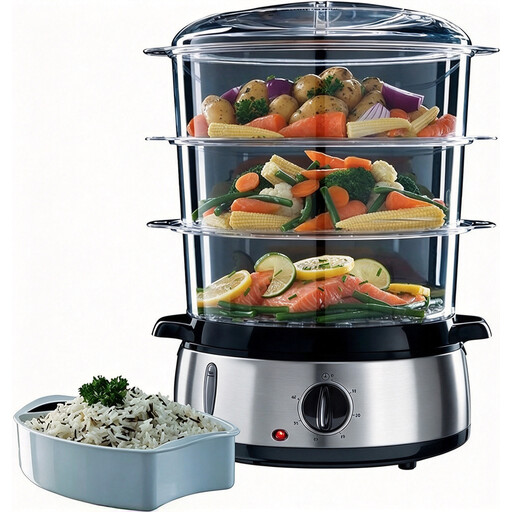 No image available
The product details list vegetables as a suitable food and a timer of up to 60 minutes; check whether one tier is large enough for your portion of pak choi.
Features automatic shut-off and side water inlets; according to the product description, the tiers are dishwasher-safe. The description warns of hot steam and advises against opening the appliance while it’s in use.
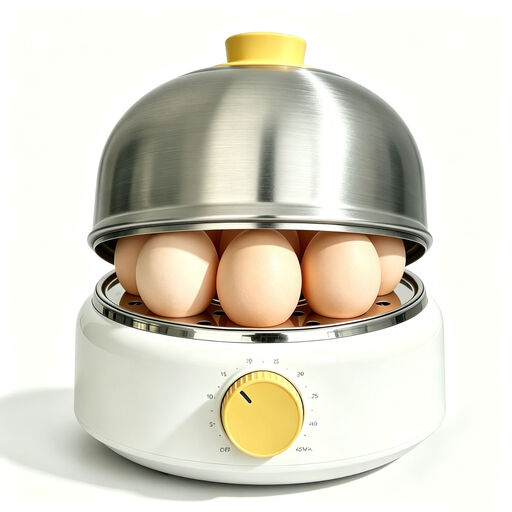 No image available
The description mentions steaming vegetables as well as cooking eggs; before choosing it for pak choi, check that the steaming area is suitable for your portion.
The title lists a 45-minute timer and overheat protection. According to the product description, the removable parts are dishwasher-safe.
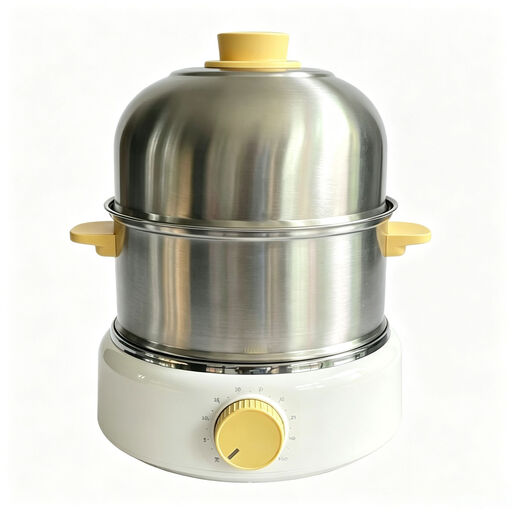 No image available
The description lists vegetables as suitable for steaming; check whether one tier has enough space for your portion of pak choi.
The title lists two tiers for up to 18 eggs and a timer; the description also mentions automatic shut-off. Overheat protection and dishwasher-safe removable parts are listed too.
Wash the pak choi and bear in mind that the leaves cook faster than the stems. You can separate them and add the leaves later; Good Food suggests around 2–3 minutes as a guide for chopped pak choi. Cooking time depends on the size of the pieces, the appliance and how firm you like it.
Don’t assume it’s safe to do so just because the appliance has a timer or automatic shut-off. The Steba DG 2 manual expressly says not to leave this model unattended while it’s in use, and warns that surfaces can become hot. Follow the instructions for the appliance you actually buy.
It depends on the model and the individual part. For the VC1451, Tefal lists the tiers, lids and drip tray, among other parts, as dishwasher-safe; the electrical base is not included in this list. The Steba DG 2 manual says not to immerse the appliance in water.
For appliances covered by the relevant EU regulations, the required CE marking is important. Germany’s Federal Network Agency explains that the manufacturer uses it to declare conformity under its own responsibility, and that any required accompanying information should also be taken into account. A CE marking does not mean that an independent body has tested every appliance.
Yes. According to the European Commission, food contact materials placed on the EU market must comply with Regulation (EC) No 1935/2004; additional rules may apply depending on the material. Whether a specific product meets these requirements needs to be assessed on a product-by-product basis.