Which camera setup is right for you?

Paper crafters who love detail

If you want to show off folds, edges or fibres in close-up, check the lens’s magnification ratio and whether it’s compatible with your camera system. Canon Deutschland, Sony Deutschland and Nikon Deutschland list different close-up capabilities for their respective lenses.

Crafters who take lots of wider shots

If you photograph whole stars or different arrangements, getting the right framing is important. A standard zoom kit can be a good starting point; for example, Canon Deutschland lists an EOS R50 kit with an RF-S 18–45 mm lens.

Photographers who use a repeatable setup

If you regularly photograph stars for a shop or portfolio, look for consistent lighting, controllable colour and a stable camera position. Canon Deutschland explains how to adjust the white balance to suit the lighting conditions.

What should you look for when choosing?

Mirrorless camera with standard zoom

A good fit if: you mainly photograph whole stars, arrangements or changing compositions.

Things to consider: Close-up performance depends on the lens included. Canon Deutschland states that the RF-S 18–45 mm can achieve up to 0.25x magnification with manual close focusing.

Mirrorless camera with macro lens

A good fit if: you want small folds or fibres to fill a large part of the frame and choose a compatible lens.

Things to consider: The macro lenses covered here aren’t automatically included in camera kits, and the stated magnification depends on the specific lens.

Compact camera with close-up mode

A good fit if: you want to photograph small details without changing lenses. The OM SYSTEM Tough TG-7 manual describes close-ups from a subject distance of as little as 1 cm.

Things to consider: When you’re very close to your subject, it can be harder to position the light effectively.

Priority What to check before buying Who should consider this?
Fine paper texture Check the magnification ratio of the specific lens and make sure the mount is compatible. Canon Deutschland states that the RF-S 18–45 mm can achieve up to 0.25x magnification with manual close focusing. If I want to show fine folds or fibres in close-up, the lens’s close-up performance matters more to me than the camera body alone. Around 36% of consumers put detail first.
Whole stars and arrangements Check what’s included in the kit, the focal length range and the minimum focusing distance of the included lens. If I want to photograph whole stars or different arrangements, I look first for suitable framing options. Around 29% of consumers prioritise wider shots.
Consistent paper colours Check whether you can adjust the white balance and keep the lighting conditions consistent. If I want to compare paper colours across repeated shots, controllable colour reproduction matters to me. Around 21% of consumers put colour comparison first.
Sharpness across three-dimensional stars Check for aperture control, a stable camera position and, where available, focus stacking. According to Canon Academy, stopping down can increase depth of field; less light may mean longer exposure times. If I want the different layers of a folded star to look sharp, I plan for depth of field and a stable shot. Around 14% of consumers prioritise keeping as much of the image in focus as possible.

Common buying mistakes

  • Assuming “macro” in the name means 1:1 magnification

    The name alone doesn’t tell you what magnification ratio a particular lens can achieve. Canon Deutschland lists 1:2 for the RF 35 mm F1.8 Macro, while Sony Deutschland lists 1:1 for the E 30 mm F3.5 Macro, as does Nikon Deutschland for the NIKKOR Z MC 50 mm 1:2.8.

    Compare the magnification ratio listed for the exact lens with the framing you want, and check that the lens is compatible with your camera system.

  • Comparing camera bodies alone

    Close-up performance depends on the lens or an available camera mode. What’s actually included also varies between kits.

    Check the full model and kit name, along with the list of included accessories, before assessing the setup.

  • Stopping down without considering exposure

    A smaller aperture can increase depth of field, but it lets less light reach the sensor. This may mean longer exposure times, making a stable camera position important.

    For still paper stars, plan for a stable setup and controllable lighting.

Key brands at a glance

Canon

The EOS R50 kit with an RF-S standard zoom is an option for wider shots; the RF 35 mm F1.8 Macro is a separate close-up option to consider.

  • Canon Deutschland states that the RF-S 18–45 mm can achieve up to 0.25x magnification with manual close focusing.
  • Canon Deutschland lists 1:2 for the RF 35 mm F1.8 Macro, not 1:1. Check whether this magnification ratio is enough for the framing you want.

Nikon

The Z50II standard zoom kit is a good starting point for varied wider shots; the NIKKOR Z MC 50 mm 1:2.8 is a separate macro option for the Z mount.

  • Nikon lists a 1:1 magnification ratio for the NIKKOR Z MC 50 mm 1:2.8.
  • The macro lens isn’t included in the standard zoom kit mentioned. Nikon also doesn’t list a charger as included with this kit.

Sony

The α6400 body with APS-C E-mount can be paired with a compatible macro lens, which you’ll need to check separately.

  • Sony Deutschland specifies a maximum magnification ratio of 1:1 for the E 30 mm F3.5 Macro.
  • Sony lists a minimum focusing distance of 0.095 m for this lens. The short distance can make it harder to position the light in front of your subject.

OM SYSTEM

The Tough TG-7 offers a compact camera alternative with macro modes if you’d rather not use interchangeable lenses.

  • OM SYSTEM lists 12 megapixels, RAW shooting and macro photography modes. The manual describes close-ups from as little as 1 cm away, as well as focus stacking.
  • Remember to consider lighting when shooting from very close range. These features don’t establish a general image quality advantage over other camera setups.

Cameras available at Joybuy

A camera option for repeat shots, with a stable position and adjustable exposure and white balance.
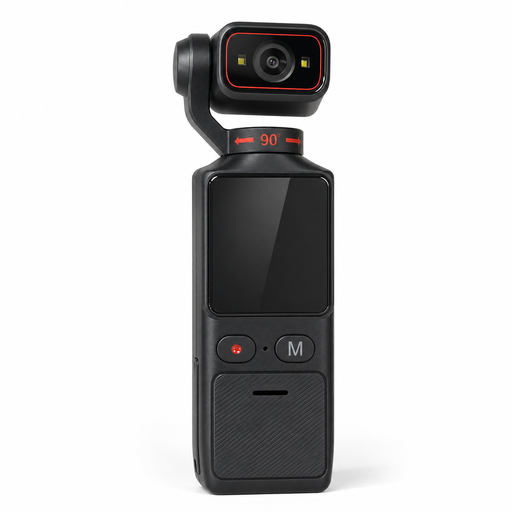
4K pocket camera with electronic image stabilisation and 180° swivel lens

4K Pocket Camera with Electronic Image Stabilisation and 180° Swivel Lens

Could be worth considering for repeat shots if you want to keep the camera steady using a tripod socket.

According to the product description, exposure and white balance are adjustable. It also lists a photo mode and a 1/4-inch tripod socket. The product title features 4K, electronic image stabilisation, a 180° swivel lens, Wi-Fi and a 1.69-inch touchscreen.

View at Joybuy

Frequently asked questions

Is a standard zoom enough for fine paper fibres?

A standard zoom may be enough for whole stars; for fibres to fill the frame, the magnification ratio of the specific lens is what matters. Canon Deutschland states that the RF-S 18–45 mm can achieve up to 0.25x magnification with manual close focusing, while Sony Deutschland and Nikon Deutschland list 1:1 for the macro lenses covered here.

How can I get a folded star sharp from front to back?

Choose an aperture to suit the depth of field you want, and stabilise the camera if you need longer exposure times. For still subjects, focus stacking may be another option if the feature is available; the OM SYSTEM Tough TG-7 manual describes this function.

What should I check when buying a camera kit?

Check which lens and accessories are actually included rather than looking at the body alone. Nikon explicitly states that a charger isn’t included with the Z50II standard zoom kit; a macro lens isn’t listed as part of the kit either.

What are my rights when buying a camera online in Germany?

For a standard online purchase, you generally have a 14-day right to cancel from the date of delivery; exceptions and possible return costs should be taken into account. If a product is faulty, you have a statutory right to a remedy from the seller, which is separate from any voluntary guarantee. EU consumer information states that the legal guarantee lasts for at least two years from receipt of the goods.