Capturing and organising information are fundamental processes in academic and professional environments. Notepads and sticky notes serve as physical tools for structuring thoughts, managing tasks, and documenting knowledge. The selection of suitable stationery is based on objective criteria like paper quality, format, and binding, which directly impact functionality and intended use. This article analyses the technical specifications of various notepad formats and presents a selection of products designed for specific requirements in the office, for academic study, and for everyday life.
Buyer's Guide: What to Look for When Choosing Notepads
The decision to purchase a notepad should be based on an analysis of its material and design properties. These parameters determine its suitability for the intended purpose.
Paper Quality and Weight (g/m?)
The paper weight, measured in grams per square metre (g/m?), is an indicator of the paper's density and thickness.
- 70 g/m?: A common standard for everyday notes. This paper is lightweight and well-suited for notebooks and spiral-bound pads that need to be portable. However, when using rollerball or fountain pens, some minor ink ghosting may occur.
- 80–90 g/m?: Offers higher opacity and a smoother writing surface. It reduces ink show-through, making it a solid choice for double-sided writing and more important records.
- 100 g/m? and up: Paper of this thickness is often used for high-end notebooks or for artistic purposes. It is highly resistant to ink and provides an excellent writing experience.
Format and Size
The format of a notepad determines its portability and the available writing area.
- A5 (148 x 210 mm): A popular format that strikes a balance between portability and sufficient space for notes. An A5 spiral notebook fits easily into most bags and backpacks, making it a favourite among students and professionals.
- A4 (210 x 297 mm): Offers double the writing area of A5 and is suitable for extensive lecture notes, detailed project plans, or as a desk pad.
- Smaller Formats (A6, A7): Ideal for quick notes, to-do lists, or as a pocket notebook.
Binding Types
The type of binding affects how the notepad lies flat and how pages can be removed.
- Spiral Binding: Allows pages to be folded back completely and enables the notepad to lie flat. This is particularly practical when desk space is limited. Individual pages can usually be torn out cleanly.
- Adhesive Binding: Often found on sticky notes or simple notepads. The sheets are glued at the top edge and can be peeled off individually.
- Thread Binding: A durable binding method used in high-quality notebooks. The pages are gathered into signatures and sewn with thread, ensuring high stability.
Curated Product Selections
Based on the technical criteria mentioned above, we present a selection of products designed for specific organisational needs.
Deli Spiral Notebook, A5, 60 Sheets/120 Pages, 70gsm - Harmony Light Series, 4-Pack
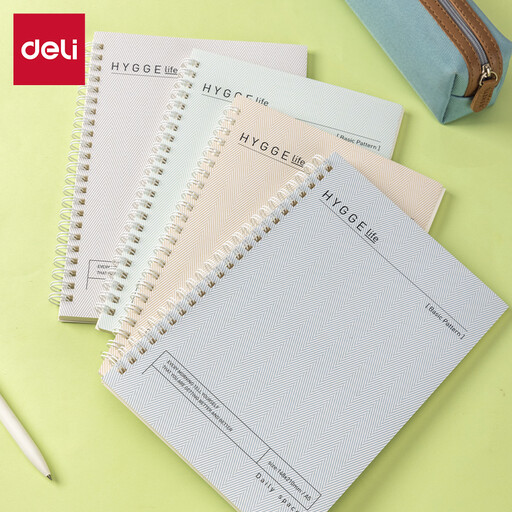
- Why we recommend this product: This notebook set combines the portable A5 format with a functional spiral binding. The 70 g/m? paper is designed for everyday notes with ballpoint pens or pencils. The 4-pack allows for colour-coding subjects or projects and offers excellent value for money for basic stationery for the office and university.
- Pros:
- Spiral binding: Allows for 360° fold-over and lies flat.
- A5 format: Compact size for on-the-go use.
- 4-pack: Convenient for organising multiple subject areas.
- Who it's for: Students who need a separate notebook for each course, as well as professionals who want to keep project-specific notes separate.
Deli Spiral Notebook, A5, 80 Sheets/160 Pages, 70gsm - 4-Pack
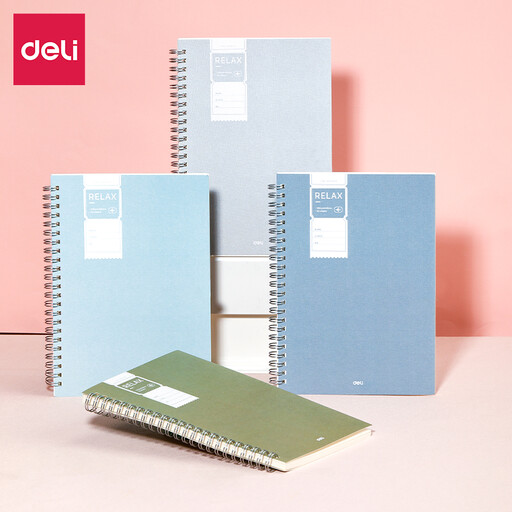
- Why we recommend this product: This model is an upgrade from the previous version, offering 33% more capacity with 80 sheets (160 pages) per notebook. It retains the functional advantages of the A5 format and spiral binding. The higher page count makes it a suitable choice for longer projects or semester-long courses, reducing the need to switch notebooks frequently.
- Pros:
- Increased page count: 80 sheets for more extensive notes.
- A5 format with spiral binding: A proven combination for flexibility and portability.
- 4-pack: An economical solution for high-volume note-taking.
- Who it's for: Users with high writing demands, such as students in writing-intensive subjects or project managers who keep detailed records.
Sticky Notes With Line
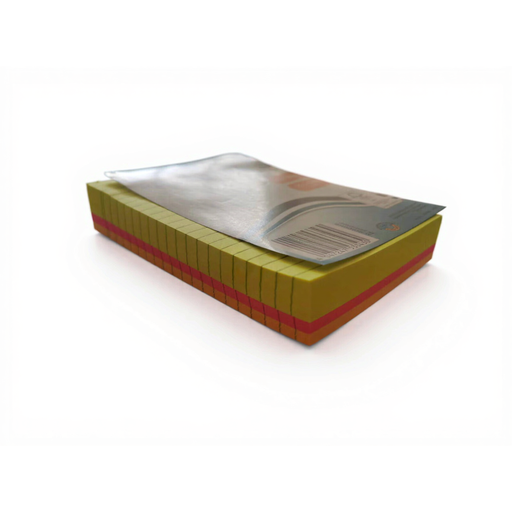
- Why we recommend this product: These lined sticky notes address the common problem of unstructured quick messages. The printed lines promote neat, legible handwriting, which increases the effectiveness of reminders, annotations, and to-do lists. The adhesive is designed to stick to smooth surfaces and can be removed without leaving residue, making them a useful tool for office supply organisation.
- Pros:
- Lined design: Supports orderly and legible writing.
- Residue-free adhesive: Sticks reliably and peels off cleanly.
- Compact size: Fits in any desk drawer or bag.
- Who it's for: Anyone who values clearly structured short notes, whether for annotating documents in the office, marking pages in textbooks, or creating shopping lists at home.
Digital Complements to Analogue Organisation
While physical notepads are indispensable for the quick capture of ideas and manual organisation, more comprehensive academic papers or complex data analyses often require digital tools. For tasks like writing term papers, managing bibliographies, or collaborating in teams, a powerful digital device can boost efficiency. If you are looking for a solution for such tasks, it may be worthwhile to explore our selection of laptops for students.
Frequently Asked Questions (FAQ)
1. What is the difference between a 'college pad' and a 'spiral notebook'? Technically, the term 'college pad' is often synonymous with a spiral-bound A4 or A5 pad that includes a perforation for cleanly tearing out pages and a 4-hole punch for filing. A 'spiral notebook' is a more general term for any notebook with a spiral binding, regardless of its format, hole-punching, or perforation.
2. What paper weight is suitable for notepads? For everyday notes with a ballpoint pen or pencil, 70 g/m? to 80 g/m? is sufficient. If you frequently use fountain pens or rollerballs and want to prevent ink from showing through, you should consider paper with a weight of 90 g/m? or higher.
3. How can I use sticky notes for organisation? Lined sticky notes are excellent for using the Kanban method for task management on a whiteboard (with columns for "To Do," "In Progress," and "Done"). They can also be used as bookmarks with annotations in books, for labelling documents, or for leaving clearly worded messages for colleagues or family members.
Written by your Joybuy Product Recommendation Officer


