
Lieferung heute & morgen

Qualitätsgarantie

Willkommens-Angebote freischalten: KOSTENLOSE Lieferung | Bis zu 80 % RABATT | Kostenlose 30-Tage-JoyPlus-Testphase
App herunterladen
A parasol for your balcony or garden should provide shade, be easy to use and suit the space you have. In practice, it’s not just the colour or shape that can lead to the wrong purchase. Important details are often overlooked, such as the stability required, the actual size of the parasol or the difference between water-repellent and waterproof fabric.
This buying guide explains which details to check before you buy and which model could suit your balcony, patio or garden.
A parasol with a diameter of 300 cm provides considerably more shade than a 155 cm balcony parasol. However, it also takes up more space and needs a sturdier fixing. On a small balcony, a large garden parasol can restrict room to move or extend beyond the railing.
So don’t just check the diameter. Also consider:
Many polyester canopies are water-repellent or have a protective coating. This can keep out light rain, but it’s no substitute for rain protection. Close your parasol in heavier rain, strong winds or thunderstorms. When checking product details, be sure to distinguish between water-repellent, waterproof and general weather resistance.
A 360° rotating parasol or a tilting parasol is easier to position in relation to the sun. However, these features are only practical if the pole, joints, base and fixing all work together. A cantilever parasol with a side pole is subject to greater leverage, so a stable surface and suitable base are essential.
A UPF 50+ parasol has a high stated UV protection factor for its fabric. For the products featured here, the manufacturers state that, depending on the model, the fabric blocks more than 98 or 99 per cent of UV radiation. These figures apply to the canopy fabric and shouldn’t be taken to mean complete protection from direct sunlight.
The fabric weight can also give you an indication of its construction. For example, WOLTU cantilever parasols use 200 g/m² polyester with a PA coating. The 155 cm WOLTU balcony parasol is listed as having 160 g/m² polyester. The polyester fabric on the Suncomfort by Glatz Siesta weighs 180 g/m².
A crank-operated parasol can usually be opened and closed without having to pull hard on the canopy. This is especially useful for larger models. A centre-pole parasol with a sliding mechanism, on the other hand, may be more compact and lightweight.
Also check:
The Suncomfort Slide has stepless angle adjustment, a crank and 360-degree rotation on the stand. WOLTU cantilever parasols offer five tilt positions and 360-degree rotation using a foot pedal.
Models such as a 155 cm parasol or 180 cm parasol are generally easier to fit into smaller spaces. A 250 cm parasol is suitable for medium-sized patios and seating areas. A 300 cm parasol can cover around seven square metres of shade, but needs a suitably sturdy base.
Check exactly what’s included. The Suncomfort by Glatz Siesta doesn’t come with a stand; the product details recommend a stand weighing at least 30 kg. The Suncomfort Slide also doesn’t include a base. Depending on the version, the WOLTU cantilever parasols mentioned come with a steel base, wind ropes and a protective cover.
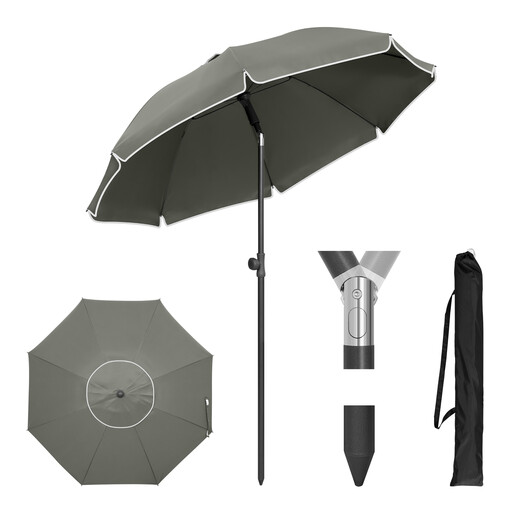
Why it suits this profile: This compact balcony parasol is a good fit for smaller balconies and patios, as well as for taking to different locations. Its small size and included carry bag make it easy to transport and store.
The 155 cm size reduces the risk of buying a parasol that’s too large for a small space. The ventilation opening and tilting design are both clearly listed.
UPF 50+, tilts both ways up to 35°, height-adjustable, foldable and supplied with a carry bag.
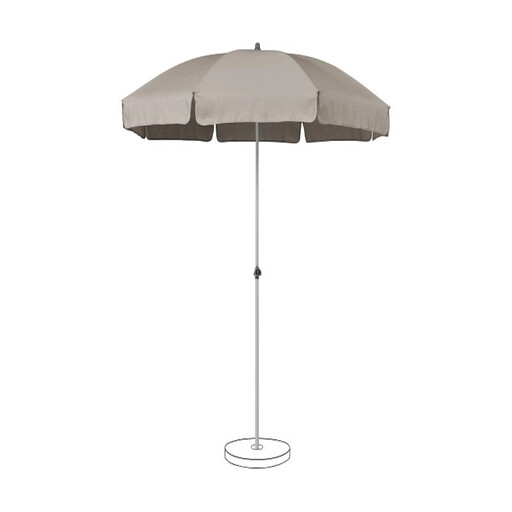
Why it suits this profile: This 180 cm garden parasol combines a compact size with details on fabric care and replaceable moving parts. It’s a good fit for smaller patios, loggias and balconies.
The product details clearly distinguish between the parasol and the optional stand. They also specify a minimum stand weight of 30 kg.
UPF 50+, 360° rotation, one-way tilt, washable cover and water-repellent polyester weighing 180 g/m².
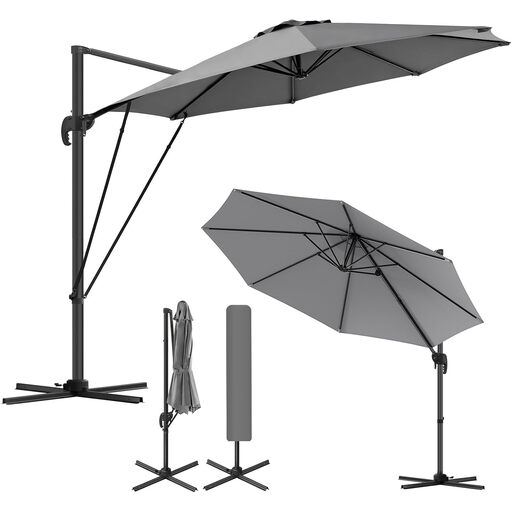
Why it suits this profile: According to the product details, this cantilever parasol has a diameter of around 300 cm and provides roughly seven square metres of shade. It’s suitable for seating areas for four to six people.
Wind ropes, a ventilation opening and a protective cover are listed as included. Even so, the parasol should be closed in stronger winds.
UPF 50+, 360° rotation via foot pedal, five tilt positions, crank and a diameter of around 300 cm.
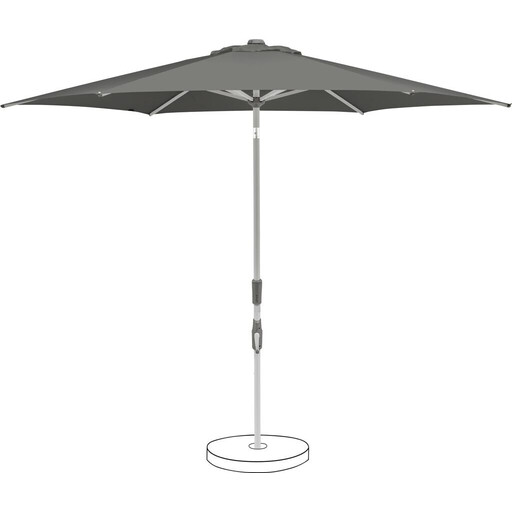
Why it suits this profile: This 250 cm patio parasol is a good choice if you’re looking for a larger shaded area, a crank and stepless tilt adjustment.
The product details clearly state that the stand isn’t included. This makes it easier to plan ahead and choose a suitable, sturdy base before you buy.
250 cm diameter, 360° rotation, stepless adjustment, crank operation and UV protection 80+ according to the product details.
We’ve put together a complete, regularly updated list of products that meet these strict selection criteria and fully comply with the safety regulations in force in the EU.
Close your parasol in strong winds, thunderstorms and whenever you’ll be away for an extended period. A parasol protective cover helps protect the dry canopy from dust and moisture while in storage. Let a cleaned canopy dry completely before folding it away.
For many polyester covers, a damp cloth or mild soapy water is all you need for cleaning. Don’t use harsh cleaning products unless the manufacturer’s care instructions specifically allow them. Check the joints, ribs, ropes and fixings before each use.
For limited spaces, a 155 cm balcony parasol or a model with a diameter of around 180 cm is often easier to fit in. You’ll also need to consider the width of your balcony, the position of the railings and a secure fixing that prevents the parasol from tipping over.
It depends on the size and design of the parasol, as well as where you’ll use it. A stand weighing at least 30 kg is recommended for the Suncomfort by Glatz Siesta. Larger cantilever parasols may need extra securing, such as wind ropes. Always follow the guidance from the manufacturer of your particular model.
There’s no single lifespan that applies to every parasol. It depends on exposure to UV rays, wind and moisture, as well as how the parasol is used and stored. Closing it regularly in bad weather, keeping it dry over winter and using a suitable protective cover can help reduce wear and tear.