Who photographs fresh pasta?

Pasta photographers by the window

You photograph individual plates in daylight and want to soften shadows without setting up another piece of equipment. Canon Europe recommends indirect window light, while Nikon USA points out that daylight can vary in intensity and colour.

Photographers with a small kitchen table

You need controllable light, but have to fit your camera, pasta and light into a small space, then pack everything away afterwards. ExpertPhotography’s examples of how compact lights can be used can also help when planning a small tabletop setup.

Creators of recipe photos for repeated use

You also take photos when daylight isn’t reliable and want the plates and ingredients to be lit consistently across several shots. Nikon USA explains how changing daylight can affect the colour and intensity of light.

What should you look for?

Start with the light you already have and the space beside your subject. Then decide whether you need adjustable colour temperature, a larger light source or a particular power supply for repeatable shots.

What matters What to check before buying Who is this important to?
Soft light Check whether a diffuser or compatible light modifier is included with your chosen variant, and whether you can position the light to the side. If I want to avoid harsh shadows on the pasta and plate, I look for diffusion and a suitable position. Soft light is the main priority for around 36% of consumers.
Consistent colours across several shots Compare the colour temperature range and stated colour rendering values for the exact model; allow time for a test shot and white balance. If I want the pasta and ingredients to look as consistent as possible across a series of photos, I need controllable light and a consistent setup. Around 29% of consumers prioritise colour consistency.
Space and mounting Check the dimensions, footprint and mount for your chosen variant, and plan to position the light outside the frame. At a small kitchen table, I want to fit the plate, camera and light without placing the light somewhere unsafe. Space and mounting are the main considerations for around 21% of consumers.
Power supply and accessories Check whether the specific variant includes a power adapter, battery, cable and the mount you need. If I want to avoid cables across the table or shoot a longer series, the power supply needs to suit my setup. Around 14% of consumers focus mainly on power and accessories.

Common misconceptions

  • Comparing lux figures from different panels directly

    A lux figure applies to specific measurement conditions and, on its own, doesn’t let you rank how well lights will illuminate your pasta table. Aputure gives a figure of 5070 Lux at 1 m and 5600 K for the amaran P60x; NEEWER gives a maximum of 600 Lux at 0.5 m for the NL-116AI. Because the measurement distances differ, these figures aren’t directly comparable.

    Only compare figures when the distance and lighting conditions match. Also assess the lighting with the plate and ingredients in your planned frame.

  • Assuming bi-colour or a high CRI guarantees true-to-life pasta colours

    Adjustable white light and manufacturers’ colour rendering figures describe the properties of a light, not necessarily the result you’ll get with your camera. Changes in ambient light can alter the look from one shot to the next.

    Keep your lighting setup and camera white balance as consistent as possible across a series, and check the colours with a test shot.

  • Treating a panel as a complete kit

    The NEEWER NL660 comes with different tripod options; according to NEEWER, NP-F batteries are not included.

    Compare the contents of your chosen variant with your setup before relying on a particular mount or power supply.

    Depending on your setup, you may also need a suitable mount, batteries or a light modifier.

Relevant brands at a glance

NEEWER

The range includes the compact bi-colour NL-116AI panel and the larger NL660. For a small table, the main differences are how much space they take up and the size of the light source you’re planning to use.

  • NEEWER says the NL-116AI has a built-in battery and adjustable white light.
  • Check that you’re choosing the tabletop tripod version of the NL-116AI. NEEWER lists a white diffuser and power adapter for the NL660, but no NP-F battery; the larger panel also needs a suitable stand or mount.

amaran

According to Aputure, the P60x bi-colour panel can be paired with a light modifier for a more controlled setup.

  • Aputure gives a colour temperature range of 3200–6500 K and a figure of 5070 Lux at 1 m and 5600 K.
  • The stated lux figure relates to that measurement point; it doesn’t tell you how the light will spread or affect shadows on your pasta table. The light and modifier also need space.

Godox

The P260C Pro is a larger bi-colour panel for setups with room beside the subject.

  • Godox gives the P260C Pro a colour temperature range of 2800–6500 K, with USB-C as an additional power option.
  • Godox states average CRI/TLCI values of at least 98. The manufacturer’s claims about soft lighting don’t guarantee the result on a particular plate of pasta. The P260C Pro and LEDP260C are different models.

Nanlite

The slim, bi-colour PavoSlim 60B is designed for a more elaborate setup with light modifiers.

  • The manufacturer’s manual lists 2700–6500 K, along with a softbox, diffuser and eggcrate.
  • Check what power supply is included with the specific kit, and allow space for the panel and the full light modifier setup.

SmallRig

The small, battery-powered Vibe P96 is better suited to a tightly framed subject or as a supplementary fill light than to lighting a whole table with a guaranteed result.

  • SmallRig gives model 3286 a colour temperature range of 2700–6500 K, a CRI of over 95 and a weight of 103 g.
  • Its compact design makes it easy to store, but doesn’t tell you on its own how well it will light your plate and ingredients.

Joybuy picks for table photography

The following Joybuy picks are lighting solutions for tabletop photography: a light box and an arc lamp. They are not all freely positionable LED panels.
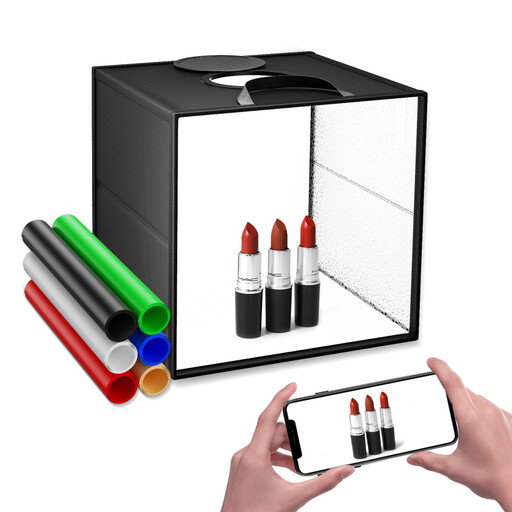
30 cm photo light box with LED lighting for product photography

30 cm photo light box with 120 LEDs

This compact light box is designed for small product arrangements on a table; it isn’t a freely positionable panel.

30 cm; 120 LEDs; three colour temperatures; nine dimming levels; six coloured backgrounds, according to the product name.

View at Joybuy
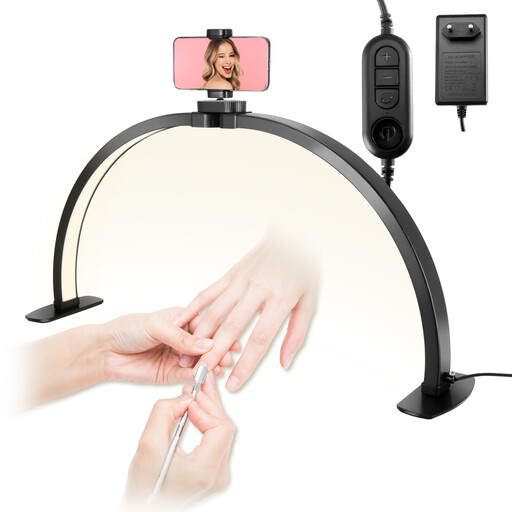
30-inch arc lamp with dimmable LED lighting and phone holder

30-inch arc lamp with LED lighting

The lamp is described as suitable for tabletop photography, but its arched design may take up a lot of room on a small table.

Three colour temperatures from 3000–6000 K; dimmable light; phone holder, according to the product name.

View at Joybuy

Frequently asked questions

Do I really need an LED panel to photograph pasta by a window?

Not necessarily. In soft window light, you can start by placing a white card on the shadow side. A panel may be useful if you want more control over light intensity and colour across several shots.

How can I position the panel without making the pasta look flat?

Try placing it to the side of the plate or slightly behind it, then check the shadows and highlights in a test shot. If the shadows are too harsh, a suitable diffuser or light modifier may help. Make sure the light and cables are safely out of your working area.

Do LED panels always come with a battery and tripod?

No, what’s included depends on the variant. NEEWER offers the NL660 with different tripod options and says that NP-F batteries are not included. Check whether the specific offer includes a power adapter, battery and mount.

What are my rights if a panel is faulty or I buy it online in Germany?

Your statutory rights against the seller are separate from any voluntary guarantee. For goods ordered online, consumers generally have a 14-day right to cancel from the date of receipt, although exceptions may apply. The Verbraucherzentrale explains these rights and the conditions that apply.

What should I check on the labelling of an LED light sold in Germany?

CE marking is required for products covered by harmonised EU rules that explicitly require it. It is not a general, independent quality mark. The Bundesnetzagentur also lists product identification, manufacturer details, German-language instructions with any required warnings, and the declaration of conformity as points to check.