Lieferung heute & morgen

Qualitätsgarantie

Willkommens-Angebote freischalten: KOSTENLOSE Lieferung | Bis zu 80 % RABATT | Kostenlose 30-Tage-JoyPlus-Testphase
App herunterladen
The modern workspace is often no longer a separate room, but an integral part of the living area. The desk no longer stands isolated in an office but blends into the home's aesthetic. In this context, the personal computer transforms from a mere tool into a design object. Its physical presence, the sounds it produces, and the light it emits all influence the room's atmosphere. A quiet hum, a gentle glow—these sensory details determine whether the device is perceived as a harmonious part of the interior or a disruptive element. Cultivating tranquility in the digital space begins with the intentional design of its physical components.
The performance of modern processors generates significant thermal energy. Effective PC cooling is therefore not an option, but a necessity for stable and durable systems. The art lies in balancing this necessity with the desire for a quiet and aesthetically pleasing environment. The fundamental principle is thermodynamics: heat must be drawn away from the source—the CPU—and dissipated into the ambient air.
A CPU air cooler achieves this through a combination of heat pipes and a heatsink. The heat pipes, typically made of copper, contain a fluid that vaporises when heated, rises to the cooler end of the pipe, condenses, and transfers the heat to the fine fins of the heatsink. The large surface area of these fins allows for efficient heat transfer to the air.
This is where case fans come into play. They create a directed airflow that draws in cool air from the outside and expels the heated air from the case. The arrangement and quality of these fans determine the efficiency of the entire system. A quiet PC fan is the result of precision engineering, where bearing technology, rotor blade design, and motor electronics work in concert. Models with Pulse Width Modulation, known as PWM fans, allow for dynamic speed control. They adjust their performance according to the current system load, ensuring an optimal balance between cooling power and noise level.
The visual component is also gaining importance. An RGB fan is no longer just a feature for gaming systems but can serve as subtle, customisable ambient lighting. The standard size of a 120mm fan offers high compatibility and flexibility for individual configurations.
The selection of cooling components is a decision that shapes both the function and form of the system. For users who value minimal noise at high performance, solutions like the be quiet! Dark Rock 5 CPU Air Cooler are a considered choice. Its asymmetrical design ensures compatibility with tall RAM modules, while the Silent Wings 4 fan is engineered for acoustically unobtrusive operation. The heatsink's special ceramic coating enhances heat dissipation and highlights the focus on technical detail.
The aesthetic of a clean, minimalist interior can be achieved with carefully selected components. A CPU cooler like the white NZXT T120 RGB Air Cooler conceals its heat pipes under a sleek aluminium cover, creating a clean visual line. Such a design is complemented by a well-thought-out airflow concept. Fans like the CORSAIR RS ARGB Series 120 use special guide vanes to concentrate airflow and direct it specifically onto components or radiators. Their daisy-chaining capability reduces cable clutter and contributes to an orderly overall appearance.
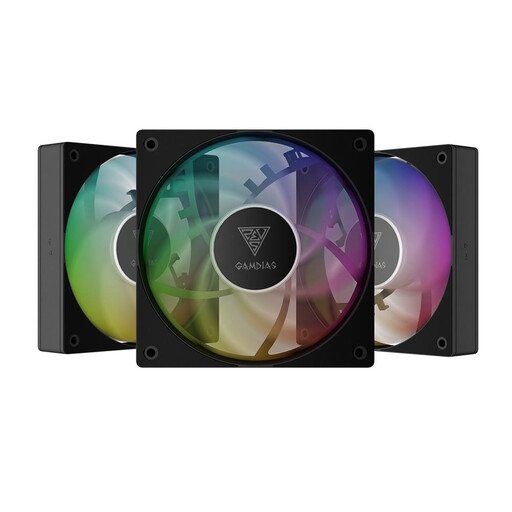
The modularity of PC building allows for tailored solutions for specific requirements. In compact cases where every millimetre counts, a low-profile cooler like the ARCTIC Alpine 17 CPU cooler can be a fitting solution for certain Intel sockets. Those building a complete system with uniform aesthetics and performance will find a cohesive unit in models like the ARCTIC Freezer 36 A-RGB Black CPU Air Cooler, which combines a heatsink with two matched fans. Individual fans like the GAMDIAS cooler AEOLUS M3-1201 provide the building blocks to create a custom and scalable cooling concept that grows with the user's needs.
For those who wish to explore an expanded selection of objects featuring thoughtful design and technical finesse, the directory for Fan with water tank offers further inspiration.