If there’s already a suitable monitor at the shared desk, a mini PC is an obvious space-saving option. Before buying, though, check that it’s compatible with your writing and reference software, and make sure you have the right ports, power supply and cables. An all-in-one combines the computer and screen, while a traditional desktop is a better fit if you’re deliberately making room for its larger case and other uses. Whichever device you choose, set up a separate backup for your dissertation and test that you can restore it. Also compare what’s included for a complete workstation.
Which form factor is right for you?
Writers with limited desk space
If you share your workspace and want to use a monitor you already have, a mini PC can take up very little room. You’ll still need to allow space for the power supply and cables, and make sure everything is accessible. Lenovo and HP offer mini PC configurations for a separate workstation.
Researchers with an established software workflow
If you use specific writing, reference or specialist software, check its requirements first, then choose a suitable operating system and ports. The Lenovo and HP configurations described here run Windows; Apple’s Mac mini uses macOS. That alone doesn’t guarantee compatibility with any particular application.
Writers with a manuscript to protect
If you want to recover drafts and sources after a mistake or data loss, set up a separate backup and test the recovery process. The German Federal Office for Information Security treats both as part of a backup strategy.
What should you look for when buying?
Mini PC with a separate monitor
A good fit if: you want to keep using a monitor you already have and take up as little desk space as possible with the computer.
The trade-off: you’ll also need a monitor and possibly a keyboard and mouse. A compact design doesn’t guarantee quiet operation or software compatibility.
All-in-one PC
A good fit if: you don’t have a monitor yet and want to buy the computer and screen as one unit.
The trade-off: you’re tied to the screen that comes with the device. The Lenovo example described here has an integrated 27-inch screen.
Traditional desktop PC
A good fit if: you specifically want a larger desktop case for other tasks and have room for it.
The trade-off: the case, monitor and cables all need space. The scope for upgrades depends on the individual model.
| Priority |
What to look for when buying |
Who is it most relevant to? |
| Desk space and noise |
Allow room for the case, power supply and cables in your actual workspace. To assess noise, look for a test of the specific model. |
If I share a desk, I want to keep as much work surface free as possible and avoid disturbing others with noise. Around 28% of consumers would say that space and quiet are their top buying priorities. |
| Software compatibility |
Check the operating system on the specific configuration against the programmes you need and your university’s requirements. |
If my writing or research workflow depends on specific programmes, the operating system needs to support them. Around 22% of consumers would put software compatibility first. |
| Data backup |
Set up a backup separate from your working files and test that you can restore earlier versions. |
If I want to avoid losing or accidentally overwriting my dissertation, being able to restore it matters most to me. Around 22% of consumers would prioritise data backup above all else. |
| Total workstation cost |
Check whether you already have a monitor, keyboard and mouse, and what’s included with the specific configuration. |
If I don’t yet have a complete workstation, I want to factor in any extras I need rather than looking only at the computer case. Around 17% of consumers would put the total cost first. |
| Monitor and peripheral connections |
Compare your monitor’s inputs with the PC’s outputs, and allow for connections to any other devices you need. |
If I want to keep using my monitor and peripherals, they need to connect to the configuration I choose. Around 11% of consumers would consider connections and screen requirements first. |
Common buying mistakes
-
Comparing only the price of the small PC case
A mini PC doesn’t automatically come with a monitor or input devices. The Lenovo configuration described here doesn’t list a keyboard or mouse, while an all-in-one has a screen built in.
Compare what’s included for a complete workstation and check the contents of the specific configuration.
-
Assuming “mini” means “silent”
Case size doesn’t give you a reliable indication of how noisy a PC will be. A review assesses one specific model under the conditions in which it was tested.
If other people work at the desk, look for a noise test of the specific model carried out in conditions similar to yours.
-
Treating a large SSD as a substitute for a backup
Internal storage won’t protect you from accidental deletion, overwriting or other causes of data loss.
Set up a separate backup and check that you can actually restore an earlier version. The German Federal Office for Information Security highlights recovery as well as backing up.
Brands to consider
Lenovo
The ThinkCentre Neo 50q Gen 5 is a mini PC for a separate workstation, while the IdeaCentre AIO range has a built-in screen.
- For configuration 13B9CTO1WWDE1, Lenovo lists Windows 11 Home, 24 GB RAM and a 512 GB SSD.
- A keyboard and mouse aren’t listed for this configuration. These details apply only to the specific variant.
HP
The Pro Mini 400 G9 is a compact range of Windows PCs for a separately equipped workstation.
- HP’s 937U0EA#ABD variant lists Windows 11 Pro, 16 GB RAM and a 512 GB SSD.
- HP lists a wired mouse for this variant, but that doesn’t make it a complete workstation. These details apply only to this configuration.
Apple
The Mac mini is a compact macOS option if your research workflow is compatible with the operating system and the specific configuration.
- Apple’s German specifications distinguish between M6 configurations with different storage capacities and list Thunderbolt and HDMI.
- Check software compatibility and what’s included for the specific configuration separately. Apple’s performance claims are manufacturer specifications.
Minisforum
The UM760 Slim and UM870 Slim are compact Windows mini PCs.
- On 23 September 2026, Heise online Bestenlisten ranked the UM870 Slim fifth and the UM760 Slim sixth in its mini PC list.
- A separate Heise review describes the UM870 Slim it tested as comparatively quiet and notes a USB-C port. This can’t be assumed of other models.
ASUS
The ExpertCenter PN54 is a compact PC that you may also want to assess for ease of access when carrying out maintenance.
- On 23 September 2026, Heise online Bestenlisten ranked the PN54 eighth. A separate Heise review highlighted how easy the tested device was to access for maintenance.
- The Heise review reported high CPU temperatures under load for the device it tested. ASUS’s claims about features in the PN54 range are manufacturer specifications; check the features and configuration of each model individually.
Mini PCs for a shared desk
This selection includes mini PCs for use with a monitor you already have or choose separately. Also check whether a screen and input devices are available, included in the box or compatible with the specific configuration.
 No image available
SOYO Y5Pro mini PC
The mini PC form factor suits a workspace where there’s little room for a computer case.
The processor options listed are Intel Core i5 8250U/8350U. It also features Windows 11, 8 GB DDR4, a 256 GB SATA SSD, Bluetooth 5.2 and Wi-Fi 5. Two HDMI outputs and USB-C are listed.
View at Joybuy
 No image available
Apple Mac mini, M6, 24 GB, 512 GB SSD
This compact macOS option may suit you if your writing and research software is compatible with the specific configuration.
It lists an Apple M6 with a 12-core CPU and 12-core GPU, 24 GB unified memory and a 512 GB SSD. HDMI, three Thunderbolt 4 ports and USB-C are listed. According to the description, the keyboard and mouse need to be bought separately.
View at Joybuy
 No image available
MaxMini B3 mini PC
The mini PC form factor may suit a shared desk if the listed specifications meet your workflow needs.
It lists an Intel N4100 with speeds of up to 2.4 GHz, 8 GB LPDDR4, a 256 GB SSD, two HDMI ports, Gigabit LAN, Wi-Fi and Bluetooth 5.0. According to the description, use only with the supplied power adapter and keep the vents clear.
View at Joybuy
 No image available
BMAX B6 mini PC
This compact option may suit you if the mini PC is compatible with your existing monitor and the software you need.
Specifications include an Intel Core i3-8109U with speeds of up to 3.6 GHz, 12 GB RAM and a 256 GB SSD. HDMI, DisplayPort, Gigabit LAN, Wi-Fi 5 and Bluetooth 5.0 are listed.
View at Joybuy
 No image available
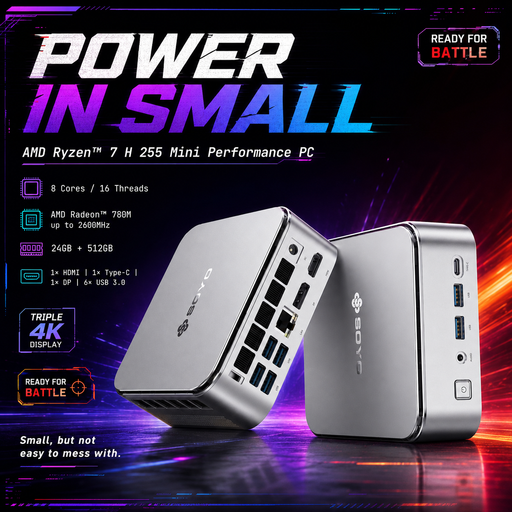
SOYO S4PLUS mini PC, Ryzen 7 H 255
Before choosing, check that the operating system and ports are compatible with your software, monitor and peripherals.
It lists Windows 11, Ryzen 7 H 255 (8C/16T, up to 4.9 GHz), 24 GB LPDDR5 and a 512 GB PCIe 3.0 SSD. HDMI, DisplayPort, USB-C and six USB 3.2 ports are listed.
View at Joybuy
Frequently asked questions
Do I need to buy a particularly powerful desktop PC for a dissertation?
Not just for writing. First, check the requirements of the programmes and devices you actually use. A place in a general mini PC ranking doesn’t prove that a model is right for your individual workflow.
How do I set up a mini PC at a shared desk?
Check where the computer and power supply can go, and whether you can connect your monitor, keyboard and mouse. The German Federal Institute for Occupational Safety and Health distinguishes its rules for screen work in workplaces from private use.
Is the internal SSD enough to back up my dissertation?
No, not if you want protection against data loss. Set up a separate backup and test that you can restore your files. The German Federal Office for Information Security explains that mirroring files won’t protect against accidental overwriting.
Can I put an old PC in the household bin?
No. The German Environment Agency explains that in Germany, electrical and electronic waste must be collected separately from unsorted household waste. Use a suitable local collection point or an appropriate take-back service at a retailer.


