Home cooks short on storage space
You want to make small portions of pea purée without giving up permanent worktop space to a blender. SWR describes blending small quantities straight in a pan or container as a practical use for a hand blender.


For small portions of pea purée and limited storage space, a hand blender is usually the obvious place to start: according to SWR, you can blend small quantities straight in the pan or in a suitable container. A compact jug blender is a better fit if you also want to make dips, sauces or drinks in its own jug regularly. Check the portion size, cleaning requirements and temperature guidance for the specific model. Wattage and manufacturers’ claims about fine blending alone don’t tell you how smooth your pea purée will be.
You want to make small portions of pea purée without giving up permanent worktop space to a blender. SWR describes blending small quantities straight in a pan or container as a practical use for a hand blender.
You care more about getting the right texture than having a large collection of accessories, and want to control the consistency as you blend. Bosch and Braun list different speed controls on some of their models and ranges.
You want to make dips, sauces or drinks as well as pea purée, and are weighing up the convenience of a dedicated blending jug against the extra storage and cleaning. WMF and Philips describe their mini blenders as suitable for other uses, including dips and drinks.
A better fit if: you want to blend small quantities in a pan or tall container, then put the appliance away.
Things to weigh up: You guide the appliance by hand, so the shape of the container, how far you immerse it and the splash guard all affect how easy it is to use.
A better fit if: you regularly prepare other foods in its own blending jug and have space for both the appliance and the jug.
Things to weigh up: You’ll need to clean the jug and blade unit as well. Check that the capacity suits your needs and follow the temperature guidance in the instructions.
| What to consider | What to check before buying | Who it matters most to |
|---|---|---|
| Space and portions | Measure the worktop and storage space available; check that the blending foot or jug suits your usual portion size. | If I only blend small quantities and have very little worktop space, I want to be able to put the appliance away afterwards. Consumers who prioritise space and small portions account for around 33%. |
| Purée consistency | Check how easy the specific model is to use and how its speed control works; assess manufacturer comparisons only in light of the conditions stated. | When making pea purée, I want to control the consistency as I blend rather than rely on power ratings alone. Consumers who care most about consistency account for around 27%. |
| Cleaning | Check the instructions for the exact model to see which parts are removable and dishwasher-safe. | After cooking regularly, the number of parts I have to clean after blending matters to me. Consumers who prioritise easy cleaning account for around 20%. |
| Other uses | Make a note of the recipes you plan to prepare, then check the jug size and the actual contents of the model’s package. | If I want to make dips, sauces or drinks as well as pea purée, I check whether a dedicated jug will suit my kitchen. Consumers who prioritise versatility account for around 20%. |
Motor power and blade design don’t prove what consistency you’ll get with your particular recipe. Manufacturers’ comparisons may also use different ingredients.
Consider how easy the appliance is to use and the container you’ll be blending in. Check the conditions behind any performance claims, too.
Extra attachments also need storage space and cleaning after use.
Before you buy, think about which attachments you’ll actually use in addition to the blending function.
A larger set can mean more parts to store and clean in a small kitchen.
A compact design or glass jug does not, by itself, mean the appliance is approved for hot ingredients.
Before adding ingredients, check the temperature guidance in the instructions for your exact model.
Hand blenders for blending in a container; the ErgoMaster MSM4B610 is a specific model described as having a removable metal blending foot.
The MultiQuick 5 Pro range includes hand blenders; the MQ 55001 M is a model with adjustable speed.
The KÜCHENminis blender is an alternative with its own 0,8-l jug.
The Daily Collection HR2602/01 is a mini blender described as suitable for uses including dips and drinks.
This selection includes hand blenders for blending small quantities in a suitable container.
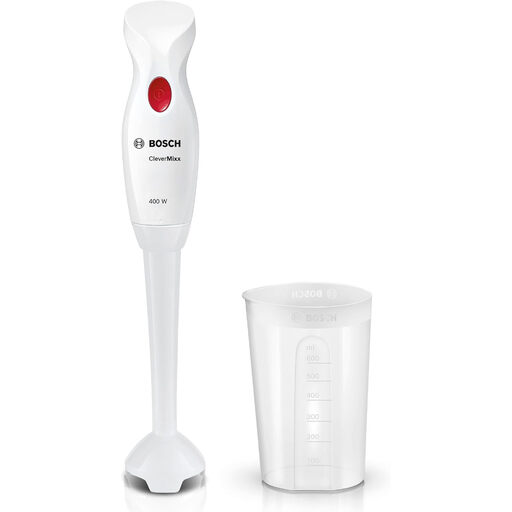 No image available
A handheld model for making purée; the product name states that the blending foot is removable.
400 W; four-blade knife.
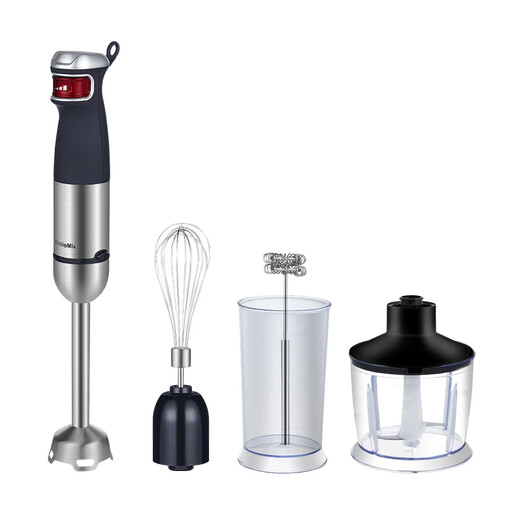 No image available
A hand blender for making purée, with variable speed control.
1,200 W; stainless steel blades.
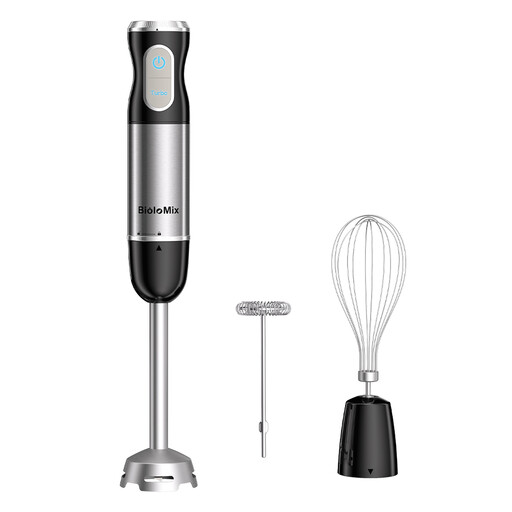 No image available
A handheld model for blending soup; the product name describes a removable design with splash protection.
Described as compatible with different types of container.
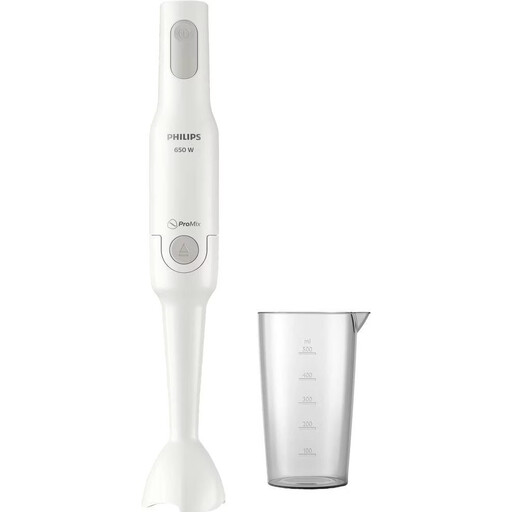 No image available
A hand blender for soups and purées, supplied with a blending beaker.
ProMix technology; 650 W; one-button release. Allow hot ingredients to cool before blending and do not blend boiling liquids.
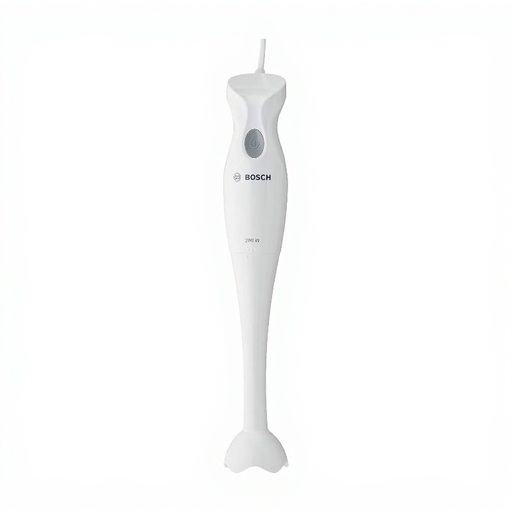 No image available
A handheld model for blending; the product name states that the blending foot is removable.
280 W; splash guard on the blending foot. Allow hot ingredients to cool a little before blending.
Use a container that suits the blending foot and is tall enough, and follow the instructions. Bosch describes the blade design of the MSM4B610 as AntiSplash. This is a manufacturer claim, not a guarantee for every quantity or consistency.
That depends on the temperature guidance for the specific model. Check the instructions before adding hot ingredients. A Philips warning about heat applies specifically to the models named there and should not be assumed to apply to the HR2602/01.
Only parts that the instructions for your exact model variant say are dishwasher-safe. A removable blending foot makes it easier to clean parts separately, but that alone doesn’t mean it is dishwasher-safe.
For a consumer purchase in Germany, the seller, not the manufacturer, is generally responsible for the statutory warranty. Verbraucherzentrale states that this lasts for two years from delivery and distinguishes these rights from a voluntary guarantee.
For appliances covered by the EU Low Voltage Directive, such as those with a rated voltage of 50 to 1,000 V AC, CE marking and the required instructions and safety information are stipulated. Bundesnetzagentur also lists verifiable manufacturer details and German-language instructions as things to check. The CE mark is not an independent endorsement of blending results.