For freshly blended single portions, a compact blender with a sealable blending cup is an obvious choice. For several portions, a larger jug or multiple compatible drinking cups are more practical. The key factors are how many portions you need and how much cleaning you’re happy to do. If you’re saving a smoothie for a later meal, a drinking lid doesn’t keep it chilled: the German Federal Institute for Risk Assessment (BfR) recommends keeping perishable foods refrigerated until they’re eaten.
Which type of blender is right for you?
Personal blenders for single portions
If you blend one portion at a time and want to drink straight from the blending cup, a compact model with a to-go cup could be a good fit. Bosch lists a 0,6-l cup for the MMB2111S; WMF also describes the container on the Kult X Mix & Go as a drinking bottle.
Households with different mealtimes
If several people drink their smoothies at different times, suitable containers and the option to keep them chilled are important. Braun lists a 1,5-l working capacity for the JB 3272 SI, along with two 600 ml bottles.
For using frozen fruit
If you want to use frozen peach pieces, check that the manufacturer explicitly recommends them for the specific model. Bosch lists frozen fruit for the MMB2111S, while Philips does so for the HR3030/00.
What to consider when making portions for different mealtimes
Compact blend-and-drink cup
A good fit if: you mostly make single portions fresh and want to drink them straight from the cup or take them with you.
The trade-off: One cup limits the portion size and needs to be clean and available again before you blend another one.
Larger jug blender
A good fit if: you want to make several portions in one jug or pour them into separate bottles.
The trade-off: As well as the working capacity, check how much space it takes up, how easy it is to clean and which drinking containers are actually included.
If you’re saving a smoothie for later, plan how you’ll store it: the BfR recommends keeping perishable foods refrigerated until they’re eaten; a sealable cup won’t chill its contents.
| What matters |
What to check before buying |
Who is this important to? |
| Getting the portions right |
Working capacity, the number of cups and lids included, and whether they’re compatible with the appliance. |
If I need individual drinks at different mealtimes, I want suitable cups without unnecessary decanting; around 36 % of consumers put portioning first. |
| Preparing and chilling portions |
Whether portions can be stored covered and chilled, or blended fresh when needed. For perishable foods, the BfR recommends a fridge temperature of 2 °C to no more than 7 °C. |
If a smoothie needs to wait until a later meal, I want to plan safe storage; around 29 % of consumers prioritise preparing food for later. |
| Frozen peaches |
Check for an explicit recommendation from the manufacturer that frozen fruit can be used with the specific model, and follow the instructions in the manual. Bosch lists frozen fruit for the MMB2111S, while Philips does so for the HR3030/00. |
If I want to use frozen peach pieces, I need clear guidance on whether the specific appliance is suitable; around 21 % of consumers prioritise frozen ingredients. |
| Cleaning and worktop space |
Check whether the appliance can be taken apart, which parts of the specific model are dishwasher-safe, and how much room is needed for the appliance and containers. Bosch lists detachable accessories and dishwasher-safe parts for the MMB2111S. |
If I need to clean between batches and find space for the appliance, day-to-day effort matters to me; around 14 % of consumers prioritise cleaning and space requirements. |
Common assumptions to avoid when buying
-
Assuming a leakproof drinking lid keeps food safe without refrigeration
A sealable cup doesn’t keep its contents chilled. The BfR recommends keeping perishable foods refrigerated until they’re eaten or processed.
If you prepare portions in advance, plan to store them covered in the fridge, or blend them fresh at mealtime.
-
Assuming the jug capacity tells you how many individual portions you’ll get
A large blending jug and several drinking bottles serve different purposes. Braun lists a 1,5-l working capacity and two 600-ml bottles for the JB 3272 SI; for the Philips HR3030/00, the manufacturer lists a 2-l jug.
Compare the working capacity, the cups included and how you’ll use the blender, rather than looking only at the largest litre figure.
Depending on the container design, you may need to buy additional compatible drinking containers.
-
Judging performance with frozen peaches by wattage alone
Power ratings and features apply to specific models; they’re no substitute for a comparative test using peaches.
Check that the exact model is explicitly recommended for frozen fruit, and follow the manufacturer’s instructions.
Key brands to consider
Bosch
Bosch describes the VitaPower Serie 2 MMB2111S as a compact blender with a 0,6-l to-go cup.
- Bosch says the MMB2111S can also be used with frozen fruit; its accessories can be taken apart and some parts are dishwasher-safe.
- One cup may become a bottleneck if you need several portions at different times. These details apply to the model named, not to all Bosch blenders.
Braun
According to Braun, the PowerBlend 3 JB 3272 SI combines a jug blender with two Smoothie2Go bottles.
- Braun lists a 1,5-l working capacity, two 600 ml bottles and a removable blade.
- If you usually make just one small portion, weigh up the space needed and the effort involved in using the glass jug against the convenience of the extra bottles. These features apply to this version.
WMF
WMF says the 0,6-l container on the Kult X Mix & Go can also be used as a drinking bottle.
- WMF lists a sealable drinking lid and 300 W for this model.
- One blend-and-drink container may become a bottleneck if you need portions in quick succession. Wattage alone doesn’t tell you whether the blender is suitable for frozen peaches.
Philips
Philips describes the 5000 Series HR3030/00 as a jug blender with a 2-l glass jug.
- Philips lists 1.200 W, frozen fruit and dishwasher-safe parts for the HR3030/00.
- A large jug doesn’t replace separate drinking containers. These details apply to the HR3030/00, not to every appliance in the 5000 Series.
Ninja
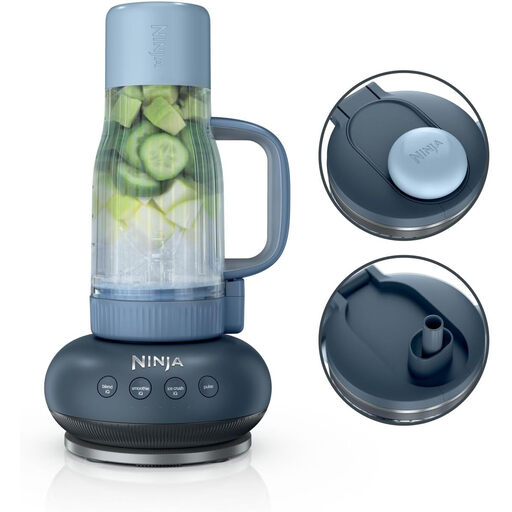
F.A.Z. Kaufkompass describes the BlendBoss as a smoothie maker with a travel cup and three blending programmes.
- This may appeal to consumers looking for a portable cup and pre-set programmes.
- The model number of the version reviewed can’t be clearly matched to the DB351EUCY version sold by Joybuy. The test result therefore can’t be confidently applied to this model.
Blenders for peach smoothies between mealtimes
This selection includes compact blenders with drinking cups and larger jugs for making several portions.
 No image available
Ninja BlendBoss blender with removable travel cup
The travel cup is a good option if you want to make a single portion in the container and drink straight from it.
710-ml cup; three automatic programmes; ice-crushing function; detachable parts described as dishwasher-safe in the product name.
View at Joybuy
 No image available
3-in-1 multifunction blender, 800 W
The blending jug is a good option if you want to make several portions in one container; the travel bottle is designed for a separate portion.
1.500-ml blending jug; 600-ml travel bottle; 300-ml chopper cup.
View at Joybuy
 No image available
ochama multifunction blender, 600 W, 1,5 l
The larger jug is a good option if you want to make a bigger batch of smoothies.
1,5-l jug; three speed settings; ice-crushing function, according to the product name.
View at Joybuy
 No image available
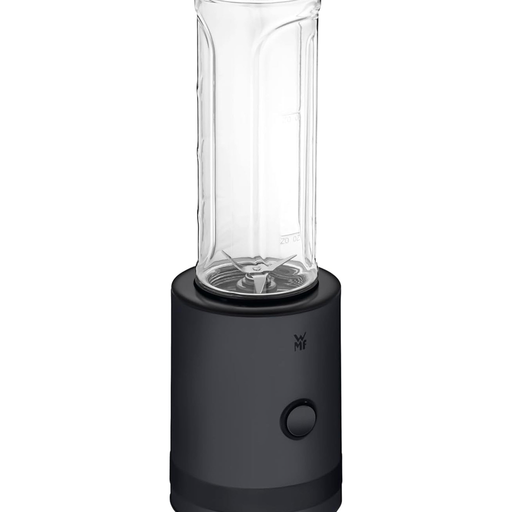
WMF Küchenminis Smoothie-to-Go blender with two containers
Two blend-and-drink containers can be handy if you want to prepare separate portions for different mealtimes.
Two 0,6-l containers; leakproof lids; 300 W.
View at Joybuy
 No image available
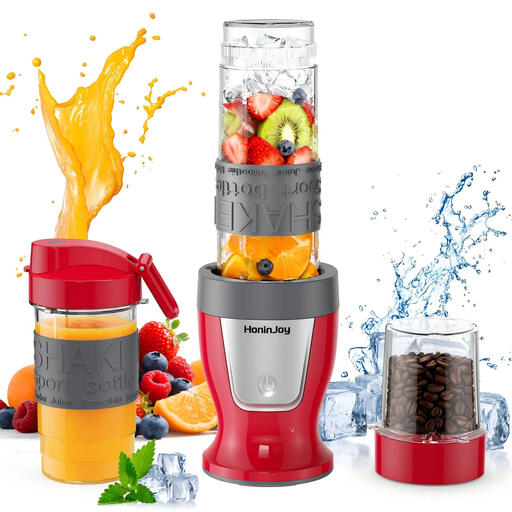
HoninJoy smoothie blender with two portable cups
Two differently sized cups are a good option if you want to make separate single portions.
650 W; 20 oz and 14 oz cups; additional grinding cup.
View at Joybuy
Frequently asked questions
Can I simply leave peach smoothies in a drinking cup until a later mealtime?
A sealable cup doesn’t replace refrigeration. The BfR recommends keeping perishable foods refrigerated and covered until they’re eaten or processed. For perishable foods, it gives a fridge temperature of 2 °C to no more than 7 °C; this doesn’t establish a general shelf life for any particular smoothie.
What should I look for when using frozen peaches?
Check whether the manufacturer recommends using frozen fruit with that specific model, and follow the instructions for preparing the ingredients. Bosch lists frozen fruit for the MMB2111S, and Philips does so for the HR3030/00; these model-specific claims aren’t the result of a comparative peach test.
What should I bear in mind before blending and when cleaning?
For smoothies, the BfR recommends using fresh ingredients with no signs of spoilage and washing fruit and vegetables thoroughly. Check which parts of the specific blender can be taken apart and which the manufacturer says are dishwasher-safe; this doesn’t automatically apply to the entire electrical appliance.
What are my rights when buying a blender in Germany?
If a product is faulty, your statutory rights are against the seller and are separate from any voluntary guarantee. Online consumer contracts generally come with a 14-day right to cancel; possible exceptions and the precise start of the cancellation period should be taken into account. This guidance is provided by the Verbraucherzentrale for the German market.
Is the CE marking an independent quality mark for blending performance?
No. According to information from the European Union, the manufacturer uses the CE marking to declare that the product meets the relevant EU requirements; no central EU body awards a general certificate for this. The marking isn’t an independent comparative test of blending performance.


