What to look for when buying
In a shared kitchen, the main factors in choosing an oven are available space, the quantity you want to bake, the heating method your recipe calls for and how the oven will be shared.
Compact countertop oven
A good fit if: you bake smaller batches one after another and have a suitable place to put the oven, with the required clearances.
Consider: A small cooking cavity doesn’t tell you how many cookies will fit on the tray.
Countertop oven with several heating methods
A good fit if: you want to choose between heating methods in the space you already have, or need more room inside than a particularly small appliance offers.
Consider: A larger cooking cavity takes up more space. Multiple shelf positions don’t guarantee that several cookie trays can be used at once.
Built-in oven with multi-level fan cooking
A good fit if: you often bake larger quantities, are allowed to use a suitable built-in space and want to cook with several compatible trays.
Consider: Check the installation dimensions, get permission to install it and allow for any extra accessories you may need. Manufacturer information is no substitute for testing how your cookies bake.
| Priority |
What to check before buying |
Who it matters most to |
| Space and positioning |
External dimensions and clearances in the instructions; for built-in ovens, also check the dimensions of the space and get permission to install it. |
If space in the shared kitchen is limited, I want to plan where the appliance will go and allow for the required clearances. Around 31% of consumers prioritise space and safe positioning. |
| Cookies per batch |
Usable tray area, trays included and explicit information about baking on several levels. |
If I bake larger batches, I want to know how much dough will fit on suitable trays and whether several trays are intended for use. Around 25% of consumers put baking capacity first. |
| Heating method and controls |
Check the available heating methods and temperature settings against the instructions in your specific recipe. |
If my recipe calls for conventional top-and-bottom heat or fan cooking, I want to be able to select the right setting on the oven. Around 25% of consumers prioritise flexible baking settings. |
| Cleaning and sharing |
Check the cleaning instructions and whether accessories can be removed. If someone has a known peanut allergy, agree how to share the oven and prevent possible cross-contact. |
If several people use the oven, I want to be able to agree on cleaning and kitchen rules easily. Around 19% of consumers prioritise easy sharing and care. |
Suitable products at Joybuy
This selection includes countertop ovens for smaller batches and built-in ovens with stated multi-level fan cooking for larger quantities. For built-in models, check that you have a suitable space and the required permission to install the oven.
 No image available
Bosch HBA571BB4 Series 2 built-in oven
An option for larger batches if you have a suitable built-in space and want to use several levels.
71 l cooking capacity; top-and-bottom heat and 3D hot-air cooking on up to three levels. Pyrolytic cleaning; according to the product description, a wire rack and a universal pan are included. Professional installation required.
View at Joybuy
 No image available
Bosch HBG578ES3 Series 6 built-in oven
For larger batches, provided you have a suitable space and installation is possible.
71 l cooking capacity and 3D hot-air cooking on up to three levels; according to the product description, it also has top-and-bottom heat. Pyrolytic cleaning, a baking tray and an Air-Fry tray are listed among the included features. Professional installation required.
View at Joybuy
 No image available
WOLTU BF12sz mini oven, 32 l, white
A countertop option for smaller batches, if the space and clearances work in your shared kitchen.
32 l cooking capacity, 1.600 W and a temperature range of 100 to 250 °C. According to the product description, it has a 60-minute timer with automatic shut-off, a removable crumb tray and a baking tray.
View at Joybuy
 No image available
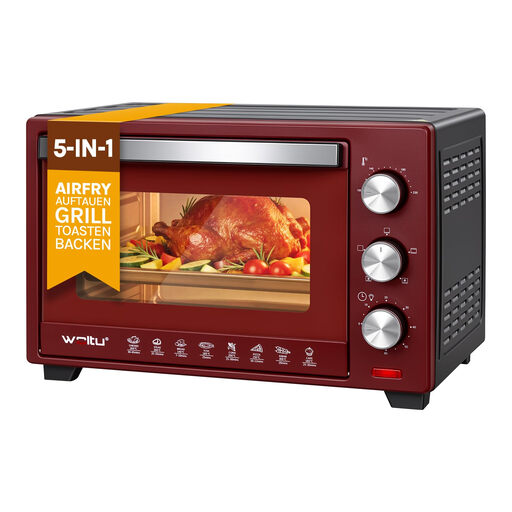
WOLTU mini fan oven, 28 l, red and black
A countertop oven option if you want to use different heating methods for your recipes and can check the available space beforehand.
28 l cooking capacity and a temperature range of 100 to 230 °C. The product description lists top-and-bottom heat and a combined setting, a 60-minute timer, a wire rack, a baking tray and a removable drip tray.
View at Joybuy
 No image available
Siemens HB978GMB1 studioLine iQ700 built-in oven
For larger batches if you have a suitable built-in space and several compatible trays.
71 l cooking capacity and a temperature range of 30 to 300 °C. According to the product description, it has top-and-bottom heat, hot-air cooking and 4D hot-air cooking on up to four levels; a baking tray and a grill rack are listed. Professional installation required.
View at Joybuy
Frequently asked questions
What temperature should I use for peanut butter cookies?
Start with the instructions in your recipe. Dr. Oetker recommends around 180 °C using top-and-bottom heat or around 160 °C with fan cooking for its chocolate peanut butter cookie recipe, and advises preheating the oven. These settings apply to that specific recipe.
Can I put a countertop oven under a wall cupboard?
Don’t decide based on the external dimensions alone. Check the positioning instructions and safety clearances for the specific model. Rommelsbacher notes that the back of the BG 1805/E gets hot and that the required clearances must be observed.
How should I manage a peanut allergy in a shared kitchen?
Agree how baking will be handled with the person affected, and prevent cross-contact through worktops and kitchen tools. The Allergy Information Service warns that even tiny traces of peanuts can trigger severe reactions; FARE recommends thorough cleaning and, where appropriate, separate utensils. Having a separate oven cannot automatically be considered a sufficient way to prevent exposure.
What certification should I look for when buying a new electric oven?
Electrical appliances operating within the 50 to 1.000 V AC range are subject to the relevant requirements of the Low Voltage Directive. The European Commission explains that CE marking is part of the manufacturer’s obligations for products covered by the directive. Check the details for the specific appliance on offer. CE marking is not an endorsement of a particular baking result.
Does the energy efficiency rating tell me how much a batch of cookies will cost to bake?
No. As the Federal Environment Agency explains, the energy label includes information such as energy consumption for a standardised baking cycle and the cooking cavity volume. It doesn’t directly tell you how much electricity it will take to bake your recipe or batch size.


