Bakers short on worktop space
You’ll need a safe, permanent spot for the appliance, with more room than its footprint alone. The required clearances vary by model; Rommelsbacher specifies 4 cm at the sides and 1 m above the BG 1055/E.


First, measure the rolled-out pastry and the usable tray area. Then check the space available, including the clearances specified by the manufacturer for that particular model. In the recipe example from Hafer – Die Alleskörner, the pastry is around 37 cm in diameter, so the manufacturers’ specifications for tins up to 25 or 29 cm don’t confirm a suitable baking surface. You’ll need a smaller galette or a tray that’s confirmed to be large enough. Conventional top and bottom heat and fan-assisted cooking may call for different recipe settings, but neither makes checking the dimensions any less important.
You’ll need a safe, permanent spot for the appliance, with more room than its footprint alone. The required clearances vary by model; Rommelsbacher specifies 4 cm at the sides and 1 m above the BG 1055/E.
If you want to stick to your planned pastry size, check the tray and oven cavity first. The recipe example from Hafer – Die Alleskörner calls for pastry rolled out to around 37 cm in diameter.
For different types of baking, you’ll need suitable heating functions and a tray size you can verify. Steba lists conventional top and bottom heat and optional fan-assisted cooking for the KB M19; its stated internal dimensions, however, don’t tell you the usable tray size.
The recipe example from Hafer – Die Alleskörner starts with pastry rolled out to around 37 cm in diameter. The manufacturers’ stated tin or oven cavity dimensions don’t automatically confirm that this pastry will fit on a particular tray.
| What matters | What to check before buying | Who is it most important for? |
|---|---|---|
| A safe place to put it | Compare the appliance’s external width and depth, along with the model-specific clearances in the manual, with the space you have available. | If I want to use the appliance on a worktop with limited space, I need room for the required clearances as well as the appliance itself. Around 36% of consumers prioritise having a safe place to use it. |
| Pastry and tray fit | Compare the largest pastry diameter with the usable tray area. Don’t assume that dimensions for round tins also apply to rectangular trays. | If you want to bake the galette to the planned size, you’ll want to make sure the pastry and tray fit together before you buy. Around 36% of consumers put this fit first. |
| Heating functions for your recipe | Check whether the specific model offers conventional top and bottom heat and, if needed, fan-assisted cooking, and how you can select each function. | If I want to follow different recipe instructions, the heating functions actually available are important. Around 21% of consumers prioritise having the right heating function. |
| Cleaning and servicing | Check what’s included, which parts can be removed and what information is available about spare parts for the exact model. | If you plan to use the appliance regularly and want to make cleaning easier, removable parts and spare part availability are worth considering too. Around 7% of consumers give these considerations priority. |
A capacity in litres doesn’t tell you whether your rolled-out pastry will fit on the tray. Rommelsbacher lists tins up to 29 cm for the BGE 1580/E, while the recipe example from Hafer – Die Alleskörner calls for pastry around 37 cm in diameter.
Before you buy, compare the pastry diameter with the usable tray area and check the opening of the oven cavity on the specific model.
Required ventilation clearances could rule out a spot even if the appliance itself fits. Rommelsbacher specifies a 4 cm clearance at the sides and 1 m of space above the BG 1055/E.
As well as measuring the width and depth, check the clearances given in the manual for that exact model.
The recipe example from Hafer – Die Alleskörner gives different temperatures for conventional and fan-assisted cooking: 200 °C and 175 °C respectively.
Use the temperature recommended for the heating function you’ve selected, and keep an eye on your bake as it cooks.
The BG 1055/E and BGE 1580/E models offer different sizes for smaller or larger baking projects.
The KB M19 is a 19-l tabletop oven for smaller bakes, where you’ll need to measure the tray and pastry separately.
The TO 2052 is a 9-l toaster oven, while the TO 2068 is a 20-l oven and toaster.
Joybuy appliances for baking when worktop space is limited: check the tray area and required installation clearances for each model before deciding on the size of your galette.
 No image available
This model is suitable for baking a pear galette only if the pastry fits on the usable tray area.
32 l; 1,600 W; temperature range 100–250 °C; timer and crumb tray.
 No image available
This compact model is suitable for your galette only if the dimensions of the specific tray and pastry are a good fit.
10 l; temperature range 100–230 °C; pizza function.
 No image available
If you bake a range of recipes, check that the stated temperature range suits them and that the tray is large enough for your galette.
28 l; temperature control and timer.
 No image available
For a galette, what matters is whether the baking area on the specific appliance is large enough; having two cooking zones doesn’t answer that question.
23 l; 15 programmes; two cooking zones.
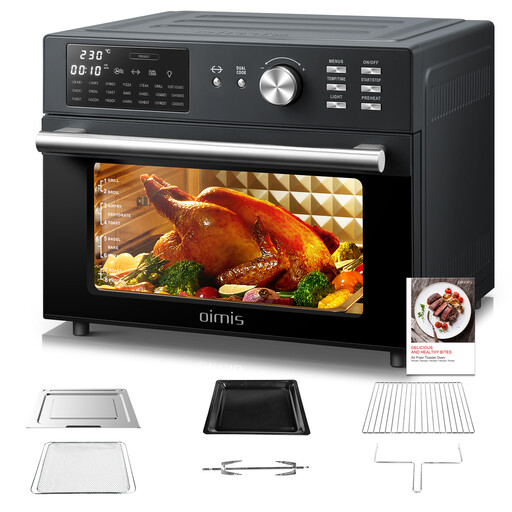 No image available
Factor in the external dimensions and usable baking area when planning where to put the appliance and how large your galette can be.
30 l; 21 programmes; 1,800 W; listed as suitable for pizzas up to 13 inches.
The specifications for the Rommelsbacher BG 1055/E don’t confirm that it will fit the recipe example from Hafer – Die Alleskörner: the manufacturer lists round tins up to 25 cm. Check the usable tray area or adjust the galette and recipe to fit.
It depends on the installation instructions for the specific model. Rommelsbacher specifies 1 m of space above the BG 1055/E; don’t assume the same clearance applies to other appliances.
If a product is faulty, your statutory rights are against the seller; a manufacturer’s guarantee is an additional, voluntary offer. The Verbraucherzentrale recommends checking the terms of each guarantee separately.
Check the details and documentation for the specific product listing. In its product checks, the Bundesnetzagentur looks at things such as CE marking, identifiable manufacturer details and German-language instructions with the necessary warnings. A product description alone doesn’t prove that an individual appliance complies with the relevant requirements.
Take it to a separate collection point for electrical waste rather than putting it in your general rubbish. The Umweltbundesamt provides information about local collection points and take-back options in shops, which may be subject to certain conditions.