Hosting a large gathering
If you’re planning a large galette or several trays of baking for a family gathering, compare the usable tray area and the number of shelf levels specified for the model you’re considering.


Start by considering the size of the tin or tray you need, along with the space available for a built-in or freestanding oven. A built-in fan oven is a particularly good option if you want to bake larger quantities or use several trays. A freestanding fan oven may be enough for a single galette that fits, but you’ll need to check the tin dimensions, available worktop space and the instructions for positioning the model. For a juicy filling, also make sure the oven setting suits your recipe.
If you’re planning a large galette or several trays of baking for a family gathering, compare the usable tray area and the number of shelf levels specified for the model you’re considering.
For a pear galette, the available oven settings should suit your recipe. In particular, check that your preferred setting is available on the appliance.
With a freestanding oven, the galette tin, available worktop space and clearance distances specified in the instructions for that model all need to work together.
A good fit if: you have a suitable built-in space and are planning a large galette or several trays for your gathering. Bosch says the HBA571BB4 offers fan-assisted cooking on up to three levels.
Keep in mind: the housing and tray dimensions need to match. Having several shelf levels doesn’t guarantee that every combination of recipes will bake evenly without adjustments.
A good fit if: you don’t have space for a built-in oven and your galette tin and tray fit inside the usable cooking space. Rommelsbacher lists baking tins up to 31.5 cm in diameter for the BG 1805/E.
Keep in mind: the capacity in litres doesn’t tell you whether your tin will fit, so check its dimensions. You may need to bake in batches if you’re catering for a larger group.
For a galette, it’s not just the oven capacity that matters. Tin size, oven settings and available space are important too.
The figures below relate to consumers choosing an oven for a pear galette at a family gathering. Each figure reflects their main buying priority.
| Priority | What to check before buying | Who is it important to? |
|---|---|---|
| Baking area and capacity | Compare your tin or tray dimensions with the usable cooking space. If you plan to bake several trays, check the multi-level cooking details for the specific model. | If I’m planning a large galette or several trays, I need enough usable space. Around 40% of consumers put baking area first. |
| Oven setting for the pastry and filling | Check that the setting specified in your recipe is available on the oven. Bottom heat can be useful if the base needs more time to bake while the filling is already done. | I want the oven setting to suit the recipe and keep the pear filling juicy. Around 30% of consumers prioritise the oven setting and baking results. |
| Built-in or freestanding | For built-in ovens, check the housing and appliance dimensions. For freestanding models, check the external dimensions, position and clearance distances in the instructions. | If there’s no suitable built-in space or worktop space is limited, the oven needs to fit where I plan to put it. Around 20% of consumers prioritise ease of positioning. |
| Energy use and cleaning | For household ovens with an energy label, compare consumption per cycle and cooking mode. The European Commission lists mini ovens as outside the scope of the energy label for household ovens. | If I want to use the oven regularly after the gathering, I’ll consider energy use and cleaning. Around 10% of consumers prioritise these ongoing costs and tasks. |
Capacity alone doesn’t tell you whether a particular tin or tray will fit inside.
Measure your tin and tray before buying, then compare them with the dimensions given for the specific model.
If the tin is too large, you may need a smaller one or an extra baking session.
Conventional heat, bottom heat on its own and fan cooking are different settings. There’s no universal temperature or cooking-time conversion between them.
Check that your oven setting matches the one in your recipe, and keep an eye on the cooking time and browning rather than assuming there’s a standard conversion.
According to the Verbraucherzentrale, the stated energy use for each cooking mode is based on a standard cycle. That doesn’t necessarily reflect the energy used for every individual baking session.
For labelled appliances, compare the figure for the relevant cooking mode alongside the oven capacity. Choose extra cleaning functions based on what you actually need.
Bosch lists a 71 l capacity and 3D fan cooking on up to three levels for the HBA571BB4 built-in oven.
NEFF describes the B1DCA0AK0 built-in oven as having a 71 l capacity and CircoTherm for up to three levels.
AEG lists a 72 l capacity and a multi-level cooking function for the EB42PB built-in oven.
The freestanding BG 1805/E is an option if you don’t have a built-in space. Rommelsbacher lists a 42 l capacity and baking tins up to 31.5 cm in diameter.
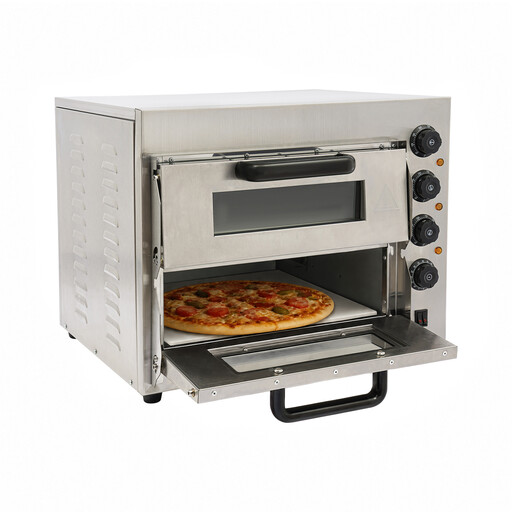
The freestanding TO 2068 is a compact option with a fan function and a cooking capacity of around 20 l.
The range includes built-in ovens as well as freestanding baking and pizza ovens with baking functions. Compare your tin dimensions with the usable cooking space, and check that the oven will fit in your chosen spot or built-in space.
 No image available
For larger baking projects, provided you have a suitable built-in space. 71 l; 3D fan cooking; pyrolytic self-cleaning; 10 AutoPilot programmes.
 No image available
A built-in option if the housing and appliance dimensions are a match. 70 l; 3 kW; grill and pizza functions; AquaClean steam cleaning.
 No image available
A built-in option with 3D fan cooking. Check the required housing dimensions before you buy. 60 cm wide; AirFry function; 3D fan cooking; steel finish.
 No image available
Also described as suitable for baking. Check whether your galette tin will fit inside. 20 l; 3,000 W; temperature range 50–350 °C; timer from 1–60 minutes.
 No image available
This oven may suit a galette if the tin and the space you need fit inside. 23 l total capacity; two cooking zones; 15 programmes. Remove the divider to create one cooking space.
No. Follow your recipe and check whether your oven has the setting it recommends. For fruit bakes, using bottom heat on its own may be an option if the base needs longer while the filling is already done.
The capacity in litres alone won’t tell you. Rommelsbacher lists baking tins up to 31.5 cm in diameter for the BG 1805/E. Compare this with the size of your tin, including its rim, and take the supplied tray into account.
Check the external dimensions and follow the clearance distances in the instructions for the specific model. Rommelsbacher notes that the distances in the instruction manual for the BG 1805/E must be followed. The back of the oven may get hot.
For household ovens covered by the scheme, the label shows information including the cooking capacity and energy use per cycle for conventional and fan-assisted cooking. The European Commission lists mini ovens as outside its scope, so the absence of a label shouldn’t be taken as a breach of the rules without checking first.
The retailer, not the manufacturer, is generally responsible for your statutory consumer rights. This is separate from any voluntary manufacturer’s guarantee. The Verbraucherzentrale also explains that, for purchase contracts made from 31 July 2026, the statutory limitation period can be extended once by twelve months if you choose a repair rather than a replacement when reporting a fault.