Who is a dehydrator suitable for?

Meal planners preparing portions in advance

People who prepare pear slices for different meals value a process they can plan and enough space for the portions they need. The Federal Centre for Nutrition points out that drying time depends on the size and thickness of the pieces.

Batch dehydrators

If you process several pears at once, compare the stated drying area and the layout of the tiers rather than looking only at the number of tiers. Rommelsbacher lists different areas and numbers of tiers for the DA 350 and DA 650 models.

Occasional small-batch dehydrators

If you only dry pear slices from time to time, weigh up the space available and the batch size against buying another kitchen appliance. The consumer advice centre also describes using an existing oven as an option for a one-off drying session.

What should you look for when buying?

Compact stackable dehydrator

A good fit if: smaller batches and limited worktop space matter more than a large stated drying area.

Consider: CASO Design and WMF list five tiers for their respective models. This doesn’t tell you how much usable space there is for pear slices.

Dehydrator with a larger stated drying area

A good fit if: you want to prepare a batch for several portions to eat later. Rommelsbacher lists a drying area of 0.42 m² for the DA 350 and 0.5 m² for the DA 650.

Consider: A larger stated area doesn’t guarantee shorter drying times or even results with every load. You’ll still need to check the spacing between slices and how dry they are.

Your existing oven

A good fit if: you only plan to dry pear slices once or occasionally and would rather not buy another appliance just yet.

Consider: The consumer advice centre describes oven-drying with the door slightly open as energy-intensive. Its estimate of around four to five hours at 60 to 70 °C is for apple and pear rings dried in an oven, not in a dehydrator.

Buying priority What to look for Who is it most relevant to?
A process you can plan Check the timer and temperature range for the specific model; check the pear slices during and after drying. When I prepare pear slices for different meals, I want to plan the drying session properly without relying on the timer alone. That’s why around 36% of consumers put a controllable process at the top of their list.
Space for larger batches Compare the stated drying area and tray dimensions; arrange the slices with space between them. When I’m preparing a larger batch, I want enough room for the pear slices without crowding them. Around 29% of consumers focus mainly on space for several portions to eat later.
Space and ease of use Check the external dimensions and tier layout against the space where you plan to use the appliance. When I’m only drying small amounts, I want the appliance to fit in my kitchen and be easy to use for individual batches. Around 21% of consumers prioritise finding a suitable place for it.
Effort involved if used infrequently Consider how often you’ll use it; to compare electricity costs, use the kWh per comparable batch and your own electricity tariff. If I only want to dry pear slices occasionally, I’ll check whether my existing oven is enough for a one-off session. Around 14% of consumers focus on whether an additional appliance is worthwhile if it will be used infrequently.

Common buying mistakes

  • Assuming the timer means the pears are fully dried

    A timer ends a set drying cycle, but it doesn’t check the remaining moisture. The Federal Centre for Nutrition points out that drying time depends on the pieces themselves.

    Cut the pears as evenly as possible, arrange the slices with space between them and check how dry they are before storing them.

  • Counting tiers instead of comparing usable space

    Five tiers can vary in size, and the number alone doesn’t tell you how many slices will fit with enough space between them.

    Compare the stated total area and tray dimensions of the specific models with the size of your usual batches.

  • Assuming a lower wattage means lower electricity costs

    The rated power alone doesn’t show how much electricity an appliance uses to dry a comparable batch.

    If you use it regularly, you can compare the actual consumption in kWh per comparable batch with your electricity tariff. If you only use it occasionally, you can also factor your existing oven into the decision.

  • Treating similarly named models or a single mark as complete proof

    Different versions of a model can vary. A material description alone doesn’t prove that the specific food-contact parts are suitable, and a CE mark alone doesn’t demonstrate that a particular appliance meets every requirement.

    Check the full model number and information about the specific version. Appliances covered by Regulation (EC) No 1935/2004 must meet requirements for food-contact materials. For equipment operating at 50 to 1000 V AC, the Low Voltage Directive 2014/35/EU also applies if it is placed on the EU market in the relevant way. The European Commission and the Federal Network Agency set out the applicable requirements and points to check.

Brands to help you compare specific models

Rommelsbacher

The DA 350 and DA 650 models offer specific figures for comparing drying area and tiers. These details apply to these models, not to every appliance made by the brand.

  • According to Rommelsbacher, the DA 350 has five height-adjustable tiers, a drying area of 0.42 m² and a 36-hour timer.
  • For the DA 650, Rommelsbacher lists seven trays, a drying area of 0.5 m² and a 99-hour timer.
  • The manufacturer’s information doesn’t guarantee a particular drying time for pear slices or even results with every load.

CASO Design

The DH 450 is a useful comparison model if you want to compare the number of tiers, temperature range and timer.

  • According to CASO Design, this model has five height-adjustable tiers, a temperature range of 30 to 70 °C and a timer from 0.5 to 48 hours.
  • The number of tiers alone doesn’t show how much space is available for a batch of pears, nor does it guarantee the same drying times as other models.

WMF

The KÜCHENminis Snack to go dehydrator is a model designed for smaller kitchens and batches.

  • WMF lists five stackable racks, a temperature range of 30 to 70 °C and a timer of up to 24 hours.
  • The manufacturer describes the appliance as quiet; this is a manufacturer’s claim, not an independent measurement. Check the details for the specific version to assess the actual space available for pear slices.

Severin

Severin describes the OD 2940 as a model for drying fruit, vegetables and herbs.

  • The manufacturer’s FAQ specifically lists fruit as suitable for drying.
  • This description doesn’t provide specific information about the timer, drying area or drying time for pear slices.

Dehydrators at Joybuy

The following Joybuy products are multi-tier dehydrators with timer functions that may suit planned drying sessions for pear slices. Before buying, check the information for the specific appliance and its food-contact parts.
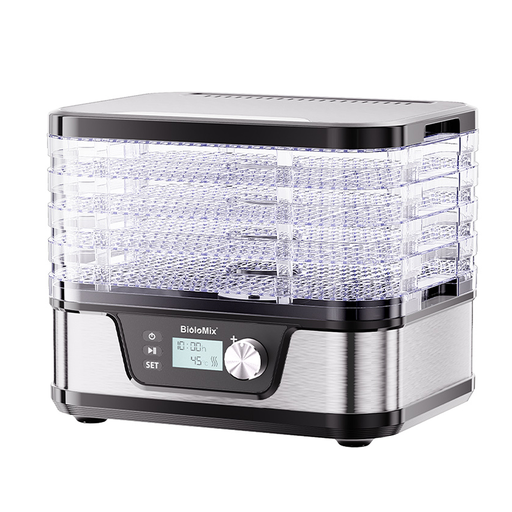
BioloMix BFD1300 dehydrator with five trays

BioloMix BFD1300 dehydrator with five trays

The five trays provide several drying levels, while the timer helps you plan the process.

The product title lists an adjustable 24-hour timer and a temperature range of 35 to 75 °C.

View at Joybuy
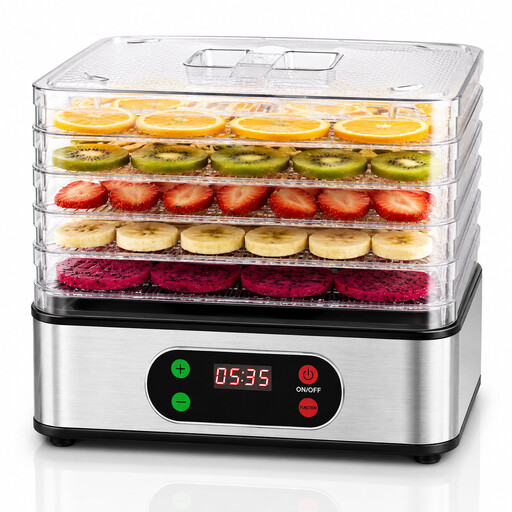
Dehydrator with LED display, temperature control and timer

Dehydrator with LED display, 35–70 °C

The adjustable timer helps you plan a drying session for portions you’ll eat later.

The product title lists temperature control from 35 to 70 °C and a timer from 0.5 to 72 hours, adjustable in 30-minute increments.

View at Joybuy

Havenwell stainless steel dehydrator with ten trays

Havenwell stainless steel dehydrator with ten trays

Ten trays provide several levels for a batch, while the timer helps you plan the process.

The product title lists a 48-hour timer and adjustable temperature control.

View at Joybuy

Havenwell dehydrator with eight stainless steel racks

Havenwell dehydrator with eight stainless steel racks

Eight drying racks provide several levels, and the timer can help you plan the process.

The product title lists a temperature range of 35 to 85 °C and a 48-hour timer.

View at Joybuy

Frequently asked questions

How do I prepare pear slices for a dehydrator?

Wash the pears, remove the cores and cut them into thin, evenly sized slices. The consumer advice centre points out that thinner slices dry more quickly; the Federal Centre for Nutrition recommends cutting pieces to a similar size and ensuring good ventilation.

Can I store the pears as soon as the timer ends?

No, check how dry they are before storing them. The Federal Centre for Nutrition recommends checking fruit while it dries; drying time depends on factors including the thickness of the pieces.

How should I store pear slices for later meals?

Make sure the pear slices are sufficiently dry and protect them from moisture during storage. The Federal Centre for Nutrition points out that incorrect storage can speed up spoilage, so there isn’t one storage period that suits every batch.

Is a dehydrator more cost-effective than an oven?

It depends on how often you dry food and which appliances you already own. The consumer advice centre describes an oven as an option for a one-off session, but notes that drying with the door slightly open is energy-intensive. To compare costs, you’ll need the measured consumption per comparable batch and your electricity tariff.

What requirements matter when choosing an electric dehydrator?

Food-contact parts must meet the requirements for food-contact materials, including Regulation (EC) No 1935/2004. The Low Voltage Directive 2014/35/EU also applies to equipment operating at 50 to 1000 V AC that is placed on the EU market in the relevant way. The European Commission and the Federal Network Agency set out the applicable requirements and points to check; make sure the information applies to the specific appliance.