
Lieferung heute & morgen

Qualitätsgarantie

Willkommens-Angebote freischalten: KOSTENLOSE Lieferung | Bis zu 80 % RABATT | Kostenlose 30-Tage-JoyPlus-Testphase
App herunterladen
Pen and marker sets may seem straightforward at first: plenty of colours, different nibs and a handy case. But choosing the wrong set for your needs can end up costing you more. A set with lots of colours, for example, is of little use if you mainly need to sign documents. Conversely, a basic ballpoint pen won’t be enough if you’re planning fine illustrations, hand lettering or colour blending.
A large number of colours says little about how suitable a set really is. What matters is whether the colours work for your project and whether the nibs can produce the lines you want. For school notes, a few easy-to-read highlighters are often enough. For illustrations or journalling, fineliners, brush pens and a range of shades can be useful.
Water-based ink is often suitable for paper and, depending on the product, may be easier to blend or remove. However, it can run if it gets wet. Pigmented or permanent ink is designed to last, but may show through more strongly on the other side of the page or be harder to remove.
So when checking product details, be sure to distinguish between water-based, water-resistant, smudge-resistant and permanent. These terms are not interchangeable.
A chisel-tip highlighter can cover broad areas and, when held at a different angle, create finer underlining. A brush pen responds to pressure, allowing you to vary the line. A fineliner with a defined nib is better for outlines, small lettering and precise notes.
It’s also worth checking the stated line width. Gel pens, for example, commonly have a 0.5 mm or 0.7 mm tip, while highlighters often cover a range such as 1 to 5 mm.
For everyday notes, school and office use, ballpoint or gel pens are practical choices. A ballpoint pen with a 1 mm tip, such as the Pelikan Stick Pro, is designed for everyday writing. Gel pens with a 0.5 mm tip, on the other hand, create finer coloured lines for journalling and sketching.
For drawing pens, calligraphy pens and brush pens, it’s also important to check whether the ink bleeds on the paper you plan to use. Thin notebook paper has different requirements from drawing card or specialist lettering paper.
Check the specific nib shape:
For permanent markers, also check which surfaces they’re designed for. A marker intended for paper won’t necessarily be suitable for glass, plastic or metal.
A set is more practical for everyday use if the pens can be neatly organised and securely stored. Replace caps fully after every use. If the product description recommends it, store pigment-based pens horizontally. For children, also consider small parts and caps, and read the relevant safety information before buying.
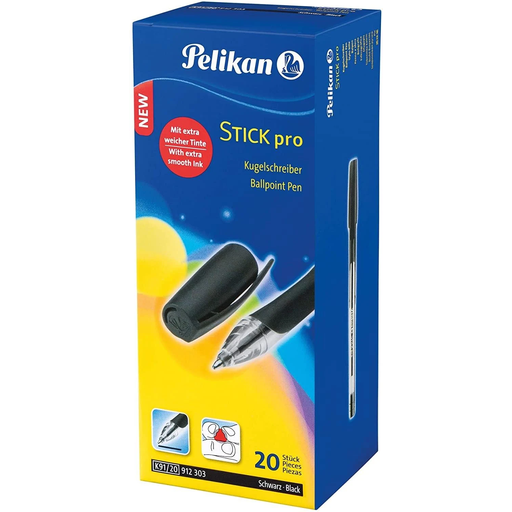
Why it suits this user: This pack of 20 black ballpoint pens is designed for school, the office and everyday note-taking.
The focus is on a clear, practical use rather than an unnecessary range of colours or specialist nibs.
20 pens, black ink, 1 mm tip, ergonomic grip zone and click cap.
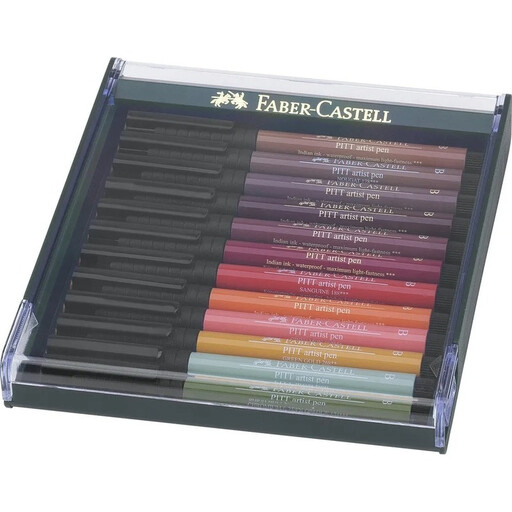
Why it suits this user: Its flexible brush tip and earthy colour palette make it a good choice for illustrators and fans of calligraphy and hand lettering.
The product description specifies a flexible B tip and pigmented, water-resistant ink, rather than making vague claims about universal use.
12 earthy shades, B brush tip, pigmented ink and a 12-piece storage case.
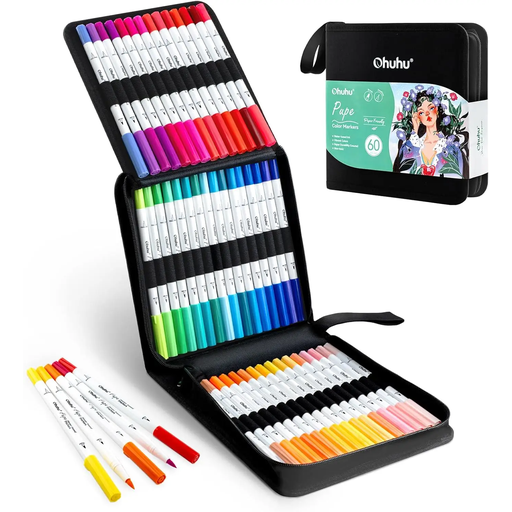
Why it suits this user: Journalling enthusiasts, keen crafters and illustrators get two types of nib in one set.
The combination of a 0.4 mm fineliner and a 1–5 mm brush tip makes the range of uses clear, with specific measurements.
59 colours plus a colourless blender, water-based ink and a handy storage case.
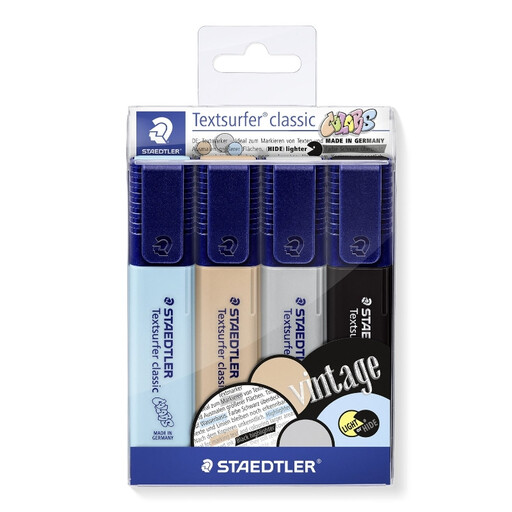
Why it suits this user: This set is designed for underlining and highlighting larger areas of text at school, university and in the office.
The soft chisel tip has a specific stated range of around 1–5 mm, rather than being described simply as a ‘multi-purpose tip’.
Water-based ink, four colours, a large ink reservoir and a chisel tip for different line widths.
We’ve put together a complete, regularly updated list of products that meet these strict selection criteria and the safety regulations in force in the EU.
Gel pens, fineliners and dual-tip markers are often handy for journalling. A fine tip is ideal for small lettering, while a brush tip lets you add headings and decorative details. If you’re using thin paper, check in advance whether the ink shows through.
Their lifespan depends on how often they’re used, how much ink they contain, how they’re stored and whether they’re properly capped. Replace caps as soon as you’ve finished using a pen. Retractable gel pens should be fully retracted when not in use. Direct sunlight and high temperatures can affect the properties of the materials and ink.
No. Price is no substitute for checking the product specifications. For everyday signatures, a multipack of ballpoint pens may be more useful than an extensive art set. For illustrations, calligraphy or layering colours, pigment pens, coloured pencils or pastel pencils may be a better choice. The key factors are how you’ll use them, the nib shape, the type of ink and the paper.