
Lieferung heute & morgen

Qualitätsgarantie

Willkommens-Angebote freischalten: KOSTENLOSE Lieferung | Bis zu 80 % RABATT | Kostenlose 30-Tage-JoyPlus-Testphase
App herunterladen
As a Joybuy Product Recommendation Officer, I analyze product information daily to provide you with clear, objective guidance. A new pen set can unleash creativity or lead to frustration. Many buyers invest in sets that look promising on paper, only to find them unsuitable in practice. Before you make a decision, it's important to understand the common pitfalls that often lead to disappointment.
The most frequent problems are not always apparent at first glance. These include:
Understanding the basic product parameters helps to avoid these problems and find a set that perfectly matches your project.
Choosing the right pen set depends on two central factors: the ink composition and the tip's design. These determine which surfaces and techniques a pen is suitable for.
The type of ink is the most important parameter for the pen's behavior on different materials.
The shape and size of the tip define the line width and the area of application.
Based on these objective criteria, we have identified products that are particularly well-suited for specific requirement profiles.
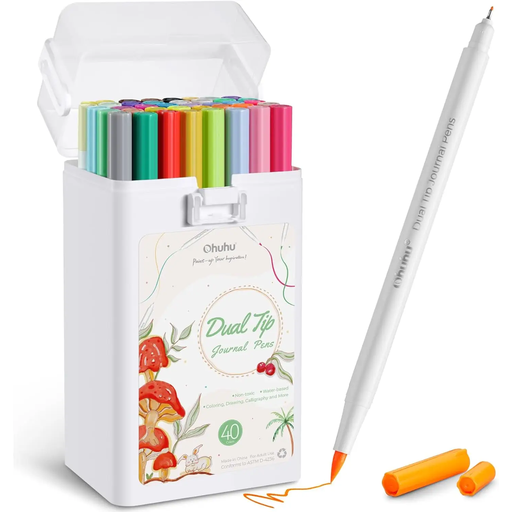
Why This Fits Their Persona: This set is designed for users who need versatility. The combination of a 0.4mm fineliner tip for notes and details and a flexible brush tip for headlines or coloring covers the typical needs of bullet journaling and light illustration work.
According to the manufacturer, the water-based ink is quick-drying and formulated to minimize bleeding and smudging on suitable paper—a direct solution to one of the most common problems.
Dual Tip: Offers a fineliner and a brush tip in one pen. Color-Coded: Each pen is color-coded and numbered for easy identification.
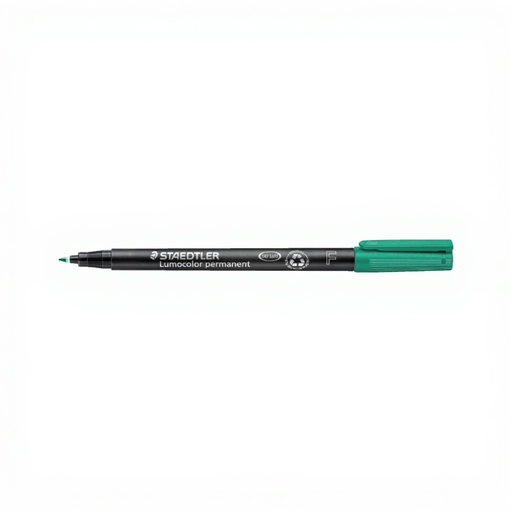
Why This Fits Their Persona: For use in the office, warehouse, or on construction sites where reliability and durability are required. This marker is designed for labeling on almost all surfaces, including glass, plastic, and metal, and provides smudge-proof and waterproof marking.
The "DRY SAFE" technology, according to manufacturer STAEDTLER, prevents the pen from drying out even if left uncapped for days. This directly addresses the problem of markers quickly becoming unusable in hectic work environments.
Universal Ink: Adheres to almost all surfaces. Refillable: Can be reused with a refill station, which reduces operating costs.
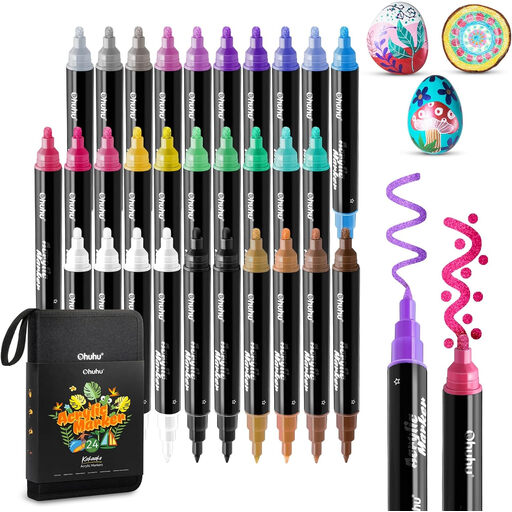
Why This Fits Their Persona: This set is aimed at artists and crafters who work on a wide variety of materials such as stones, wood, ceramic, or canvas. The acrylic ink is known for its high opacity and durability, making it ideal for permanent art projects.
The highly pigmented ink provides high opacity, counteracting the problem of pale or translucent colors. The waterproof and lightfast formula ensures that artworks retain their vibrancy, even outdoors.
Multi-Surface Capability: Works on porous and smooth surfaces. Dual Tip: A fine tip for details and a round tip for larger areas.
We've compiled a complete, up-to-date list of products that fully meet these strict selection criteria.
Most manufacturers recommend storing dual-tip pens (e.g., with a fineliner and a brush tip) horizontally. This ensures that the ink flows evenly to both tips. For single-tip pens, storing them cap-down is often beneficial. Regardless of the pen type, securely capping it after each use is the most important step to prevent it from drying out.
The "waterproof" property means that the ink is no longer soluble in water after it has completely dried on a specific surface. This is particularly important when you combine different media, for example, when you want to color a sketch drawn with a fineliner using watercolors. However, it does not mean that the ink is water-resistant during or immediately after application.
Yes, combining different types of pens is a common technique. The order of application is crucial. A proven method is to first draw the outlines with a waterproof fineliner and let them dry completely. Afterward, areas can be filled with water-based markers or watercolors without the lines smudging. When using acrylic pens, they should generally be applied as the last layer, as their opaque quality will cover underlying layers.