
Lieferung heute & morgen

Qualitätsgarantie

Willkommens-Angebote freischalten: KOSTENLOSE Lieferung | Bis zu 80 % RABATT | Kostenlose 30-Tage-JoyPlus-Testphase
App herunterladen
A pendant light should illuminate a room effectively while fitting in with your interior. In practice, unclear product information, misjudged dimensions or missing details about the light source can easily lead to the wrong purchase. This is especially worth bearing in mind when choosing a pendant light for a dining table or kitchen island: check the technical specifications carefully rather than relying on product photos alone.
A large lampshade may look impressive in photos, but that doesn’t automatically mean it provides enough light. Key factors include the number of light sources, maximum wattage, beam angle and, for LED models, the stated light output in lumens. If the lumen rating is missing, it’s difficult to judge the actual brightness.
A pendant light with a glass shade can spread light relatively widely. A dense metal or fabric shade, on the other hand, directs more light downwards or softens it. This is often ideal over a dining table, but may not provide enough light to illuminate the whole room on its own.
An adjustable suspension is handy, but not every light can be shortened or extended as needed. Check the maximum overall height and cable length stated in the product details. Above a dining table, the light shouldn’t obstruct your line of sight or hang too low. With a pendant light for a kitchen island, also make sure that cupboard doors and worktops remain easy to access.
With a dimmable pendant light, the fitting, LED driver and dimmer switch must be compatible. Some models require a suitable dimmer, sold separately. For an E27 light, dimmability also depends on the bulb you use. The product description should make it clear whether a light is ‘dimmable’ or ‘dimmable with a compatible dimmer’.
An E27 pendant light gives you flexibility, as you can choose the bulb separately and replace it later. Check the maximum permitted wattage, for example 40 or 60 watts. Wattage tells you how much energy a bulb uses, not directly how bright it is.
An LED pendant light with an integrated light source generally uses less electricity. Check the following details in particular:
With a built-in LED, the light source usually can’t be replaced separately. If it needs repairing, you may have to replace the entire fitting.
A compact light is often enough for a small hallway or reading nook. Over a long table, a linear ceiling light or pendant light with several light points may be a better choice. If you’re using several individual lights, make sure the spacing between the shades suits the length of the table.
As a guide, the shade shouldn’t be so wide that it gets in the way of walkways or open cupboard doors. A large shade, such as a 58 cm pendant light, will have a much stronger visual impact than a small single-bulb fitting.
A metal pendant light can usually be cleaned with a soft, dry cloth. Avoid abrasive cleaners on coated surfaces. Fabric, paper and rattan pendant lights need particularly careful cleaning, as moisture and pressure can deform the material.
Also check the IP rating. A product with an IP20 rating is designed for dry indoor spaces and isn’t suitable for bathrooms or areas that are consistently damp. Install it in accordance with the instructions. If you’re unsure about the electrical connection, use a qualified electrician.
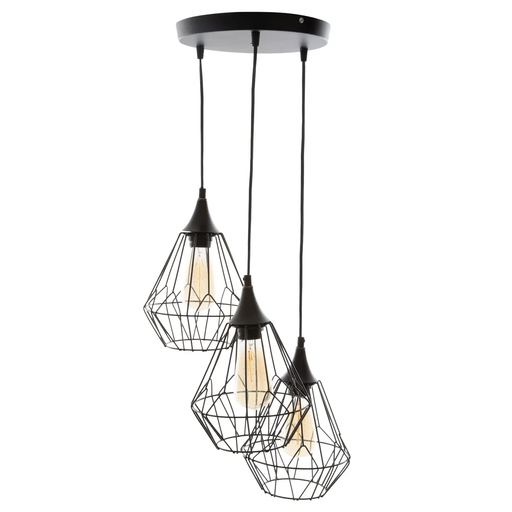
Why it suits this shopper: The three-light design in black-coated steel is suitable for dining rooms, living rooms or kitchens, and takes E27 bulbs up to 40 W.
The E27 fitting makes it clear which bulbs you can choose and replace later. According to the product details, the cables can be adjusted to three lengths: 30, 40 and 50 cm.
Three light points, a steel frame and an industrial look; bulbs are not included.
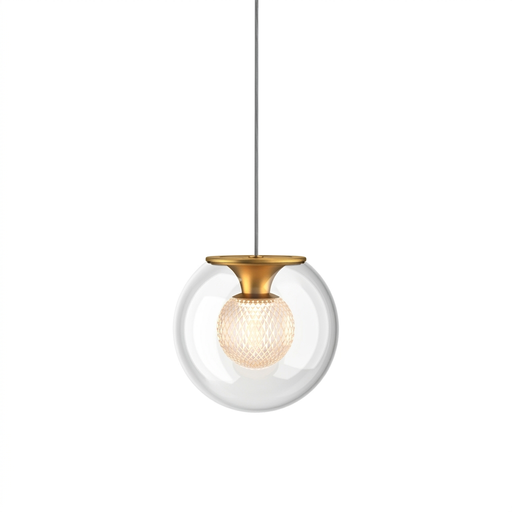
Why it suits this shopper: The gold-coloured design and double-layered glass shade make a striking feature above a dining table or kitchen island.
The product details specify an integrated 7-W LED, 3,000 Kelvin and dimming with a compatible dimmer. Check these requirements before buying a switch.
Hand-blown glass shade, according to the product details; warm white light and an adjustable steel cable.
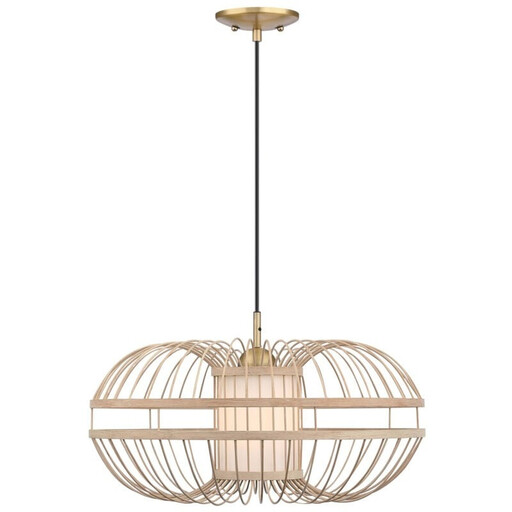
Why it suits this shopper: Bamboo, brushed brass accents and a frosted glass shade combine natural and modern styling for dining rooms, living areas or kitchens.
The product details specify a maximum overall height of 161 cm, a cable length of 127 cm and E27 compatibility up to 60 W. This makes it easier to plan the installation height and choose a bulb in advance.
Designed for flat and sloping ceilings; E27 bulb not included.
Switch off the power before installation. Make sure the ceiling and fixings are suitable for the weight of the light. For hard-wired models or unclear wiring, it’s safest to use a qualified electrician.
Power consumption is the main factor affecting running costs. A 7-W LED uses less energy than a 60-W bulb over the same period, but you can only compare their actual brightness using the lumen rating. With E27 models, you can fit a bulb with the right colour temperature and brightness, and dimmability if required.
We’ve put together a complete, regularly updated list of products that meet these strict selection criteria and fully comply with the safety regulations in force across the EU.
As a practical guide, leave around 60 to 80 cm between the tabletop and the bottom of the shade. The right height also depends on the size of the shade, sightlines and the height of the people using the room. If you’re hanging several lights, space them evenly across the table.
Lifespan depends on the LED module, hours of use, heat dissipation and electrical installation. Check the manufacturer’s figures on the product itself. A built-in LED often isn’t designed to be replaced separately; with an E27 pendant light, you can replace the bulb without replacing the fitting.
Running costs depend on wattage, daily use and your electricity tariff. The simple calculation is: power in kilowatts × hours of use × electricity price. For example, a 10-W light uses 0.01 kWh per hour of operation. For a realistic comparison, you should also take brightness and how you use the light into account.