
Lieferung heute & morgen

Qualitätsgarantie

Willkommens-Angebote freischalten: KOSTENLOSE Lieferung | Bis zu 80 % RABATT | Kostenlose 30-Tage-JoyPlus-Testphase
App herunterladen
A pendant light is often more than just a light source—it's the centrepiece of a room. Whether it's hanging over the dining table, kitchen island, or in the living room, it plays a crucial role in defining the atmosphere. However, the selection is vast, and making a decision can be difficult. The wrong choice can not only strain your budget but also compromise the functionality and aesthetics of an entire space. Many buyers focus on design while overlooking critical technical details that make all the difference in daily use.
Before we dive into the selection criteria, let's look at the three most common problems that arise after purchasing a pendant light. Understanding these pitfalls is the first step toward making an informed decision.
A frequent mistake is choosing a pendant light that doesn't match the size of the table or the room. A lamp that is too small over a large dining table will look lost and fail to illuminate the area adequately. Conversely, an oversized pendant light in a small room or over a delicate table can feel oppressive and out of place. Proportions are key to achieving a harmonious overall look.
Many pendant lights look great in the showroom but produce an unpleasant, glaring light at home. This is particularly problematic for a pendant light over the dining table, where you might look directly into the light source. A good pendant light should direct light downwards or gently diffuse it through a shade to create a warm, inviting atmosphere without any glare.
A light is purchased without considering its installation height or dimmability. A non-adjustable pendant light can hang awkwardly in rooms with low or very high ceilings. Similarly, a non-dimmable light means the intensity can't be adjusted for different situations—from bright task lighting to a soft, ambient glow in the evening.
To avoid the mistakes mentioned above, you should focus on a few objective parameters. These will help you separate the wheat from the chaff and find a light that is both functional and aesthetically pleasing.
The right size and positioning are fundamental. Follow these simple guidelines:
These three terms are crucial for the lighting effect:
The material determines not only the durability but also the style.
Based on the criteria above, we have compiled a few models for different needs and styles.
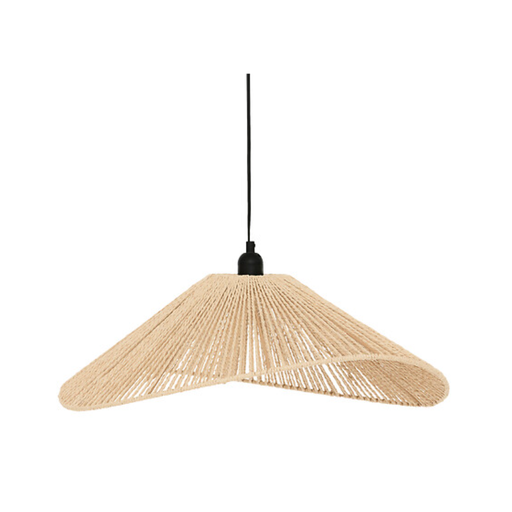
Why it's a great fit: Ideal for those who appreciate a warm and organic atmosphere. The natural paper material and large diameter create a soft, expansive ambient light that perfectly complements Scandinavian or rustic decor.
The paper shade diffuses light evenly and gently. This effectively bypasses the pitfall of glaring light (Pitfall 2) and creates a cosy mood.
Large diameter (58 cm) for broad illumination of large areas; very lightweight material, which simplifies installation.
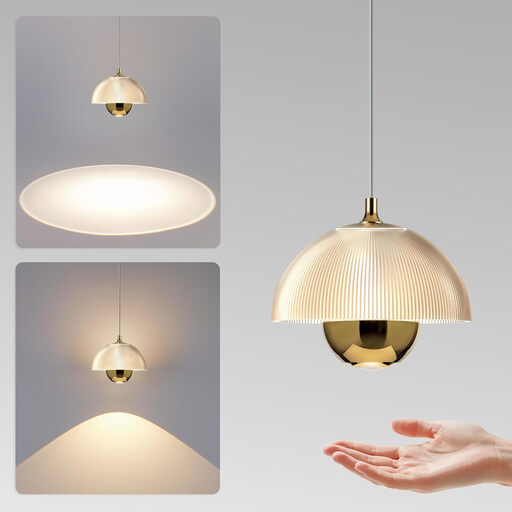
Why it's a great fit: For users who value convenience and modern technology. The touchless sensor control is a unique and hygienic feature, especially for a pendant light in the kitchen or over the dining table.
This model solves the lack of flexibility pitfall (Pitfall 3) with three selectable colour temperatures (2700K/3850K/5000K) and stepless dimming—all controllable with a wave of the hand.
Innovative, touchless control via infrared sensor; adjustable light colour and brightness for any situation.
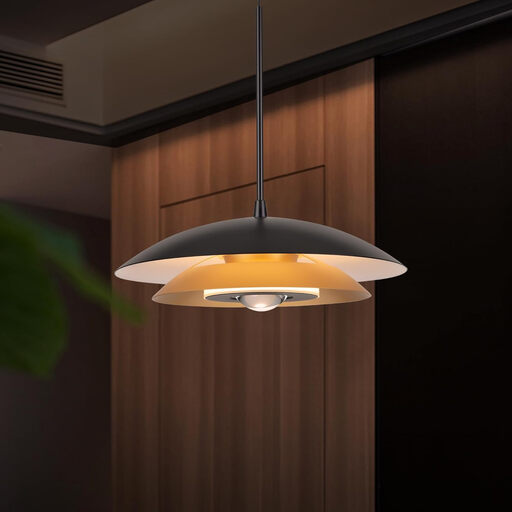
Why it's a great fit: Perfect for creating a modern industrial look. The contrast between the matte black outer shade and the golden interior makes a strong design statement, ideal for lofts or minimalist spaces.
The double-shade construction is specifically designed to prevent glare (Pitfall 2). The outer shade directs the light, while the golden interior reflects it warmly and softly.
Architectural design for glare-free, warm light (3000K); integrated, energy-efficient 12W LED module.
We have compiled a complete, up-to-date list of products that fully meet these strict selection criteria and UK safety regulations.
As a general rule, there should be a distance of 75 to 90 cm between the tabletop and the bottom edge of the lampshade. This height provides optimal illumination of the surface without obstructing the view of the person opposite or getting in the way when you stand up.
No. Dimmability depends on two factors: the light fixture itself and the bulb used. For lights with integrated LEDs, the manufacturer must explicitly state that it is dimmable. For lights with a socket (e.g., E27), you need a bulb marked as "dimmable" and a compatible dimmer switch installed on the wall.
First, check the socket type of the light (e.g., E27, E14, GU10). LED bulbs are the recommended choice due to their high energy efficiency, long lifespan, and low heat emission. Also, always pay attention to the maximum wattage specified by the manufacturer to avoid overheating the fixture.