Batch cooks making larger quantities of pesto
If you regularly make pesto for several meals, consider the recipe quantity, the number of batches needed and the operating limits of the specific appliance together.


If you regularly make larger batches of pesto, a multi-purpose chopper may suit you. A food processor is worth considering if you also want to slice or grate ingredients. Choose based on the amount your recipe actually makes and the filling and operating guidance for the specific model, rather than bowl capacity alone. Plan how to store your homemade pesto separately from your choice of appliance.
If you regularly make pesto for several meals, consider the recipe quantity, the number of batches needed and the operating limits of the specific appliance together.
If you want to control how finely the herbs and nuts are chopped and add the oil to achieve your preferred consistency, ease of use and lid design matter just as much as bowl size.
If you also use the same appliance for slicing or grating, weigh up the extra usefulness of the attachments against the storage space they need and the effort involved in cleaning them.
| Buying consideration | What to look for | Who is it important for? |
|---|---|---|
| Batch size and number of batches | Compare the recipe quantity with the filling and operating guidance for the exact model. | If I’m preparing food for several meals, I want to know whether my recipe quantity will fit in the bowl and how many batches I’ll need. Around 31% of consumers rank batch size as a top buying consideration. |
| Planning for later use | Plan the appliance capacity and storage separately; don’t assume an oil layer guarantees a particular shelf life. | If I’m making pesto for later meals, I don’t want to base my storage plans solely on how it was prepared or on a layer of oil. Around 25% of consumers put safe planning for later use first. |
| Control over texture | Check the chopping blade, pulse function and, where relevant, whether the specific model allows you to add liquid during processing. | If I want to chop herbs and nuts to my liking, I look at how much control I have over the process. Around 19% of consumers say pesto texture is their main buying consideration. |
| Cleaning between batches | Check which removable parts the manufacturer says are dishwasher-safe. | If I need to make several batches, I want to know which parts I’ll need to clean and put away afterwards. Around 13% of consumers consider cleaning effort their top priority. |
| Other tasks besides making pesto | Check that the exact model comes with the slicing and grating discs you actually need. | If I also want to slice or grate vegetables, I need the right attachments, not accessories I’ll hardly use. Around 12% of consumers prioritise other food-preparation tasks. |
Bowl size, maximum fill level and suitability for small quantities are different things. Bowl capacity alone doesn’t tell you how much pesto you can make in one batch.
Compare your recipe quantity with the filling and operating guidance for the exact model, and take small leftover quantities into account too.
Making several batches means extra filling and emptying steps.
F.A.Z. Kaufkompass reviews general-purpose choppers; Rommelsbacher recommends the EGK 200 rather than the MZ 500 for particularly small quantities of pesto. So a general chopper review won’t necessarily tell you whether an appliance suits your portion size.
Consider test results and the manufacturer’s guidance in relation to your batch size and the instructions for the specific model.
Slicing and grating discs are designed for other food-preparation tasks, but they aren’t essential for every pesto recipe.
Choose a model with more attachments if you’ll use the extra functions regularly.
In a recipe booklet, Verbraucherzentrale describes storing pesto under oil for an extended period. However, the German Federal Institute for Risk Assessment advises against making and storing homemade herbs in oil for later use at home. The advice does not relate to exactly the same preparation.
Plan the quantity you make and how you’ll use it separately; don’t assume the appliance or a layer of oil guarantees a particular shelf life.
The MZ 500 is a larger multi-purpose chopper for chopping and puréeing; Rommelsbacher recommends a different appliance for small quantities of pesto.
The MultiTalent 3 MCM3501M is worth considering as a food processor if you also want to slice and grate as well as make pesto.
The MultiPro Express FDP65.820SI is designed for a range of food-preparation tasks, while the Easy Chop CHP61.100WH is a smaller chopper for making separate batches.
The 5KFC0516 chopper may appeal if pulse control and the option to add oil while processing matter to you.
The KÜCHENminis chopper is a compact option if you’re happy to divide a larger recipe into small batches.
This selection includes electric choppers in a range of bowl sizes, from a model with several bowl options to a mini chopper for smaller portions of pesto. Bowl size alone doesn’t determine how much pesto you can process at once.
 No image available
Three bowl sizes give you options for different quantities of ingredients. Compare the intended amount of pesto with the filling and operating guidance.
 No image available
The 2-l bowl may be suitable for preparing several ingredients, provided its intended fill level and operating cycles work with your recipe.
 No image available
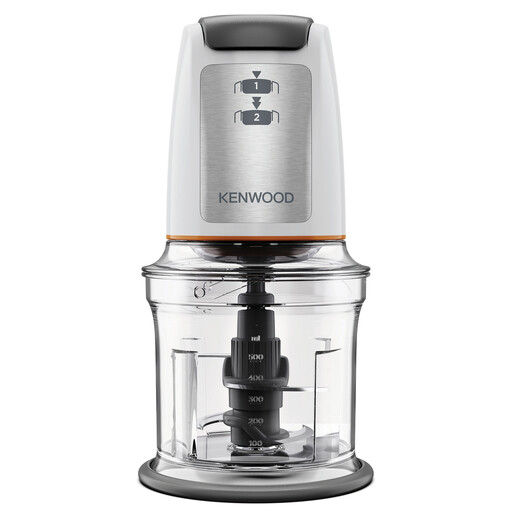
The product description recommends this mini chopper for small to medium portions of pesto; larger recipes may need to be split into several batches.
No, the capacity in litres isn’t enough on its own. Rommelsbacher uses the figure for the MZ 500 to describe its bowl capacity; for the MultiPro Express FDP65.820SI, Kenwood gives a separate working capacity for liquids as well as the bowl capacity. Compare your recipe quantity with the filling and operating guidance for the exact model.
Check the lid design of the specific model and follow its instruction manual. KitchenAid lists a drizzle basin and pulse function for the 5KFC0516 chopper; don’t assume other models have the same features.
You can’t use this as a general rule for safe storage. In a recipe booklet, Verbraucherzentrale describes storing pesto under oil for an extended period; the German Federal Institute for Risk Assessment advises against making and storing homemade herbs in oil for later use at home. The advice does not relate to exactly the same preparation. So don’t rely on a layer of oil or the appliance you used as proof of how long your homemade pesto will keep.
No, you can’t assume this for every model. Rommelsbacher describes the MZ 500’s removable parts as dishwasher-safe. For other models, check the guidance for each part individually, paying particular attention to the instructions for the motor unit.
No. The European Union describes the CE mark as the manufacturer’s declaration that the product meets the EU requirements that apply to it, not as approval by a central EU body. The requirements that apply to a specific appliance need to be assessed based on that product.