
Lieferung heute & morgen

Qualitätsgarantie

Willkommens-Angebote freischalten: KOSTENLOSE Lieferung | Bis zu 80 % RABATT | Kostenlose 30-Tage-JoyPlus-Testphase
App herunterladen
For managing large properties or tackling demanding gardening, landscaping, and forestry work, powerful and reliable tools are essential. Where cordless devices reach their limits and power cables restrict your range, petrol garden tools offer the necessary power and freedom. However, selecting the right tool depends on a careful analysis of its technical specifications. This guide is designed to provide you with objective information and highlight the key criteria for making an informed decision.
The decision to invest in a petrol-powered garden tool should be based on clearly defined technical parameters and its intended use. Three main aspects are particularly relevant.
The performance of a petrol engine is primarily determined by its displacement (in cubic centimetres, cm?) and power output (in kilowatts, kW, or HP). A larger displacement generally allows for higher torque, which is crucial for cutting thick branches, felling trees, or mowing dense undergrowth. Professional-grade garden tools for forestry often have a displacement of over 50 cm?, while tools for semi-professional or private use on large areas are typically in the 25 to 50 cm? range.
A 4-in-1 petrol multi-tool combines several functions in one unit, typically a brush cutter, a petrol hedge trimmer, a pole pruner, and sometimes a chainsaw. Such a petrol garden tool set offers excellent flexibility and value for money for users who need to perform a variety of tasks. In contrast, specialised single-purpose tools like a dedicated petrol chainsaw or hedge trimmer are often optimised for maximum performance and ergonomics for a specific job, making them the preferred choice for intensive, repetitive work.
The weight and balance of a tool are critical for fatigue-free operation. Anti-vibration systems reduce the strain transferred to the hands and arms, which is particularly important during long periods of use. Adjustable handles and well-designed carrying harnesses, common on brush cutters and pole pruners, improve control and safety during operation.
Based on the criteria mentioned above, we have compiled a selection of tools that are well-suited for various applications due to their technical specifications.
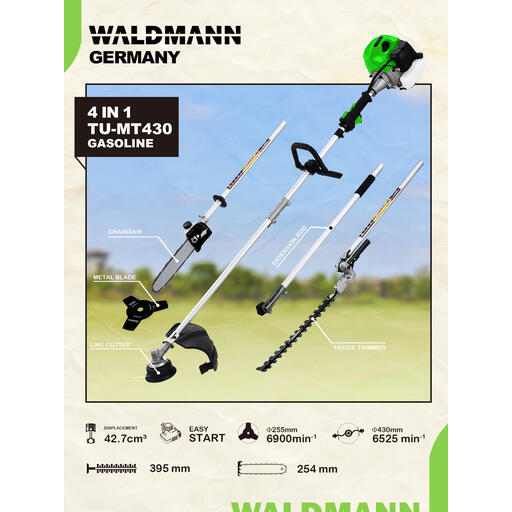
Why it stands out: This 4-in-1 system combines the functionality of four separate garden tools into a single motorised unit. The powerful engine, with 42.7 cm? displacement and 1.35 kW of power, delivers the necessary force for all included attachments.
Advantages:
Who it's for: Property owners and semi-professional users looking for a versatile and cost-effective system for a wide range of maintenance tasks, from lawn edging to high-reach tree care.

Why it stands out: The HT262 is designed as a specialised petrol hedge trimmer, built for efficiency and ergonomics. The rear handle, adjustable by 90° in both directions, allows for a comfortable posture during vertical and horizontal cuts.
Advantages:
Who it's for: Users with large, formal hedges, as well as gardeners and landscapers who need a robust and ergonomic specialised tool for professional hedge trimming.

Why it stands out: This petrol chainsaw, with a displacement of 53.2 cm? and a rated power of 2.0 kW (2.7 HP), is clearly designed for demanding sawing and felling work. It belongs in the category of high-performance forestry tools.
Advantages:
Who it's for: Experienced private users, forest owners, and semi-professional users who need a powerful and reliable chainsaw for demanding tasks like processing firewood or felling trees.
The models presented here cover specific use cases. If you haven't found the right tool for your project yet, or if you'd like to compare more technical specifications, you can find a wider selection in our range.
Discover our full range of petrol-powered tools in the Fuel category and find the perfect tool for your project.
The choice depends on the application. Petrol garden tools generally offer higher peak performance and unlimited runtime (as long as fuel is available), making them ideal for large areas and heavy-duty work. Cordless tools are quieter, emission-free during operation, and require less maintenance, but are better suited for small to medium-sized properties and tasks where maximum power is not the deciding factor.
Most 2-stroke petrol engines, like those used in many garden tools, require a mixture of petrol and 2-stroke engine oil. The mixing ratio is specified by the manufacturer and must be followed precisely to avoid engine damage. Many modern devices, including the WALDMANN models presented here, require a 40:1 ratio (1 part oil to 40 parts petrol). Always consult your tool's operating manual for the correct specifications.
Regular maintenance is crucial for longevity and safety. Basic maintenance tasks include cleaning the tool after each use, checking and cleaning the air filter, inspecting the spark plug, and sharpening and oiling cutting attachments (e.g., chainsaw chains or hedge trimmer blades). For chainsaws, it is also essential to regularly check the chain tension and the function of the chain brake.