
Lieferung heute & morgen

Qualitätsgarantie

Willkommens-Angebote freischalten: KOSTENLOSE Lieferung | Bis zu 80 % RABATT | Kostenlose 30-Tage-JoyPlus-Testphase
App herunterladen
The search for the right frying pan can quickly become overwhelming. Especially with ceramic pans, which are marketed as a healthy alternative to conventional non-stick pans, there are pitfalls that lead to disappointment and unnecessary expense. Many home cooks find that the promised non-stick effect wears off quickly or that the pan doesn't work properly on their induction cooktop.
As a Joybuy Product Recommendation Officer, I'll help you distinguish marketing promises from genuine performance features. This guide focuses on the three most common problems and shows you what to look for to find a durable and safe PFAS-free ceramic pan.
To avoid these pitfalls, you should check three core technical parameters before buying. These are the key determinants of your new pan's longevity, performance, and safety.
A high-quality ceramic coating is based on sol-gel technology and is naturally free of plastics like PTFE. However, its robustness depends on its composition and multi-layer structure.
For those using an induction cooktop, the base is the most important part of the pan. A good pan for induction needs a base with specific properties.
Additional features determine how flexible and practical a pan is for everyday use.
Based on the criteria above, we have identified a few models suitable for different user profiles and requirements.
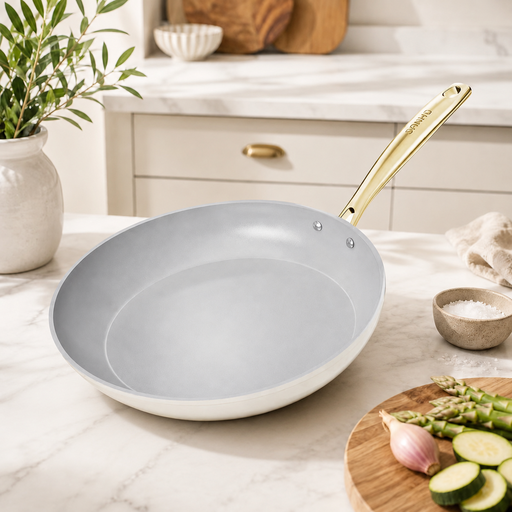
Why This Fits Their Persona: Ideal for small families and daily use. The 26cm (10-inch) size is versatile for everything from pancakes to sautéed vegetables. Its oven-safe feature allows for finishing dishes like frittatas directly in the pan.
The patented diamond-titanium coating is designed for longevity, countering the problem of short-lived non-stick performance. The encapsulated stainless steel base ensures efficient and even heat distribution on induction cooktops.
Completely PFAS, PFOA, and PTFE-free. The high oven-safe temperature of up to 260°C (500°F) makes it extremely versatile for recipes that start on the stove and finish in the oven.

Why This Fits Their Persona: Perfect for small kitchens, RVs, or anyone who values a tidy setup. The set stacks for extremely compact storage and covers most common cooking needs with its various sizes.
The 3-ply stainless steel construction ensures solid performance on induction cooktops, bypassing the pitfall of poor induction suitability. The diamond-titanium ceramic coating provides the necessary durability.
The main feature is the detachable handle, which allows for up to 70% space savings. The complete induction cookware set is also dishwasher and oven-safe (up to 250°C / 480°F).
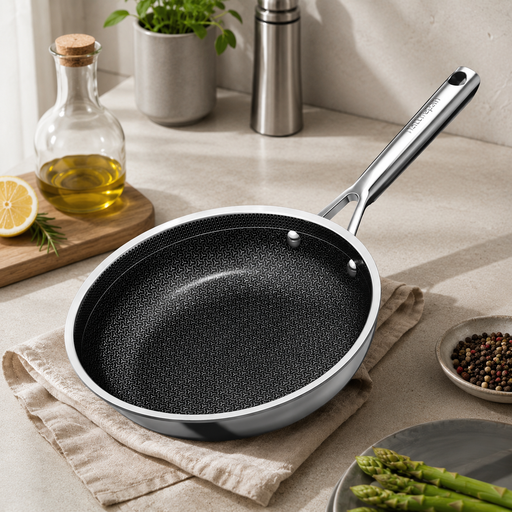
Why This Fits Their Persona: For cooks who want to combine the high-heat searing of stainless steel with the non-stick properties of a coated pan. Ideal for steaks, pan-fried potatoes, or dishes that require a good crust.
The laser-etched hexagonal surface protects the non-stick coating in the valleys from scratches and wear. The raised stainless steel pattern allows for direct searing, bypassing the drawbacks of pure ceramic pans at high temperatures.
The 5-ply hybrid construction offers excellent heat control. The combination of stainless steel and ceramic allows for high-heat searing without sticking. It is PFAS-free and oven-safe up to 260°C (500°F).
We have compiled a complete, up-to-date list of products that fully meet these strict selection criteria.
The lifespan of a ceramic pan depends heavily on the quality of the coating and proper care. A coating reinforced with titanium or diamond particles is more resilient. To maximise its lifespan, you should follow these tips:
The health advantage of a ceramic pan is that it is free from PFAS, PFOA, and PTFE. When conventional PTFE-coated pans are overheated (above 260°C / 500°F), they can release potentially harmful fumes. Since ceramic coatings do not contain these substances, this risk is eliminated. This makes them a safe choice for everyday cooking, especially for health-conscious households.
You can identify a good induction pan by its base. It should be thick, flat, and magnetic. Hold a magnet to the base—if it sticks strongly across the entire surface, it is suitable. In the product description, look for terms like "multi-layer base" or "encapsulated stainless steel base". These constructions ensure fast and even heat transfer from the induction cooktop to the pan.