
Lieferung heute & morgen

Qualitätsgarantie

Willkommens-Angebote freischalten: KOSTENLOSE Lieferung | Bis zu 80 % RABATT | Kostenlose 30-Tage-JoyPlus-Testphase
App herunterladen
The search for the right frying pan can quickly become overwhelming. Especially when it comes to a PFAS-free ceramic pan, many manufacturers promise durability and health safety. However, not every product lives up to its promise. Many buyers find that after just a few months, the non-stick effect fades or the pan warps on the stovetop. This guide will show you the crucial features to look for and help you make an informed decision that fits your cooking habits.
Before we dive into the important features, let's shed light on the typical problems that lead to disappointment. Recognising these pitfalls is the first step toward a satisfying purchase.
To avoid the problems mentioned above, you should focus on three core technical features. These define the quality and longevity of a pan without PFAS.
Not all ceramic-coated pans are created equal. Durability heavily depends on the composition. Simple coatings are susceptible to scratches and wear. Look for models whose ceramic layer is reinforced with particles like diamond or titanium. These additives significantly increase the surface's mechanical resistance and abrasion-proof qualities, leading to a longer lifespan for the non-stick properties and enabling sustained healthy cooking with little fat. Such pans are consistently PFOA-free and free from other per- and polyfluoroalkyl substances (PFAS).
For optimal performance, especially on induction hobs, a multi-layered, warp-resistant base is essential. A good pan base consists of a ferromagnetic core (usually stainless steel) enclosed by layers of aluminium. This construction ensures two things:
A pan's oven-safe temperature is limited by its least heat-resistant component.
Based on the criteria above, we have identified a few models that are suitable for different user profiles and requirements.
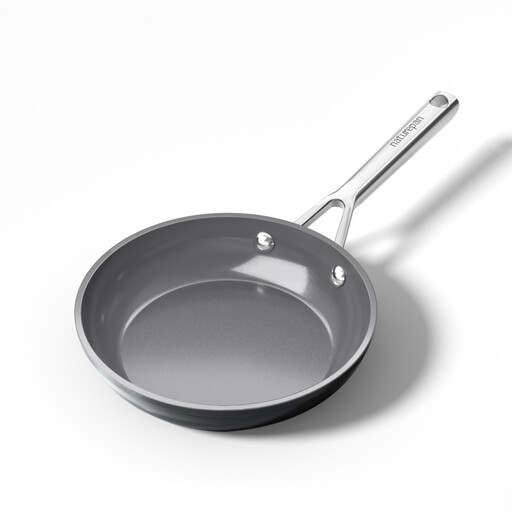
Why This Fits Their Persona: Ideal for small households or quickly preparing single portions like fried eggs or omelettes. Its compact size saves space and is quick to heat up and clean.
The ceramic coating reinforced with diamond and titanium particles counteracts the problem of a short-lived non-stick effect. The optimised base ensures even heat distribution.
High versatility: Suitable for all hob types, including induction, and oven-safe up to 260°C thanks to the stainless steel handle.
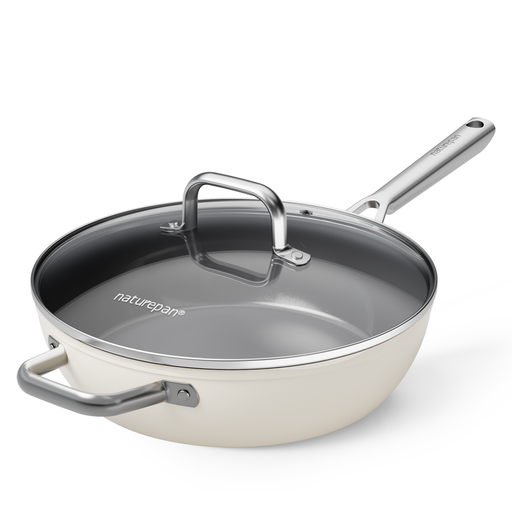
Why This Fits Their Persona: The large 28cm pan with a high rim and lid is perfect for family meals, stews, sauces, and one-pot meals. It offers ample volume and prevents splatters.
The robust, reinforced coating can withstand frequent use. The high rim and included lid solve the problem of grease splatters with larger dishes.
Maximum flexibility for various cooking methods (frying, braising, steaming). The stainless steel handle allows for a seamless transition from hob to oven (up to 260°C).
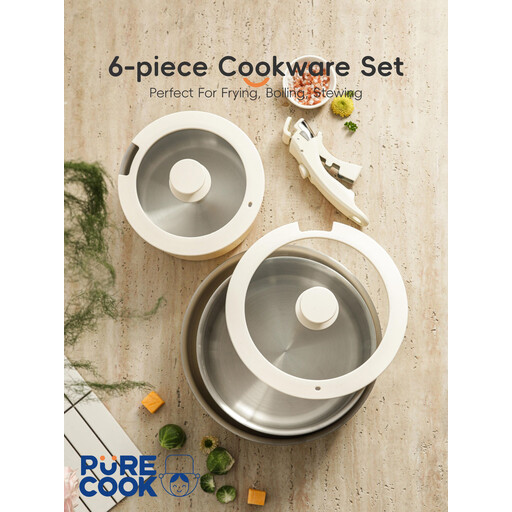
Why This Fits Their Persona: This set is designed for cooks who value modularity and easy storage. The detachable handle allows the pots and pans to be stacked inside one another to save space.
The detachable handle completely solves the problem of limited oven-safety. The pots can be used in the oven without the handle. The 304 stainless steel interior is extremely durable.
The set is stackable and saves valuable kitchen cabinet space. The combination of a stainless steel interior and ceramic exterior offers durability and easy cleaning.
We've compiled a complete, up-to-date list of products that fully meet these strict selection criteria and safety standards.
To maintain the non-stick properties, you should follow a few basic rules. Avoid extreme heat and never heat the pan empty. Only use wooden, silicone, or plastic utensils. Even if many pans are declared dishwasher-safe, washing by hand with a soft sponge and mild detergent is gentler and significantly extends the coating's life.
The essential difference lies in the material composition. Ceramic coatings are free of PFAS (per- and polyfluoroalkyl substances), which include PFOA and PTFE (known by the brand name Teflon). A pan without PFAS does not release potentially harmful fumes, even if accidentally overheated. This makes it a stable choice for health-conscious cooking, as long as the coating is intact.