
Lieferung heute & morgen

Qualitätsgarantie

Willkommens-Angebote freischalten: KOSTENLOSE Lieferung | Bis zu 80 % RABATT | Kostenlose 30-Tage-JoyPlus-Testphase
App herunterladen
The search for a new frying pan leads many health-conscious consumers to the ceramic pan, which is marketed as a PFAS-free alternative to traditional non-stick pans. However, the market can be difficult to navigate, and not every product lives up to its promises. Before you make a decision, it's crucial to understand the common pitfalls that often lead to disappointment and rapid wear and tear.
As your Joybuy Product Recommendation Officer, I'm here to help you separate marketing claims from verifiable facts. We'll shed light on the three most common issues with ceramic pans:
This guide will show you which technical features to look for to find a durable, high-performance, and healthy pan.
To make an informed purchasing decision, you should examine three core parameters. These determine the longevity, functionality, and safety of your new ceramic-coated frying pan.
A non-stick pan without PFAS is typically based on a mineral-based sol-gel coating. It is free from per- and polyfluoroalkyl substances (PFAS), including PTFE and PFOA. However, its actual performance and durability depend on the quality and composition of this layer.
Look for the following features:
Compatibility with your cooktop is crucial. The base's construction is especially important for a ceramic pan for induction.
The ability to move a pan from the stovetop directly into the oven significantly expands your cooking options. Whether a pan is oven-safe primarily depends on the handle's material.
Instead of making generic recommendations, we have identified models tailored to specific user profiles and needs.
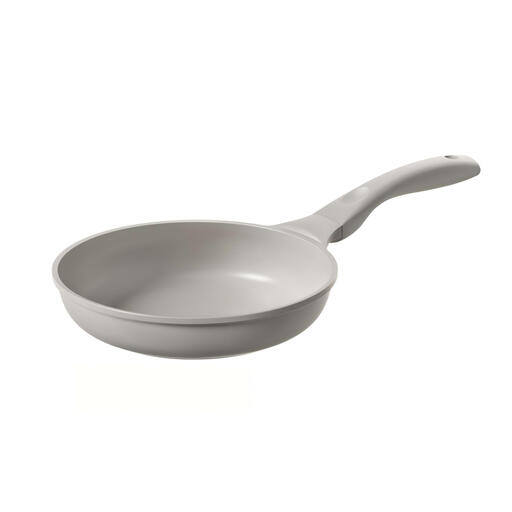
Why This Fits Their Persona: Ideal for daily use, from fried eggs to sautéed vegetables. The hassle-free cleaning (dishwasher-safe) and universal cooktop compatibility make it a reliable tool for quick, everyday cooking.
The explicitly scratch-resistant, PFAS-free coating addresses the problem of short-lived performance. The thickened base ensures solid performance on induction cooktops, avoiding the "false compatibility" pitfall.
Fast, even heat distribution on all cooktop types; dishwasher-safe for effortless cleaning.
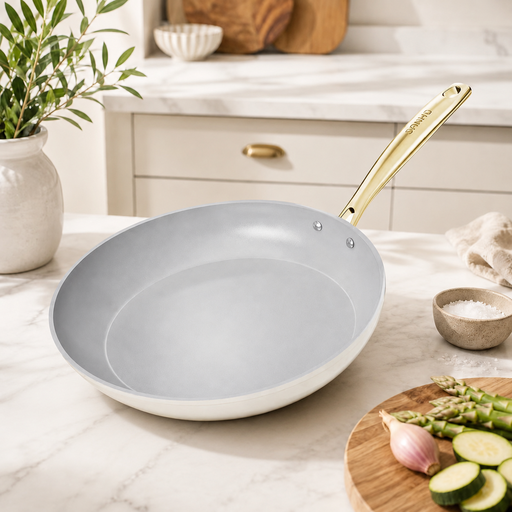
Why This Fits Their Persona: Perfect for cooks who value durability and versatility. Its high oven-safe temperature allows for complex recipes that require a seamless transition from stovetop to oven, like searing a steak or finishing a gratin.
The patented diamond-titanium coating directly addresses concerns about rapid wear. The high oven-safe temperature of 260°C exceeds the standard, offering true professional-grade functionality that many cheaper models lack.
Extremely robust, reinforced coating for a long lifespan; high oven-safe temperature (up to 260°C) for maximum cooking flexibility.
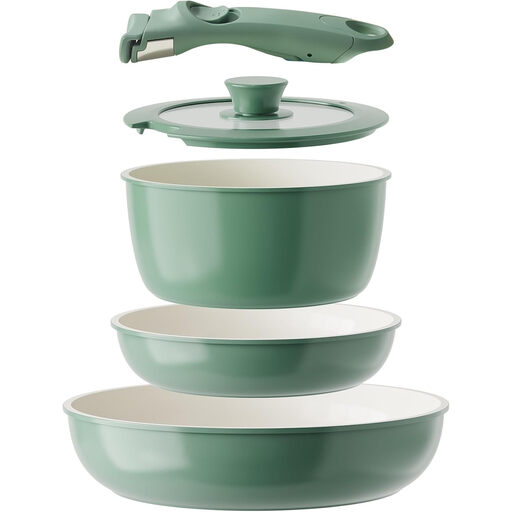
Why This Fits Their Persona: The perfect solution for small kitchens, RVs, or anyone who values organization and efficiency. The stackable design with a detachable handle saves up to 75% of cabinet space and makes the set extremely versatile.
This set solves a problem that individual pans create: lack of space. Instead of offering just one function, it serves as a cooking, baking, serving, and storage system. The high oven-safe temperature (up to 450°C without the handle) is a clear indicator of quality.
Extremely space-saving thanks to its stackable design and detachable handle; versatile for everything from cooking and baking to serving.
We have compiled a complete, up-to-date list of products that fully meet these strict selection criteria and safety regulations.
To preserve the non-stick properties, you should follow a few basic rules:
High-quality ceramic coatings are very durable. If small particles should come loose due to severe mechanical damage (e.g., from scratches), they are considered harmless because the coating is mineral-based and made without harmful substances like PFAS. Unlike damaged PTFE coatings, no harmful fumes are released when overheated. However, a heavily scratched pan will lose its non-stick effectiveness and should be replaced.
You can identify a good ceramic pan for induction by its thick, solid base, often described as a "sandwich" or "encapsulated" base. It should be fully magnetic across its entire surface. A simple test: if a magnet holds firmly across the entire bottom of the pan, good energy transfer on an induction cooktop is likely. A heavier pan is also often an indicator of a solid, heat-retentive base.