
Lieferung heute & morgen

Qualitätsgarantie

Willkommens-Angebote freischalten: KOSTENLOSE Lieferung | Bis zu 80 % RABATT | Kostenlose 30-Tage-JoyPlus-Testphase
App herunterladen
As your Joybuy Product Recommendation Officer, I see every day how customers are misled by unclear product descriptions and marketing hype. The confusion is especially high when searching for a healthy and durable frying pan. Many people choose a ceramic pan assuming they've found a non-toxic and robust alternative to conventional non-stick pans, only to be disappointed a few months later.
Before you make a decision, you should know the three most common pitfalls that lead to a bad purchase:
To make an informed decision that meets your cooking habits and quality standards, you should check three core parameters. These features determine longevity, safety, and cooking performance.
Since it's usually a ceramic-coated pan, the underlying material is crucial for heat conduction and distribution.
A healthy pan should be free of harmful chemicals. Precision is key here:
The ability to move a pan from the hob directly into the oven significantly expands your cooking options.
Based on the criteria above, we have identified several models that represent a considered choice for different needs and cooking styles.
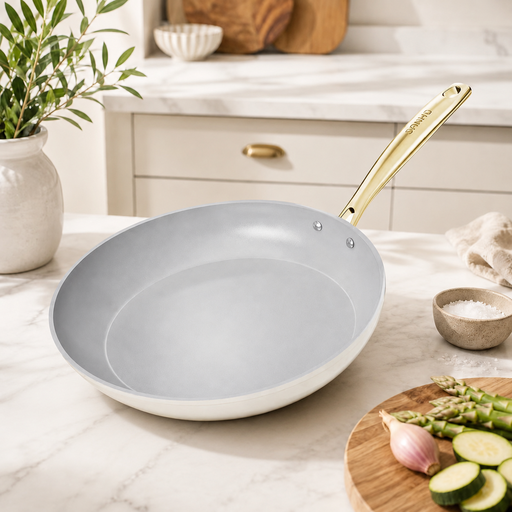
Why This Fits Their Persona: Ideal for daily use in families. The 26 cm size is versatile for everything from pancakes to chicken fillets. The high oven-safe temperature allows for flexible cooking methods without having to switch pans.
The patented diamond-titanium coating offers greater resilience than standard ceramic, addressing the problem of rapid wear. It is explicitly declared as PFAS-free, bypassing the vague "non-toxic" trap.
High oven safety up to 260°C and compatibility with all hob types, including induction. The ergonomic handle stays cool on the hob.
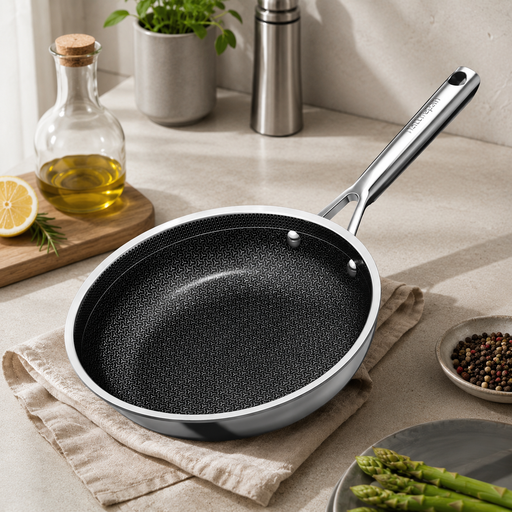
Why This Fits Their Persona: Perfect for ambitious cooks who want to combine high-heat searing with non-stick properties. The hybrid surface allows for searing steaks with a crust, while delicate foods won't stick. The size is ideal for family-sized portions.
The laser-etched hexagonal pattern with raised stainless steel ridges protects the underlying ceramic coating from direct contact with metal utensils. This is a structural solution to the scratch-resistance problem.
Combines the benefits of stainless steel (searing) and ceramic (non-stick). The 5-ply construction ensures excellent heat distribution, and the pan is oven-safe up to 260°C.
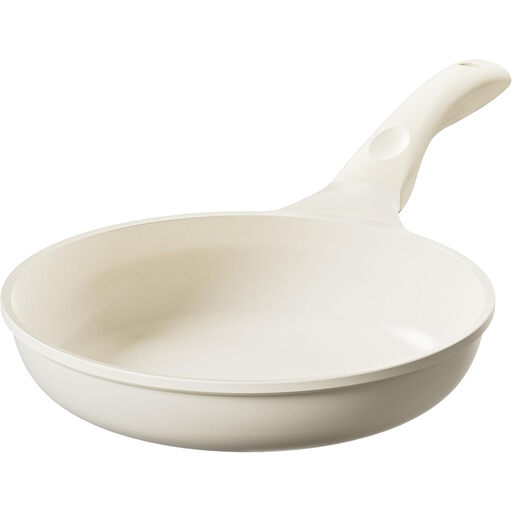
Why This Fits Their Persona: A solid and reliable pan for daily needs in smaller households. The 24 cm size is ideal for cooking eggs, vegetables, or single portions of meat without taking up much cupboard space.
This model is clearly designated as PTFE/PFOA/PFAS-free, providing the safety that health-conscious buyers are looking for. It avoids exaggerated durability claims and focuses on reliable non-stick performance for everyday use.
Very easy to clean and compatible with all hob types, including induction. The ergonomic Bakelite handle stays cool during cooking on the hob.
We have compiled a complete, up-to-date list of products that fully meet these strict selection criteria and German safety regulations.
The lifespan of a ceramic coating depends heavily on its quality, use, and care. With proper care—avoiding metal utensils, hand washing, and preventing overheating—a high-quality coating can last for several years. Cheaper models often show a noticeable loss of non-stick properties after just a few months.
It is generally not recommended. Even if some manufacturers advertise high scratch resistance, the coating is more delicate than uncoated stainless steel or cast iron. To maximise its lifespan, you should use utensils made of wood, silicone, or heat-resistant plastic. The exception is hybrid pans with a protected surface.
An induction-compatible pan must have a magnetisable base. Look for the coil symbol (a stylised spiral) on the packaging or the bottom of the pan. Another quality feature is a thick, full-surface "sandwich base" that absorbs heat evenly from the induction field and distributes it throughout the entire pan body. This ensures even cooking results.