
Lieferung heute & morgen

Qualitätsgarantie

Willkommens-Angebote freischalten: KOSTENLOSE Lieferung | Bis zu 80 % RABATT | Kostenlose 30-Tage-JoyPlus-Testphase
App herunterladen
The search for the right PFAS-free ceramic pan for induction can quickly become overwhelming. Manufacturers advertise durability and health benefits, but not every product delivers on its promise. As a Joybuy Product Recommendation Officer, I'll help you identify the crucial features and avoid common purchasing traps, so you can make an informed decision for your kitchen.
Many buyers invest in a new frying pan with a ceramic coating, assuming they are getting a durable and healthy alternative, only to find that the non-stick effect fades or the pan base warps after just a few months. This is often due to three common problems:
To avoid a bad purchase, you should check three key technical parameters before making a decision. These are the primary determinants of your new pan's performance, safety, and longevity.
The main reason for buying a ceramic pan is often the desire to avoid potentially harmful chemicals. Here are the key terms:
A pan for induction needs a ferromagnetic base to efficiently convert the hob's energy into heat. A high-quality base is characterised by the following features:
A pan's versatility is demonstrated by its additional uses:
Based on the criteria above, we have identified several models that are particularly well-suited for specific user profiles.
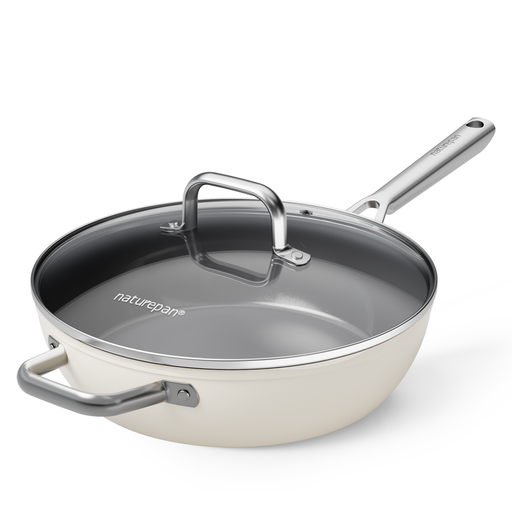
Why this model is a great fit: With its 28 cm diameter, high sides, and matching lid, this pan is ideal for family-sized portions, braised dishes, or one-pot pasta. It's an all-rounder for daily, intensive use.
The ceramic coating, reinforced with diamond and titanium particles, is designed for longevity. The stainless steel handle and oven-safe rating up to 260°C also make it extremely versatile and resilient.
The combination of high sides, a lid, and oven-safe properties allows it to function as both a frying pan and a casserole dish, saving space and money.
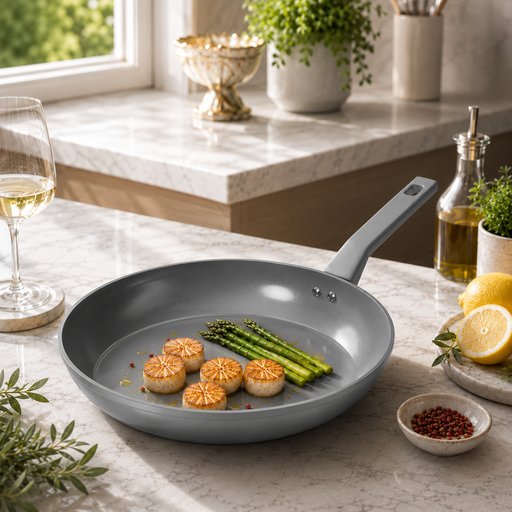
Why this model is a great fit: The compact 20 cm size is perfect for singles, couples, or for preparing eggs and small side dishes. It's space-saving and ideal for getting started with PFAS-free cooking.
Despite its accessible price point, the pan features a diamond-titanium ceramic coating and a multi-layered base with a stainless steel plate, ensuring fast and even heat distribution on induction hobs.
The pan is explicitly certified free of PFAS, PFOA, lead, and cadmium, offering a high degree of safety. The wood-look Bakelite handle stays cool on the hob.
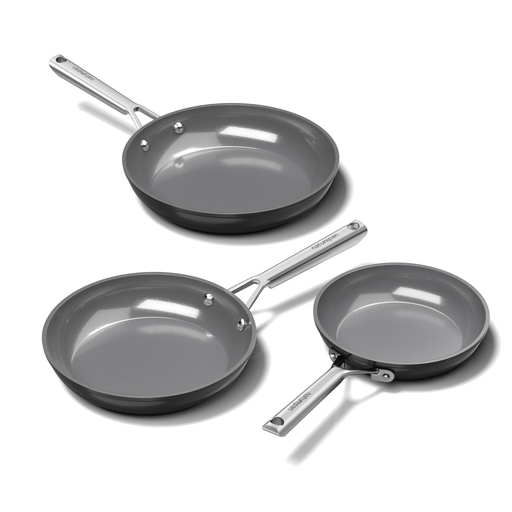
Why this model is a great fit: This **ceramic pan set** covers all common sizes and provides a uniform, high-quality setup for any cooking situation—from a small omelette to a large Sunday roast.
All three pans share the same quality features: a reinforced diamond-titanium coating, an induction-optimised base, and stainless steel handles that allow for oven use up to 260°C. This prevents quality inconsistencies in your kitchen equipment.
Buying a set often offers a price advantage over purchasing individual pans and ensures that all pieces have the same performance and care requirements.
We have compiled a complete, up-to-date list of products that fully meet these strict selection criteria and UK safety regulations.
The lifespan of a ceramic-coated pan depends heavily on the quality of the coating and its care. With daily use and correct handling (using wood or silicone utensils, avoiding overheating, hand washing), a high-quality coating can last for several years. Inexpensive, thin coatings can lose their non-stick properties after just a few months.
Yes, using oil or fat is actually recommended. Although ceramic pans have good non-stick properties, a small amount of oil helps to protect the surface and achieve an even better searing result. It's best to use oils with a high smoke point, such as rapeseed or sunflower oil, and avoid overheating the empty cookware.
Pay attention to the product description: a thick, multi-layered base with an explicitly mentioned stainless steel plate is a clear sign of quality. Details about the base thickness (e.g., 5 mm) are also a good indicator. A solid weight often suggests a more robust construction and better heat retention.