
Lieferung heute & morgen

Qualitätsgarantie

Willkommens-Angebote freischalten: KOSTENLOSE Lieferung | Bis zu 80 % RABATT | Kostenlose 30-Tage-JoyPlus-Testphase
App herunterladen
For many health-conscious cooks, the search for a new frying pan leads to the ceramic pan, which is marketed as a PFAS-free alternative to conventional non-stick pans. However, the market is confusing, and not every product delivers on its promises. Before you make a decision, it's crucial to understand the common pitfalls that often lead to disappointment and unnecessary expense.
As your Joybuy Product Recommendation Officer, I'm here to help you separate marketing hype from fact. Here are the most common problems and what you need to look for to find a truly durable frying pan.
Many buyers invest in a supposedly healthy pan, only to find that the non-stick effect diminishes after just a few months or that the pan is unsuitable for their hob. Pay close attention to these three critical points:
To avoid a bad purchase, you should focus on the technical specifications that define a high-quality ceramic-coated frying pan.
A non-stick pan without PTFE and other per- and polyfluoroalkyl substances (PFAS) is typically based on a ceramic sol-gel coating. The crucial difference lies in the reinforcement of this material. Look for coatings that are reinforced with particles like diamond or titanium. These additives significantly increase the mechanical resistance and longevity of the non-stick layer. Such a pan is not only a pan free from harmful substances but also an investment that pays off for years.
For owners of induction hobs, the base of the pan is the most critical component. A high-quality base should be fully encapsulated and made from a ferromagnetic material (like stainless steel). This ensures two things:
A pan's versatility is demonstrated by its heat resistance. If you want to sear your dishes on the hob and finish them in the oven, you need an oven-safe pan. Check the maximum temperature resistance. Solid stainless steel handles are often the most reliable choice here, as they can withstand high temperatures and, with the right design, stay cool on the hob. Pans with plastic handles are usually only oven-safe up to about 150-180°C (300-350°F), which is not sufficient for many recipes.
Based on these objective criteria, we have identified several products that are suitable for different user profiles and their specific requirements.
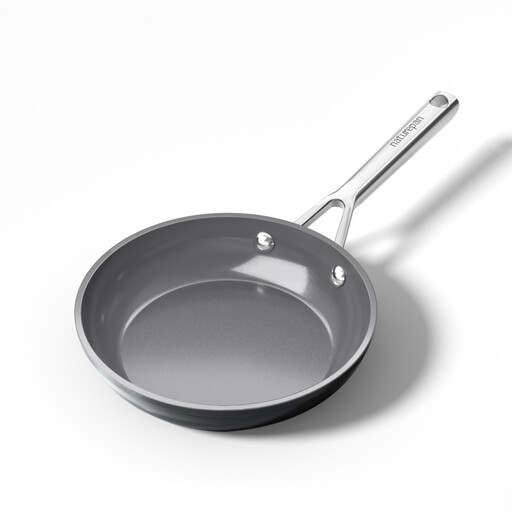
Why it's a good match: This compact 20cm induction pan is ideal for single-person households, a quick fried egg, or small side dishes. It's space-saving and easy to handle.
The ceramic coating, reinforced with diamond and titanium particles, counteracts the problem of short lifespan and ensures durable non-stick performance.
The optimised base ensures fast, even heat distribution on all hob types, including induction, and is oven-safe up to 260°C (500°F).
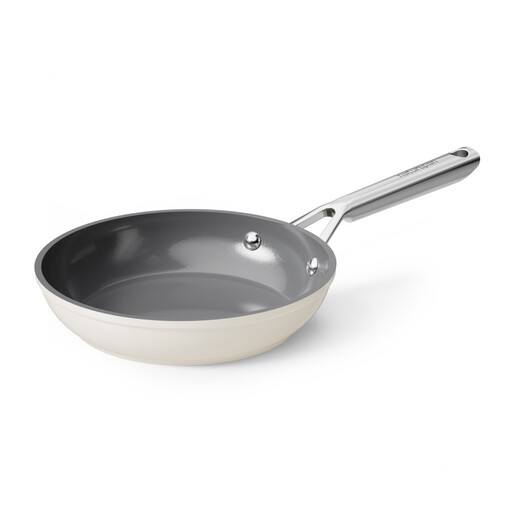
Why it's a good match: With a 24cm diameter, this pan offers ample space for meals for 2-3 people. It is robust enough for daily use in a family kitchen.
The solid construction and a base optimised for all hob types prevent uneven heat distribution, which is critical for larger pans on induction hobs.
The combination of size, durable coating, and oven-safety (up to 230°C / 445°F) makes it a versatile and **durable frying pan** for everyday family life.
We have compiled a complete, up-to-date list of products that fully meet these strict selection criteria and German safety regulations.
1. How do I properly care for a ceramic pan to extend its lifespan? To maintain the non-stick properties, you should wash the pan by hand with a soft sponge and mild dish soap, even if it is labelled as dishwasher-safe. Avoid metal utensils and use tools made of wood, silicone, or plastic instead. Never heat the pan empty on the highest setting.
2. Are ceramic pans really a safer alternative to PTFE pans? Ceramic non-stick coatings are manufactured without the use of PFAS, PFOA, and PTFE. This means that even if accidentally overheated, no potentially harmful fumes are released. For this reason, they are considered a healthy choice for anyone who values pans free from harmful substances.
3. How can I identify a high-quality, induction-compatible ceramic pan? Look for a thick, magnetic, and perfectly flat pan base. An indicator of quality is a "full-surface" induction base that covers the entire underside, rather than just an embedded perforated plate. Additionally, manufacturers of high-quality pans often state the weight—a heavier pan usually indicates a more solid, warp-resistant base.