
Lieferung heute & morgen

Qualitätsgarantie

Willkommens-Angebote freischalten: KOSTENLOSE Lieferung | Bis zu 80 % RABATT | Kostenlose 30-Tage-JoyPlus-Testphase
App herunterladen
The search for a new frying pan can quickly become overwhelming. Especially when it comes to a healthy pan free from potentially harmful chemicals, consumers encounter a lot of promises and marketing jargon. Finding a PFAS-free frying pan is the goal for many health- and eco-conscious households. However, not every pan advertised as "green" or "natural" delivers on its promise. This guide will help you identify the crucial features and avoid common buying mistakes.
Before you make a decision, you should be aware of three common problems that often only become apparent after a few weeks of use and lead to disappointment.
To avoid these pitfalls, focus on three objective criteria that determine the quality and longevity of your new pan.
The most common alternative to traditional PTFE coatings (a form of PFAS) is a ceramic coating. This is based on a sol-gel process, where an inorganic, mineral-based layer is applied. It is naturally free of PFAS, PFOA, and PTFE.
The base is the foundation of any good pan. For optimal performance, especially on induction hobs, a multi-layered construction is crucial.
A scratch-resistant pan remains functional for longer. Its durability depends directly on the material and craftsmanship.
Instead of making a blanket recommendation, we have selected products for different user profiles that meet the criteria mentioned above.
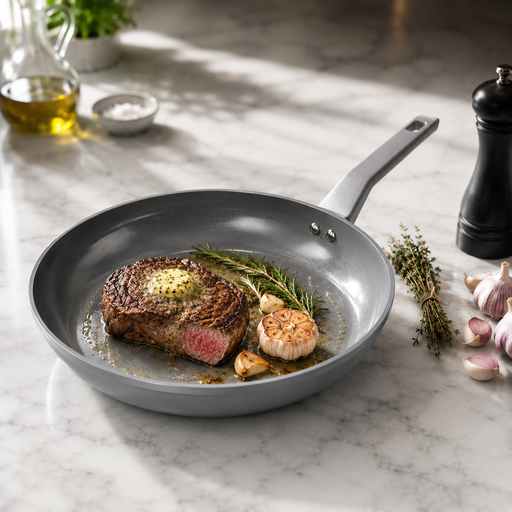
Why this product is a good fit: Ideal for daily use, from fried eggs to delicate fish. The certified toxin-free composition offers peace of mind for the whole family, and it is easy to handle.
The ceramic layer, reinforced with diamond particles and titanium, counteracts the problem of short-lived coatings. The 5-layer construction with a stainless steel base ensures it remains warp-free on induction hobs.
According to the manufacturer, it is 100% free of PFAS, PFOA, PTFE, lead, and cadmium, which signals clear and comprehensive freedom from harmful substances.
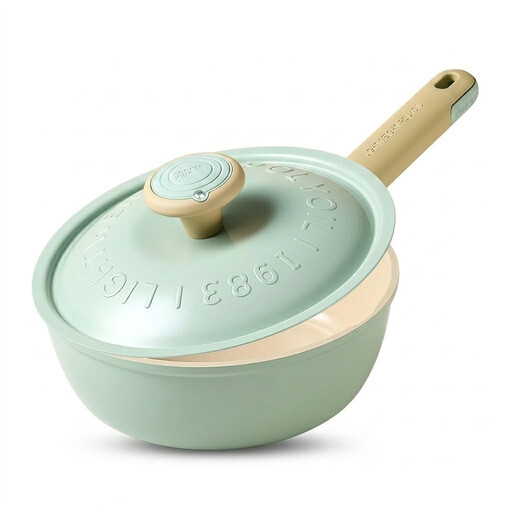
Why this product is a good fit: For anyone who loves to stir-fry. The high, curved shape of the wok is ideal for cooking vegetables and meat at high heat without anything spilling out.
The explicit "PFAS-free" designation provides clarity and bypasses the trap of vague "eco" labels. Its universal suitability for gas and induction hobs indicates a stable base construction.
Combines the benefits of a PFAS-free non-stick coating with the versatile shape of a wok, which can also be used for braising or steaming.
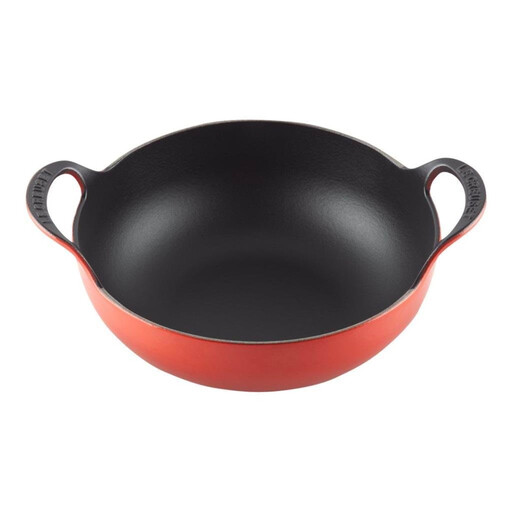
Why this product is a good fit: For cooks seeking extremely durable cookware and who are willing to forgo a synthetic non-stick layer. Cast iron is an investment for many years and is naturally PFAS-free.
Enamelled cast iron has no coating that can scratch or lose its effectiveness. The material is solid, completely warp-resistant, and suitable for all hob types, including induction.
Exceptional heat distribution and retention, which is ideal for searing and even braising. Additionally, the cookware is very easy to care for and robust.
We have compiled a complete, up-to-date list of products that fully meet these strict selection criteria and rigorous safety standards.
To maintain the non-stick properties, you should heat the pan slowly on a medium setting and avoid using "booster" functions. Always use a few drops of oil or fat. After it has cooled, clean the pan by hand with warm water, a soft cloth, and mild detergent. Avoid steel wool or abrasive sponges.
Don't rely on general terms like "eco-friendly". Look for explicit and comprehensive declarations on the packaging or in the product description. Phrases like "100% PFAS-free", "free of PFAS and PTFE", or certifications from independent institutes offer the greatest assurance. The sole claim of "PFOA-free" is not a guarantee of being completely PFAS-free.
Suitability for a specific hob type depends on the material of the pan's base, not the coating. For a frying pan for induction, a magnetisable base is required. Look for the coil symbol (a stylised spiral) or an explicit statement like "suitable for all hob types, including induction". Ceramic, stainless steel, or cast iron pans are generally available for all hob types.