
Lieferung heute & morgen

Qualitätsgarantie

Willkommens-Angebote freischalten: KOSTENLOSE Lieferung | Bis zu 80 % RABATT | Kostenlose 30-Tage-JoyPlus-Testphase
App herunterladen
The search for a new frying pan can be more complex than it first appears. Especially when the requirements are a 26 cm size and a PFAS-free construction, health-conscious home cooks face a flood of information. As your Joybuy Product Recommendation Officer, I'll help you identify the essential features and avoid common purchasing pitfalls so you can make an informed decision.
Marketing promises can often create more confusion than clarity. Pay attention to these three points to avoid a poor investment.
To make the right choice, you should focus on the technical fundamentals. Three parameters are crucial here.
For many buyers, avoiding per- and polyfluoroalkyl substances (PFAS) is the primary reason for a new purchase. Conventional non-stick coatings are often based on polytetrafluoroethylene (PTFE), a chemical from the PFAS group. A pan without PFOA and PTFE therefore relies on alternative materials.
The most common alternative is the ceramic pan. However, modern versions go a step further. A titanium-ceramic coating, for example, integrates titanium particles into the ceramic matrix. This increases the surface's hardness and abrasion resistance compared to pure ceramic coatings, contributing to a longer lifespan for the non-stick properties. Look for multi-layer constructions that ensure a robust and heat-resistant surface.
For users of induction hobs, the base of the pan is the most important component. A good ceramic pan for induction needs a base with magnetic properties. High-quality models often feature a multi-layer sandwich base:
A solid, flat base prevents hot spots and ensures even cooking results, whether you're frying an egg or a steak.
Even the most robust pan requires proper care. Although many models are advertised as a dishwasher-safe pan, hand washing is almost always the gentler method. Aggressive dishwasher tablets and high temperatures can damage the coating over time. A soft sponge, warm water, and mild washing-up liquid are usually sufficient and will preserve the non-stick effect for much longer. Also, avoid using metal utensils and quenching the hot pan with cold water to prevent thermal shock.
Here are some models that are suitable for specific user profiles based on objective product features.
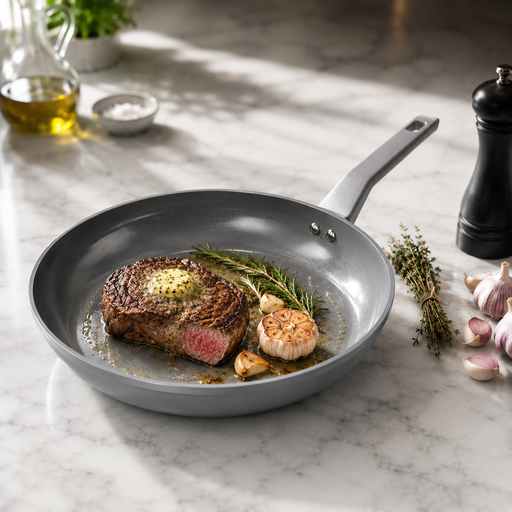
Why this model is a good fit: At 26 cm, this pan is the ideal size for daily use in small to medium-sized households. It is designed for all hob types, including induction, and meets the core requirement of being 100% free of PFAS, PFOA, and PTFE.
The titanium-ceramic coating, reinforced with diamond and titanium particles, is designed for greater wear resistance than simple ceramic, counteracting the problem of short lifespan. The double-layer stainless steel base ensures solid induction performance.
Certified free of PFAS, PFOA, PTFE, lead, and cadmium. The 4+1 layer construction allows for fast and even heat distribution without hot spots.
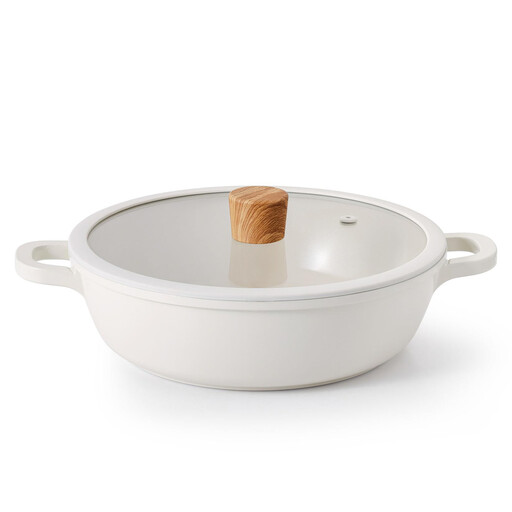
Why this model is a good fit: For families or cooks who enjoy preparing versatile dishes. With a 28 cm diameter and higher walls, this model is suitable not only for frying but also for braising, boiling, and even serving at the table.
Its explicit compatibility with all hob types, including induction, and its robust die-cast aluminium construction address concerns about performance and durability. The ceramic coating is also free of harmful substances.
High versatility as a pan-pot combination. A tempered glass lid and removable silicone handles for safe carrying are included.
We have compiled a complete, up-to-date list of products that fully meet these strict selection criteria and German safety regulations.
The lifespan of a ceramic pan depends heavily on the quality of the coating and proper care. With correct use—meaning no metal utensils, avoiding overheating, and cleaning by hand—a high-quality model can provide good service for several years. A gradual decline in non-stick performance is normal for this type of coating.
Even if a model is labelled as a dishwasher-safe pan, hand washing is strongly recommended. The aggressive salts and detergents in dishwasher tablets can make the ceramic surface porous over time and cause the non-stick properties to deteriorate more quickly.
The official induction symbol (a stylised coil) on the packaging or the pan base is the first indicator. A simple practical test: hold a magnet to the bottom of the pan. If it sticks, the base is ferromagnetic and suitable for induction. A good pan for all hob types will have a fully magnetic base for optimal energy transfer.