
Lieferung heute & morgen

Qualitätsgarantie

Willkommens-Angebote freischalten: KOSTENLOSE Lieferung | Bis zu 80 % RABATT | Kostenlose 30-Tage-JoyPlus-Testphase
App herunterladen
The search for a new, health-conscious frying pan often leads to the world of ceramic coatings. Drawn in by the promise of toxin-free cooking, buyers often make a purchase without knowing the crucial details. However, not every ceramic pan marketed as a "healthy pan" delivers on its promise. Certain structural weaknesses and misleading labels can cause the non-stick effect to deteriorate quickly or the pan to underperform on your home hob.
As your Joybuy Product Recommendation Officer, I'll help you identify these pitfalls. We will focus on the objective features that define a durable and high-performance PFOA-free ceramic pan, ensuring your investment pays off in the long run.
Before you make a decision, you should be aware of the typical flaws that often only become apparent after a few weeks of use.
PFAS-free non-stick pan to ensure more comprehensive freedom from harmful substances.To avoid a bad purchase, you should focus on three core technical parameters. These determine the durability, performance, and safety of your new frying pan.
The term "ceramic pan" refers to the non-stick layer, not the pan's body. These coatings are based on a sol-gel process and are naturally free of PTFE (the main component of Teflon) and PFOA. However, durability depends on the quality and any reinforcements.
titanium pan in this context usually means a ceramic-based coating with titanium particles. These make the surface harder and more resistant to scratches, which significantly extends the life of the non-stick properties and makes a scratch-resistant pan more likely.healthy pan.The base is the foundation of a pan's performance, especially for a coated induction pan.
A good frying pan is more than just its coating. The overall construction determines its range of uses and safety.
oven-safe pan, a handle made of stainless steel or another heat-resistant material is essential. Riveted handles are considered particularly secure and durable. Plastic or Bakelite handles are not suitable for high temperatures in the oven.28 cm pan is a versatile size for families and for preparing larger portions. Models with a high rim are also suitable for stews and sauces.Here are some models that represent a considered choice for different user profiles, based on the quality criteria mentioned.
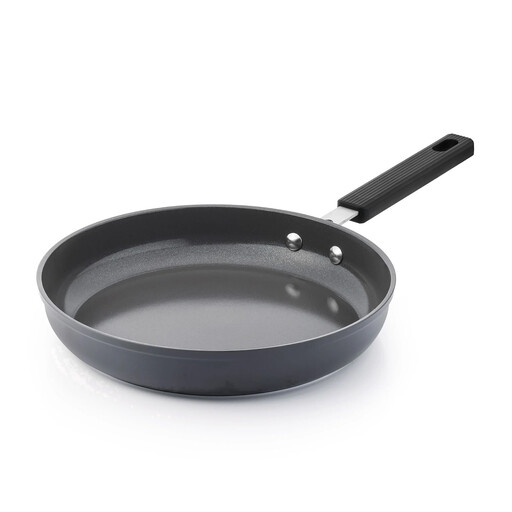
Why it's a good fit: Ideal for daily use, from fried eggs in the morning to quickly sautéing vegetables in the evening. Its straightforward handling and easy cleaning make it a reliable partner for quick meals.
The pan is explicitly declared as PFAS-free, going beyond just being PFOA-free. Its magnetic base is designed for all hob types, including induction.
The ceramic coating allows for very easy cleaning. The heat-insulating handle ensures safe handling on the hob.
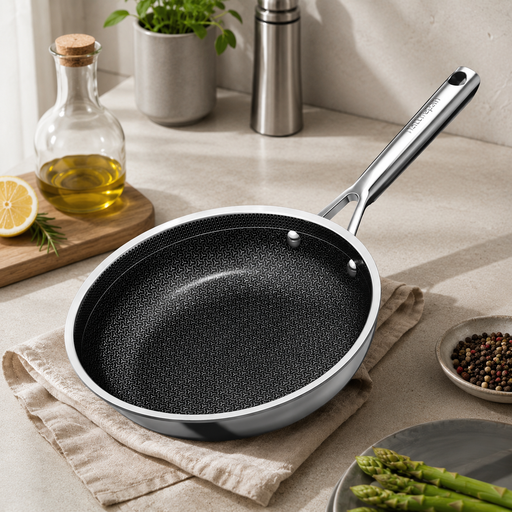
Why it's a good fit: For chefs who value precision. The hybrid technology allows for high-heat searing like a stainless steel pan, combined with the non-stick benefits of a ceramic coating. Ideal for steaks, fried potatoes, and dishes that require excellent browning.
The 5-ply hybrid construction with a stainless steel core and the diamond-titanium particle-reinforced coating counteract rapid wear and tear. The laser-etched honeycomb pattern provides additional protection for the non-stick layer.
The pan is oven-safe up to 260°C and offers maximum flexibility from hob to oven, thanks to its stainless steel handle and robust construction. The hybrid surface combines the benefits of stainless steel and non-stick.
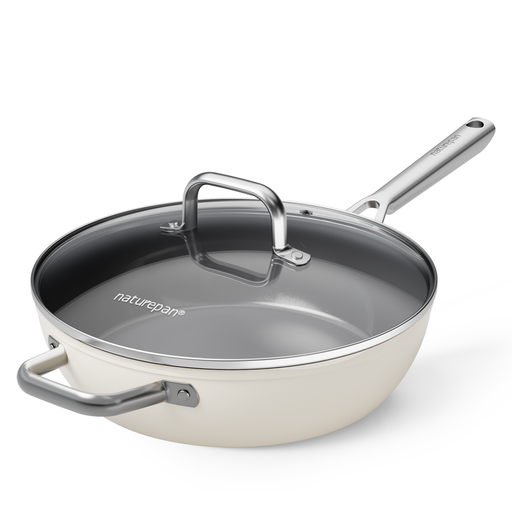
Why it's a good fit: With its high rim and included lid, this 28 cm pan is perfect for family-sized portions, one-pot meals, goulash, or curries. It offers ample volume and prevents splatters during cooking.
The ceramic coating, reinforced with diamond and titanium particles, is designed for heavy use. The fully encapsulated base ensures even heat distribution, which is crucial when cooking large quantities.
The combination of a high rim, a lid, and oven safety up to 260°C makes it extremely versatile. It can be used as a frying pan, braiser, and casserole dish. It is also explicitly PFAS-free.
We've compiled a complete, real-time updated list of products that fully meet these strict selection criteria and relevant safety standards.
Proper care is crucial for the longevity of the non-stick coating. Keep the following points in mind:
The term titanium pan usually does not refer to a pan made of solid titanium, but rather to a ceramic non-stick coating that is reinforced with titanium particles. These particles increase the hardness and abrasion resistance of the surface. Such a reinforced coating is generally more durable and scratch-resistant than a simple, unreinforced ceramic coating.
The easiest way is the magnet test: hold a magnet to the base of the pan. If it sticks firmly, the base is ferromagnetic and suitable for induction hobs. Another indicator of good induction performance is a thick, fully encapsulated base, which ensures optimal energy transfer and heat distribution.