A4 portrait references for the home office
If you want to examine facial details on a larger print than a postcard-sized image, check for A4 support, compatible photo paper and the connections you need.


The key is the largest reference you actually want to print: a postcard printer may be enough for small individual images, while A4 portraits call for a photo printer designed to handle that size. A3+ only makes sense if you plan to use the extra space. If you print frequently, factor in the ink or ribbon and photo paper for your chosen format. For documents or scans, check the features of the specific device.
If you want to examine facial details on a larger print than a postcard-sized image, check for A4 support, compatible photo paper and the connections you need.
If you print lots of versions of the same image, consider ink or ribbon and paper together rather than relying solely on a quoted print yield.
Printing individual postcard-sized portraits and using one device for photos, documents and scans are different use cases. Decide which device is right for your workspace based on the task you do most.
| Consideration | What to check before buying | Who is this important to? |
|---|---|---|
| Image size and detail | Check the photo paper sizes supported and the paper feed specifications for the model in question. | If I want to assess facial features on A4, I need enough print area. Around 33% of consumers need this level of A4 detail. |
| Consumables for frequent printing | Consider the ink or ribbon and matching paper together for the same photo format. | If I print lots of portrait variations, I want to keep an eye on how much ink or ribbon and paper I use. Around 27% of consumers prioritise ongoing material costs. |
| Small prints and desk space | Check whether the small output size is sufficient and which paper or set is supplied with the device. | If I only need occasional small references, desk space matters too. Around 20% of consumers have this requirement. |
| Photos and office tasks | Check the scan and copy functions, photo paper feed and the connections you need on the specific model. | If I print documents or scan originals as well as the occasional portrait, I want one device to handle all the office tasks I need. Around 13% of consumers have this priority. |
| A3+ prints | Allow for the space needed for the printer and larger photo paper, and check the type of ink it uses. | If I specifically need a larger reference area, A3+ is an option. Around 7% of consumers prioritise this format. |
Quoted yields are based on manufacturers’ test conditions and don’t automatically predict how much material you’ll need for your format and printing frequency.
Compare the consumables and photo papers designed for the same format, and factor in how often you print portrait variations.
The Canon SELPHY CP1500 is designed for small media, while the inkjet models considered here support A4 or A3+, depending on the device.
First decide on the largest reference you want to print, then check which media the printer explicitly supports.
Alongside its suitability for photo printing, the F.A.Z. buying guide lists the Canon imagePROGRAF PRO-300’s weight, footprint and print speed as drawbacks.
Choose A3+ only if you really need the larger area, and check the printer and paper dimensions against the space you have in mind.
The model ranges mentioned here span the SELPHY CP1500 for small prints, the PIXMA G650 for A4 and the imagePROGRAF PRO-300 for A3+.
The EcoTank ET-8500 is an A4 ink-tank option with scan and copy functions, while the Expression Photo HD XP-15000 is designed for A3+.
The ENVY Inspire 7220e is an option for a mix of home office tasks and the occasional smaller photo print.
The portable printers below are designed for small prints from a smartphone. They’re suitable only if this small format is enough for your references, and they’re not a replacement for an A4 or A3+ photo printer.
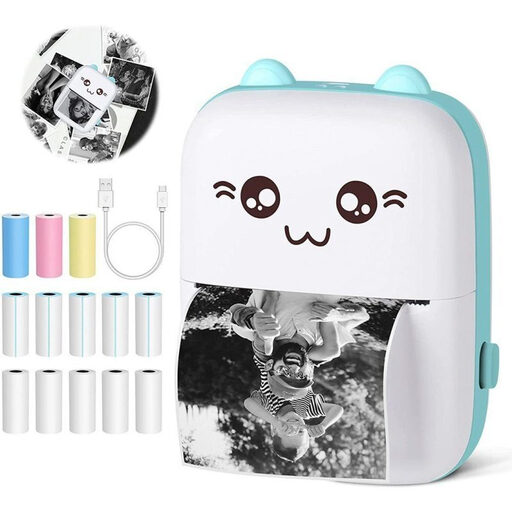 No image available
An option if you want to print smartphone photos as small references and don’t need A4 size.
The product title describes this device as a portable thermal printer. The product details list Bluetooth connections to smartphones, tablets and laptops.
 No image available
It may suit very small mobile image references, but its output size isn’t designed for assessing fine details on A4.
The product details list 50 × 76 mm self-adhesive paper, Bluetooth for iOS or Android devices and a weight of 180 g.
No. The Canon SELPHY CP1500 doesn’t support A4. Canon lists postcard media measuring 100 × 148 mm among the formats supported by this model. For A4 portraits, you’ll need a different model that explicitly supports A4.
No, a manufacturer’s quoted yield isn’t enough on its own. Canon bases the PIXMA G650 figure on 10 × 15 cm photo printing, while Epson quotes up to 2,300 photos for the ET-8500. To make your own estimate, you’ll also need to consider the paper you use, the actual print size and the range of images you print. The manufacturers’ figures aren’t directly comparable.
For supported PIXMA printers, Canon recommends starting with a nozzle check and, if the results indicate it’s needed, running a standard or deep cleaning cycle. Check your printer’s manual to see which maintenance options it offers; cleaning isn’t necessarily something you need to do as a matter of routine.
For a typical purchase of a movable item, statutory claims for defects generally expire two years after delivery. Section 438 of the BGB sets out this time limit, although statutory exceptions may apply. A voluntary manufacturer’s guarantee is separate from these rights.
No. The German Environment Agency says that old electrical appliances must not go in household rubbish and must be collected separately. Options include local recycling centres and retail take-back points. Removable batteries must be disposed of separately.