For photographing whole ceramic pieces, you can start by testing your existing smartphone with a consistent window-light setup to see whether the results meet your needs. If you want more control over settings and lenses, a mirrorless camera gives you greater flexibility. For tiny glaze details, however, the specific lens or close-up mode is what matters. You can manage reflections from the window mainly by adjusting the light and shooting angle. A polarising filter may help, but it will reduce the amount of light.
Which approach is right for you?
Photographing ceramics to sell
For consistent shots of whole pieces where the shape and glaze colour need to be clear, consistent lighting and controlled white balance are good places to start. Canon Europe notes that the colour of natural light changes depending on the conditions.
Documenting glaze details
If you want to fill the frame with small textures, check the magnification ratio of the specific lens or the camera’s close-up mode. Canon Europe emphasises that close-up photography requires careful focusing.
Photographing glossy pieces by the window
If the window is reflected in the glaze, changing the camera angle and adjusting the position of the light can help manage the reflection. A polarising filter can reduce reflections, but it also affects the amount of light available; Canon Academy says it can reduce light by up to two stops.
What should you look for when buying?
First decide whether your priority is photographing whole pieces, capturing small glaze details or managing reflections from a window. You can then compare cameras, lenses and lighting setups with your needs in mind.
| Priority |
What to check when buying |
Who this matters most to |
| Comparing glaze colours |
Check for RAW capture and adjustable white balance. Canon Europe notes that the colour of natural light changes depending on the conditions. |
If I want to compare glazes across several pieces, I need lighting that stays as consistent as possible and controlled white balance. Around 31% of consumers put colour comparison first. |
| Capturing small details |
Check the magnification ratio of the supplied lens: Canon Europe gives a figure of 0.16x for the RF-S 18–45 mm at 45 mm with autofocus; Nikon Germany specifies 1:1 for the separate Z MC 50 mm, while Sony Germany specifies 1:1 for the separate SEL30M35. |
If I want to fill the frame with fine glaze textures, the close-up capability needs to suit the specific lens or camera mode. Around 25% of consumers prioritise small details. |
| Managing window reflections |
First, adjust the shooting angle and position of the light. If you use a polarising filter, check that it fits the filter thread. According to Canon Academy, a polarising filter can reduce light by up to two stops. |
If I want to control highlights without losing sight of the glaze surface, I need to weigh up reducing reflections against losing light. Around 25% of consumers put reflection control first. |
| A straightforward workflow |
Try your existing smartphone first, and check exactly what’s included with camera kits. For the Z50II kit reviewed, Nikon Germany notes that no charger is included. |
If I want to photograph whole pieces with as few extra purchases as possible, I want to make the most of my existing setup before comparing what’s included in each kit. Around 19% of consumers prioritise a straightforward workflow. |
Common misconceptions
-
“Macro” means the same thing for every kit zoom lens
Magnification varies by lens and shooting mode. According to Canon Europe, the Canon RF-S 18–45 mm reaches a maximum of 0.16x at 45 mm with autofocus; the Sony and Nikon macro lenses mentioned are both specified at 1:1. The TG-7 has a built-in microscope mode.
For your smallest glaze details, compare the magnification ratio of the specific lens or the close-up mode of the compact camera rather than relying on the model name alone.
Camera brands worth considering
Canon
The EOS R system offers a documented kit for photographing whole ceramic pieces: the EOS R50 with the RF-S 18–45 mm lens.
- Canon specifies a 24.2 MP APS-C sensor for the R50.
- According to Canon Europe, the kit zoom reaches a maximum magnification of 0.16x at 45 mm with autofocus; Canon does not specify sensor-shift image stabilisation for the R50.
Nikon
The Z50II with the NIKKOR Z DX 16–50 mm is a standard zoom kit; a separate Z macro lens offers another option for close-up photography.
- Nikon specifies a 1:1 magnification ratio for the NIKKOR Z MC 50 mm f/2.8.
- According to Nikon Germany, the Z50II kit reviewed does not include a charger; the lens specification alone does not demonstrate the colour accuracy of the complete system.
Sony
The α6400 with the 16–50 mm II zoom is an APS-C E-mount option; the separate E 30 mm F3.5 Macro is another lens to consider.
- Sony specifies a maximum magnification ratio of 1:1 for the SEL30M35.
- The macro lens is not included in the α6400 zoom offer reviewed, so it should be considered a separate lens purchase.
OM SYSTEM
The Tough TG-7 is a compact camera with a fixed lens, RAW capture and built-in macro modes.
- OM SYSTEM specifies 12 MP and focusing from 1 cm in microscope mode.
- The 1 cm figure is not a stated 1:1 magnification ratio; the close-up mode is not the same as a camera with an interchangeable macro lens.
Joybuy product selection
A selection of Joybuy cameras for different ceramic photography scenarios.
 No image available
Sony Alpha 6100 APS-C mirrorless camera with 16–50 mm power zoom lens
The 16–50 mm power zoom is listed as an option for capturing different compositions of whole ceramic pieces.
RAW capture is listed in the product specifications; Canon Europe explains that white balance can be adjusted after the fact in RAW images.
The tilting screen lets you shoot from different angles.
View at Joybuy
 No image available
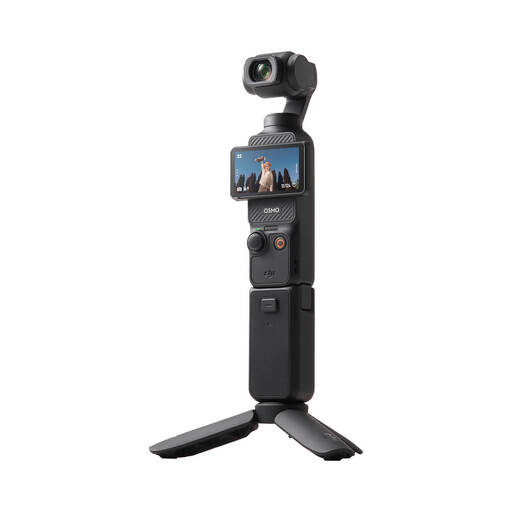
DJI Osmo Pocket 3 Creator Kit
For photographing ceramics by a window, take some test shots to check whether the gimbal design and the framing you need will work with your setup.
The product name specifies a 1-inch sensor and 4K recording at 120 fps.
View at Joybuy
Frequently asked questions
Do I need to buy a new camera straight away to photograph whole ceramic pieces?
Not necessarily. Adobe lists a smartphone as an option for product photography on a limited budget. Start by testing your lighting setup, then check whether your device can deliver the framing and settings you need.
How can I start taking consistent glaze photos by a window?
Keep the background and lighting as consistent as possible, and check the white balance, as the colour of natural light changes depending on the conditions. You can adjust white balance later in RAW files. Small details need careful focusing; a tripod can help prevent camera shake during longer exposures.
What should I check is included in a camera kit before buying?
Compare the exact model and lens names, as well as the listed contents. According to Nikon Germany, the Nikon Z50II kit reviewed does not include a charger; a separate macro lens may also be worth considering for small glaze details.
How should I dispose of an old camera in Germany?
According to the German Environment Agency, old cameras should not be put in household waste. Find out where to take electrical waste for recycling.


