Who is this lighting suitable for?

Artists who want to document their work

If you want to capture the tonal range of charcoal across the whole image, you can position two lights either side of your work. The University of Oregon recommends checking the brightness in the centre and around the edges.

Photographers working with a dark background

If you want to light the drawing while keeping an eye on the dark background, test how the light falls on your work. COLBOR says a grid is designed to reduce spill light.

Beginners without studio lighting

If you don’t already have lights and stands, first check exactly what’s included. A softbox sold on its own won’t produce any light.

What should you consider when choosing?

A kit with two diffused continuous lights

Suitable if: You don’t already own lights and want to document an entire drawing as evenly as possible.

The trade-off: Two stands take up space, and light can spill onto the background.

A single softbox with a grid

Suitable if: You already have a compatible light and want to direct it more precisely onto the drawing.

The trade-off: One light position won’t ensure the whole sheet is evenly lit.

A continuous-light setup assembled separately

Suitable if: You want to choose the light and modifier separately and adjust the colour temperature.

The trade-off: You’ll need to choose the light, softbox and, if required, an adapter or stand separately.

Priority What to check when buying Who will find it especially important
Even lighting Check the brightness in the centre and around the edges of the image. See whether two usable lights and diffusers are included. If I want to capture the tonal range across the whole sheet, similar brightness in the centre and around the edges matters to me. Around 36% of consumers would prioritise even lighting for this task.
Dark background Check whether a grid is included and whether the edges of the paper remain sufficiently lit in a test shot. If I want the background to stay dark, I want to limit spill light without darkening the edges of the drawing. Around 29% of consumers would prioritise background control for this task.
Neutral tones Check the colour temperature specifications for the model you’re considering. Set the white balance to match the lighting you’re actually using. If I want the paper and charcoal to look as true to life as possible, I want to use consistent lighting and adjust the white balance. Around 21% of consumers would prioritise neutral colour reproduction for this task.
A complete setup Check what’s included with each option: lights, bulbs, stands and connections. According to the manual, a compatible adapter is required for Bowens light modifiers on the Nanlite FS-60B. If I don’t already own studio lighting, I want to know before buying which parts are actually included for a usable setup. Around 14% of consumers would prioritise a complete, compatible setup for this task.

Common mistakes when choosing

  • Assuming a softbox is a complete lighting setup

    A light modifier on its own doesn’t produce light. According to the manual, you need the designated adapter to use Bowens accessories with the Nanlite FS-60B.

    Before buying, check the parts list and the connection required for each component.

    Depending on the equipment you already own, you may also need a light, a stand, an adapter or a second light position.

  • Assuming the wattage in a product name tells you how it will light your image

    NEEWER includes “700W” in the NK200 product name, while the product page describes the listed LED bulbs as 35-W bulbs. These details don’t show how evenly a particular piece of work will be lit.

    Distinguish between the product name and the bulb’s power rating, then check how the light falls in your own setup.

  • Using widely diffused light that also illuminates the background

    You may need different light positions to photograph the drawing evenly while keeping the background dark. COLBOR says the BP65 grid can help reduce spill light, but you’ll still need to check how the sheet is lit.

    Compare shots taken with and without the grid, paying particular attention to the edges of the paper and the charcoal shadows.

Brands to consider

NEEWER

The NK200 is a starter kit for anyone without existing studio lighting.

  • The kit version described includes two 60 × 60 cm softboxes and two stands. The E27 sockets and 5700-K LED bulbs are specified by the manufacturer.
  • Variants with two or three bulbs are available. Check what’s included in the specific offer; “700W” in the product name doesn’t refer to the power consumption of an individual bulb.

Godox

The SB-FW6060 is a single 60 × 60 cm light modifier with a Bowens mount and grid. The SL60IIBi is a dimmable continuous light sold separately.

  • Godox says the mounts on the models mentioned are compatible with each other.
  • The SL60IIBi specifications describe the light, not how the softbox will perform on your work. You may need to plan for a second light position and additional accessories separately.

COLBOR

The BP65 is a single 65 cm parabolic light modifier with a Bowens mount and grid, designed for use with a compatible light you already own.

  • COLBOR says the grid can help reduce spill light and lists a carry bag as included.
  • You’ll need to provide a light source separately. The manufacturer’s description of the grid isn’t independent evidence that it will produce a more even photo of a charcoal drawing.

Nanlite

The FS-60B is an adjustable bi-colour continuous light for a workspace you put together yourself.

  • The manual specifies an adjustment range of 2700–6500 K and an FM accessory mount.
  • According to the manual, you’ll need the designated adapter to use Bowens light modifiers. Technical colour-rendering figures don’t replace testing the light on your actual work.

Rollei

The 65 cm Quick Parabolic Softbox is a Bowens option sold separately, with diffusers and a grid.

  • The product description lists an inner and outer diffuser, as well as a grid.
  • According to the product description, the light shown isn’t included.

Joybuy products for directional lighting

The option below is a single softbox with a grid for use with a Bowens light you already own. It may help you control spill light on a dark background more precisely.
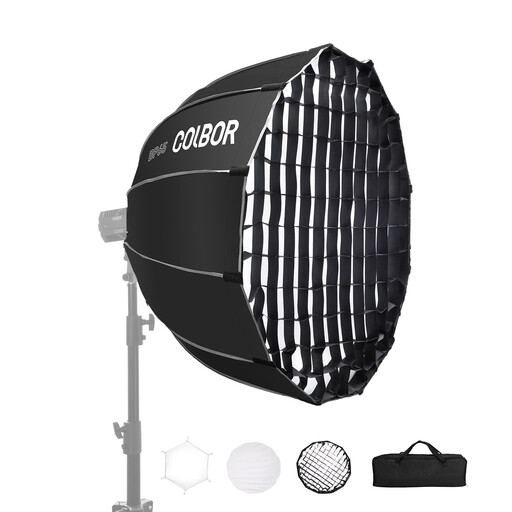
COLBOR BP65 65 cm quick-release softbox with 16 rods, double diffuser and honeycomb grid

COLBOR BP65 65 cm quick-release softbox with 16 rods, double diffuser and honeycomb grid

For more precise light control with a Bowens light you already own; the light source is sold separately.

The product title lists 16 rods, inner and outer diffusers, and a honeycomb grid. COLBOR says the grid can help reduce spill light.

A single light position won’t guarantee even lighting across the whole sheet. Compare the brightness in the centre and around the edges.

View at Joybuy

Frequently asked questions

How should I position the lights for an even photo?

Start with two diffused lights, one on each side of the drawing. The University of Oregon and the Fashion Institute of Technology describe lighting positions at the sides. Check the brightness in the centre and around the edges rather than treating a particular angle as a guarantee of success.

Do I need a light with adjustable colour temperature to capture the tones accurately?

Not necessarily. Avoid mixing light sources without control, and set the white balance to match the lighting you’re actually using. Adjustable colour temperature gives you more flexibility, but doesn’t replace this step. Adobe explains how white balance helps you adjust for the light source.

What are my rights if I buy online in Germany and want to return an item or report a fault?

For a typical online purchase by a consumer in Germany, there is generally a 14-day right to cancel, as explained by the Verbraucherzentrale. This is separate from your statutory rights if goods are faulty and any voluntary manufacturer’s guarantee. In the EU, new goods are generally covered by a statutory guarantee of at least two years.

Does every softbox need CE marking?

No, not automatically for every passive fabric light modifier. According to the European Commission, CE marking is only required for products covered by relevant EU harmonisation legislation. For the Low Voltage Directive, the Commission specifies, among other things, ranges of 50–1000 V AC and 75–1500 V DC. Whether it applies to a particular electrical device depends on its characteristics. CE marking is not an independent quality seal.

How should I dispose of an old LED bulb?

Dispose of it separately from household waste. The German Environment Agency classifies LED lamps as electrical equipment covered by the Electrical and Electronic Equipment Act.