
当日/次日达

品质保障

开启新人专享福利: 全场免邮 | 低至 2 折 | 免费试用 30 天 JoyPlus 会员
下载 Joybuy
If you’re looking for a resin 3D printer for prototyping, model production, engineering or commercial work, you’ll quickly come across high resolution figures and impressive speed claims. What matters, though, is whether the specifications suit the way you actually work. The ANYCUBIC Photon Mono M7 Pro 14K Resin 3D Printer combines a high-resolution LCD with automated features, making it particularly suitable for users who need repeatable workflows and a larger build volume.
According to the product specifications, speeds of up to 170 mm/h are achievable with High-Speed Resin at a layer height of 0.1 mm. For Standard Resin, the Photon Mono M7 Pro is rated at up to 130 mm/h. Actual print times also depend on model height, exposure time, lift movements, support structures and the material profile.
So, if you regularly use Standard Resin, don’t base your decision solely on the maximum speed quoted for a fast resin 3D printer.
A high screen resolution doesn’t, on its own, tell you how much detail a printer can produce. The X/Y resolution of 16.8 × 24.8 µm, even light distribution and mechanical stability of the Z-axis are also important. The M7 Pro uses a 10.1-inch monochrome LCD with a 14K resolution of 13,320 × 5,120 pixels, along with a COB light source and Fresnel lens.
Automatic resin feeding reduces the need for manual top-ups, but it can’t prevent every operating error. You’ll still need to choose resin that’s suitable for your printing environment, exposure time and intended application. Liquid UV resin also requires nitrile gloves, eye protection and a well-ventilated space.
According to Anycubic’s specifications, the M7 Pro supports layer heights from 0.01 to 0.15 mm. For many detailed models and prototypes, 0.05 mm is a common starting point. LightTurbo 3.0 lighting combines a COB light source and Fresnel lens with an algorithm designed to ensure uniform light distribution.
The 14K LCD is particularly useful for reproducing fine edges, small lettering and complex surfaces. However, it’s no substitute for correct orientation, suitable supports and a well-tuned slicer profile.
The build volume is 223 × 126 × 230 mm, or around 6.5 litres. This gives you room to print taller individual models or several smaller parts in one run. Before you buy, check that the build area and height are suitable for your models.
The printer measures 312 × 315 × 520 mm and weighs around 12.8 kg. You’ll also need to allow room for the hinged cover to open. Whether you’re setting it up in a workshop, office or maker space, plan for more than just the footprint: leave enough clearance from walls and ventilation openings too.
According to the product specifications, the Photon Mono M7 Pro offers:
Automatic resin feeding is particularly useful if you print frequently. Make sure the resin bottle is sealed correctly; according to the product instructions, leaving the seal around the bottle neck in place can affect automatic feeding.
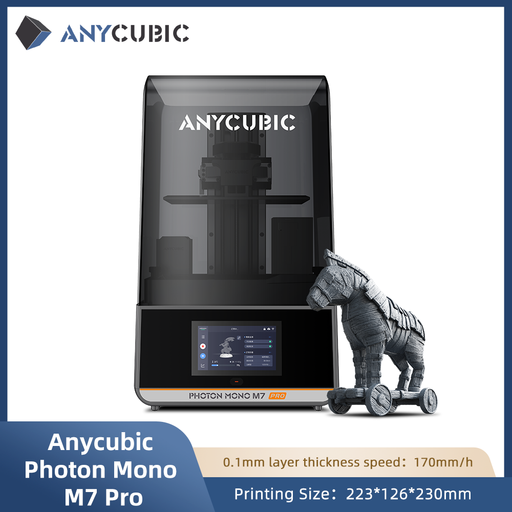
Why this product suits this profile: The combination of a 14K monochrome LCD, 16.8 × 24.8 µm X/Y resolution and a 223 × 126 × 230 mm build volume is designed for detailed prototypes and model production runs.
The specifications distinguish between Standard and High-Speed Resin, making it easier to put the advertised speed into perspective.
Up to 170 mm/h with High-Speed Resin, automatic resin feeding, a temperature-controlled resin vat and a levelling-free design.
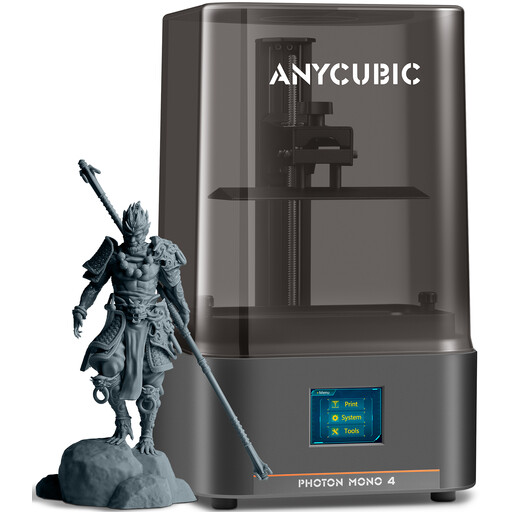
Why this product suits this profile: This more compact printer has a build volume of 153.4 × 87 × 165 mm and 10K resolution, making it suitable for miniatures, figures and smaller models.
Its smaller build volume makes the space required clear and helps you avoid choosing unnecessarily large hardware for small prints.
10K monochrome LCD, speeds of up to 70 mm/h with High-Speed Resin and a compact design.
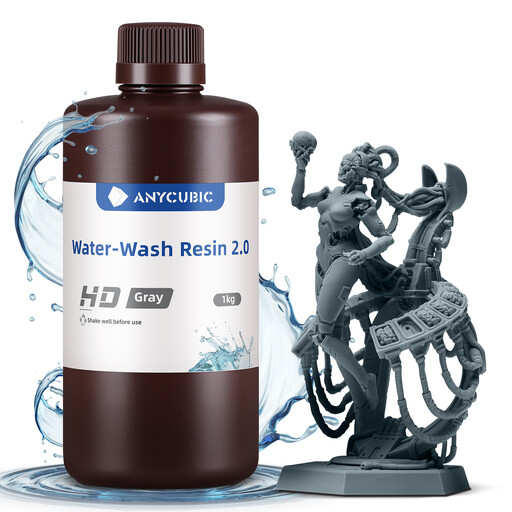
Why this product suits this profile: This water-washable photopolymer may appeal if you’d like to handle post-processing differently from the usual Standard Resin and IPA routine.
The product specifications explicitly state that it can be cleaned with water or IPA of at least 95% concentration. However, wastewater should never be poured straight down the drain without checking how to dispose of it safely.
405 nm compatibility, cleaning specified with water or IPA, and a 1 kg pack.
We’ve put together a complete, regularly updated list of products that meet these strict selection criteria and fully comply with the safety regulations in force in the EU.
For many standard applications, a Anycubic resin 3D printer with 405 nm resin is a good choice. Anycubic Standard Resin is designed for LCD, DLP and SLA systems. According to the product specifications, the recommended ambient temperature is around 20 to 40 °C. For functional models that need to be tougher, ABS-Like Resin 2.0 may be a better option.
After printing, models usually need to be removed from the build plate, cleaned, dried and post-cured. A wash and cure station such as the ANYCUBIC Wash & Cure 3 Plus can help you organise these steps. When cleaning with IPA, use a concentration of at least 95%, unless the instructions for the resin you’re using recommend otherwise.
Its build volume, 14K resolution, networking options and automatic resin functions are relevant for prototyping, model production, engineering and commercial printing workflows. For dental or other regulated applications, you’ll also need to check material approvals, internal quality processes and the relevant industry-specific requirements.
The product specifications state speeds of up to 170 mm/h with High-Speed Resin. With Standard Resin, speeds of up to 130 mm/h are quoted. Results depend on factors including layer height, model geometry, exposure, supports and ambient temperature.
In addition to resin, you’ll need to budget for release film, protective film, gloves, cleaning products, filters and, if required, a wash and cure station. If you print regularly, remember to factor in replacement LCD protective film and consumable parts too.