If you want to shape the stereo image yourself, a separately positionable stereo pair is a sensible starting point, but you’ll need two suitable inputs and time to set things up carefully. In a room with challenging acoustics, placing the microphones closer can reduce the amount of room sound picked up. A recorder with built-in X/Y microphones makes it easier to get started, but gives you less freedom to position each microphone independently. Compare test recordings: DPA Microphones notes that close placement reduces the room’s influence, but can also change the natural listener’s perspective.
Which option suits you?
Pianists looking for stereo sound
If you want to shape the sense of space in a solo performance and have time to experiment with positioning and test recordings, a separately positioned stereo pair gives you plenty of flexibility. DPA Microphones explains that stereo recording depends on the microphones’ polar patterns, orientation and spacing.
Pianists recording in a challenging room
When recording at home, you’ll need to balance room sound, the instrument’s tonal balance and any audible background noise. DPA Microphones explains that close miking reduces the room’s influence, but whether the result works for you depends on the instrument and microphone position.
Beginners without a recording setup
If you’d like to start with just a few components, a recorder with built-in microphones can make setup easier. If you plan to add external microphones later, check how many suitable inputs it has. Zoom lists two external XLR/TRS inputs for the H4essential.
What to consider when choosing
First decide whether you want to shape the stereo image yourself or prefer a simpler setup. Then consider your room, connections and options for expanding your system later.
Separately positionable stereo pair
Best suited to: If you want to position two microphones on your grand or upright piano and shape the sense of space yourself. LEWITT, sE Electronics and RØDE offer documented matched-pair options.
Consider: You’ll need two suitable inputs and will need to plan for microphones, cables and positioning. The farther apart the microphones are, the more room sound they’ll pick up.
Close miking or a piano mounting kit
Best suited to: If you want to reduce room sound or position microphones on your instrument without taking up much space. DPA Microphones describes the DPK2015 as a stereo kit with mounts for grand and upright pianos.
Consider: Close placement can change the listener’s perspective and make key or pedal noise more noticeable. Check the sound with test recordings.
Recorder with built-in X/Y microphones
Best suited to: If you want to start recording without a separate pair of microphones and place the recorder as a single unit in front of the instrument. The Zoom H4essential has built-in X/Y microphones and two external XLR/TRS inputs.
Consider: You can’t position the built-in microphones independently in different places around the instrument.
Single microphone
Best suited to: If you only have one suitable input or simply want to make a straightforward recording to assess your playing.
Consider: A single microphone won’t give you the stereo perspective of a two-microphone recording, so its position is important for balancing the instrument’s sound.
| Priority |
What to check before buying |
Who this matters most to |
| Stereo and sound perspective |
Check whether the setup is designed for two microphones and two recording channels. Compare different distances and orientations. |
If I want to shape the sense of space in my solo performance, separate positioning is especially important to me. Around 36% of consumers put a natural stereo image first. |
| Room sound and background noise |
Check the possible microphone positions, then listen for room sound, key noise and pedal noise in both quiet and loud passages. |
If my room has a strong effect on the sound, I want to be able to assess room sound and background noise carefully. Around 29% of consumers prioritise controlling these factors. |
| A simple, compatible setup |
Count the usable microphone inputs and check the power supply required, as well as the cables and mounts you’ll need. |
If I want to get started with as few components as possible, it’s important that the setup works with my existing recording equipment. Around 21% of consumers prioritise simplicity and compatibility. |
| Room to expand later |
Check whether you might want to connect external microphones later, and remember that the number of inputs is not the same as the number of recording tracks. |
If I might want to use external microphones or try different positions later, I look for suitable connection options. Around 14% of consumers prioritise a setup they can expand. |
Common selection mistakes
-
Assuming four recording tracks means four microphone inputs
According to Zoom, the H4essential offers four recording tracks but only two external XLR/TRS inputs. The number of tracks therefore doesn’t tell you how many external microphones you can connect at the same time.
Count the physical microphone inputs you’ll need for your planned recording rather than relying on the number of tracks alone.
-
Assuming close placement will automatically sound most natural
Close miking reduces the room’s influence, but it can change the listener’s perspective and the perceived balance of the instrument.
Compare short recordings made from close up and farther away, then decide what works best for your instrument and room.
-
Considering only the microphones when choosing a stereo pair
An XLR stereo pair needs a suitable signal path, and compatible condenser microphones need the right power supply. According to the manufacturer, the RØDE NT5 requires P48.
Check what’s included, which inputs you have and what power supply you’ll need before putting your recording setup together.
Brands to consider
LEWITT
The LCT 040 MATCH Stereo Pair is a compact small-diaphragm stereo pair for anyone who wants to position two microphones separately.
- LEWITT says the two microphones are matched for frequency response and sensitivity.
- The manufacturer lists acoustic guitar and drums as applications during development. Use test recordings to find the right position for a piano.
sE Electronics
The sE7 Matched Pair is a small-diaphragm stereo pair that the manufacturer lists as suitable for piano.
- sE Electronics lists a cardioid polar pattern, switchable attenuation and an 80-Hz low-cut filter for the sE7.
- Filters and attenuation won’t automatically improve the sound; a filter can affect the bass you want to capture.
RØDE
The NT5 is available individually or as a matched pair and uses an XLR connection.
- RØDE lists P48 phantom power and 16 dBA rated self-noise among the model’s specifications.
- A 2013 Bonedo review described the tested set as transparent, but felt it lacked a little body and airiness. This historical verdict applies to the set tested.
Zoom
The H4essential is a recorder option with built-in X/Y microphones for a compact stereo setup.
- Zoom lists four recording tracks and two external XLR/TRS inputs.
- The four tracks don’t mean four external microphone inputs, and the built-in microphones share the recorder’s position.
DPA Microphones
The DPK2015 Piano Stereo Kit is sold by the manufacturer as a stereo set with mounts for grand and upright pianos.
- DPA Microphones lists mounting options inside and outside the piano, with the lid open or closed.
- DPA Microphones also points out that close placement can change the natural listener’s perspective. The manufacturer’s information is not an independent comparison.
Joybuy products for this topic
Joybuy products for recording piano at home.
 No image available
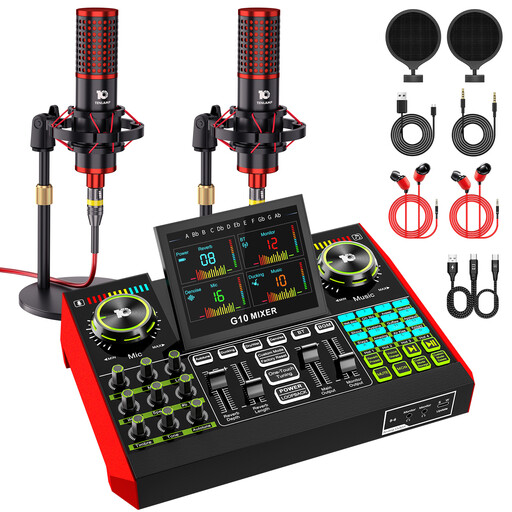
Yinkaer G10-P17-P17 podcast kit with two 3.5 mm microphones and mixer
If you’re considering a set with two microphones and an audio mixer, check that the mixer and connections support the two-channel signal path you want to use with your recording equipment before recording piano.
The product title lists two 3.5 mm condenser microphones, an audio mixer and disc stands. Also check exactly what’s included and whether it’s compatible with your recording equipment.
Joybuy
Frequently asked questions
How do I find the first microphone position for my grand or upright piano?
Start with a short test recording, then adjust the distance and orientation. DPA Microphones notes that close placement reduces the room’s influence, but can sound different from a recording made at a listener’s distance.
Can I connect two XLR condenser microphones directly to my computer?
Check whether your audio interface or recorder has two usable microphone inputs and supplies the power your microphones need. According to the manufacturer, the RØDE NT5 requires P48; the manual for the fourth-generation Focusrite Scarlett 2i2 lists two microphone inputs and a 48 V switch. This doesn’t guarantee compatibility with every microphone or computer.
What should I allow for in terms of accessories and service?
Check exactly what’s included and whether you’ll also need stands, mounts, cables or suitable recording inputs. For a consumer purchase in Germany, the statutory rights against the seller are separate from a voluntary manufacturer’s warranty; any additional warranty services are subject to the relevant terms and conditions.
Can I publish a performance recorded at home if it features someone else’s composition?
The right to make a private copy does not give you general permission to distribute or publicly perform a recording. Before publishing a cover of a protected work, you’ll need to clarify the usage rights for the specific use; a video may also require the right to make an audiovisual recording. The rights that apply depend on the work and how you plan to publish it.


