Performers in a reverberant room
When recording an acoustic piano, you can test microphone positions before the concert to reduce unwanted reflections.


If unwanted room reflections are your main concern, start by positioning the microphone closer and compare it with other positions before the concert. According to DPA Microphones, a shorter distance reduces the influence of the room, while a greater distance captures more of its sound. A stereo pair can give the bass and treble a sense of space, but it needs two suitable recording channels and should be checked in mono, as Shure explains. A single microphone or a recorder with built-in X/Y microphones can make setup simpler. The right choice also depends on whether you’re recording a grand or an upright piano.
When recording an acoustic piano, you can test microphone positions before the concert to reduce unwanted reflections.
If you want a spatial balance between the bass and treble, careful stereo placement matters more than getting set up as quickly as possible.
If you don’t already have recording equipment, you’ll need to decide whether to buy a recorder, interface, microphones and accessories separately or as a package.
A good fit if: you’d like to try a straightforward mono recording first, or experiment with positioning on an upright piano.
Trade-off: You only need one recording channel, but it won’t capture true stereo. Placing it very close can also make the overall sound less natural.
A good fit if: you want to shape the spatial balance between the bass and treble, and have two microphones and suitable recording channels.
Trade-off: Two microphones take longer to position and need an additional listening check in mono, where phase cancellation may become noticeable.
A good fit if: a discreet, close position matters more to you than a spacious sense of the room.
Trade-off: Close placement can limit the amount of room sound, but it won’t automatically give you the natural overall sound you want.
A good fit if: you want a self-contained stereo recording without having to position several separate microphones.
Trade-off: A compact setup won’t make up for a poor position in the room. External microphones also need suitable connections and power.
| What matters | What to check before buying | Who is it important for? |
|---|---|---|
| Room sound and naturalness | Try a close position on your own piano and compare the sound with a greater distance. | If I want to reduce unwanted reflections without making the piano sound too confined, I’ll test several positions beforehand. Around 36% of consumers prioritise room control. |
| Bass, treble and stereo | Check that you have two microphones and two suitable recording channels; listen to the test recording in mono as well. | If I want to give the bass and treble a sense of space, I need a stereo image I can shape and should listen for possible phase cancellation in mono. Around 29% of consumers prioritise stereo. |
| A simple concert setup | Work out whether you need a self-contained recorder and listen to the planned position before you start. | If I want to keep the setup manageable before the concert, I’ll check the microphone position and the complete recording chain. Around 21% of consumers prioritise a simple setup. |
| System compatibility | Check the inputs, phantom power requirements, what’s included, cables and secure mounting. | If I don’t already have a suitable setup, I want to know in advance what extra equipment I’ll need to record. Around 14% of consumers prioritise a system they can plan around. |
A close position can reduce the influence of the room, but it also changes the sound of the instrument in the recording. DPA Microphones explains this trade-off, while Shure recommends listening to different positions.
Set aside time before the concert for a few short test recordings. Compare whether better room control or a more distant overall sound works best for you.
According to the manufacturer, the RØDE M5 requires P24 or P48 phantom power and has XLR outputs. You’ll also need two suitable inputs to record the microphones on separate tracks.
Before buying, check what’s included and compare the exact model’s requirements with your existing equipment.
For a setup with one microphone over the bass strings and another over the treble strings, Shure warns that phase cancellation may occur during mono playback.
Listen to a short test recording in both stereo and mono. If you notice any problems, adjust the microphone positions.
The models below represent different recording approaches. Manufacturer specifications don’t prove that a product will sound better in a particular untreated room.
The M5 is a directional small-diaphragm condenser microphone, also available as a matched stereo pair. The NT5 is available as a matched stereo pair too.
The sE7 is a small-diaphragm condenser microphone for piano, also available as a matched pair.
Shure suggests the low-profile Beta 91A as an option for close placement on a grand piano, and documents setups using one or two microphones.
The H4essential is a self-contained recorder with built-in X/Y microphones and two inputs for external microphones.
Neumann specifically lists the KM 184 directional small-diaphragm condenser microphone as an option for classical piano.
One product option for an audio setup with multiple microphones and a mixer.
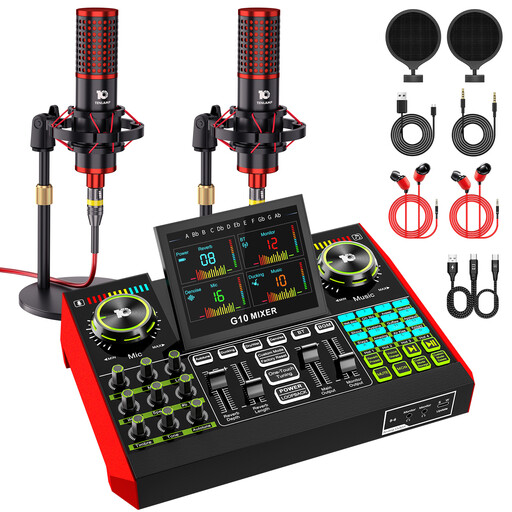 No image available
This set may suit you if you’re looking for a mixer as well as two microphones for a multi-part audio setup. Before buying, check that the connections and recording chain are right for your piano recording.
The product name lists two 3.5 mm condenser microphones, an audio mixer and microphone stands. The product description lists PC, Mac and mobile devices as compatible.
Yes, if a mono recording suits your needs. Shure suggests positioning a single microphone over the open top section of an upright piano. Listen to the recording with the instrument you’ll be using to check that the bass and attack sound right to you.
Check the power requirements for the exact model: the RØDE M5 needs P24 or P48. For two separately positioned microphones, you’ll need two suitable recording channels. Listen to the test in mono as well, as Shure warns that a bass-and-treble arrangement may cause phase cancellation. Adjust the position if the recording sounds too focused on the attack or too spacious.
No. The Verbraucherzentrale distinguishes between your statutory rights against the seller and a voluntary warranty, the terms of which are set out in the relevant warranty conditions. When buying, check both the seller’s information and any manufacturer’s warranty terms.
No, you should check the necessary rights in advance. Under § 77 Abs. 1 UrhG, the performing artist has the exclusive right to record their own performance on a visual or audio medium. Whether any additional rights in the work being performed or venue rules apply depends on the concert. This does not mean you have blanket permission to publish the recording.