
Lieferung heute & morgen

Qualitätsgarantie

Willkommens-Angebote freischalten: KOSTENLOSE Lieferung | Bis zu 80 % RABATT | Kostenlose 30-Tage-JoyPlus-Testphase
App herunterladen
Hello, I'm Joy, your Product Recommendation Officer at Joybuy. If you want to prepare authentic Japanese or Korean dishes like kimbap, sushi, or a colourful bento box, choosing the right pickled radish is crucial. However, the variety of shapes, flavours, and names like Takuan or Danmuji can be confusing.
This guide is designed to bring you clarity. I'll introduce you to different types of pickled radish and provide practical tips to help you make an informed decision for your next culinary project.
Choosing the right product largely depends on your intended use. Here are some objective criteria to guide you.
Although both terms are often used for yellow radish, there are subtle differences.
Both varieties have a sweet and sour flavour profile and often get their characteristic yellow colour from the food colouring riboflavin (E101) or gardenia extract.
Pickled radish is available in various cuts, each optimised for specific applications:
The basic ingredients are radish, water, salt, and acidity regulators. Differences can be found in the sweeteners and colourings.
Here is a selection of products from our range that cover different needs and applications.

Why it stands out: The traditional whole form offers maximum flexibility for various Japanese and Korean dishes.
Pros:
Who It's For: Home cooks who want to slice the radish themselves for sushi, salads, or as a side dish, and who value traditional preparation.
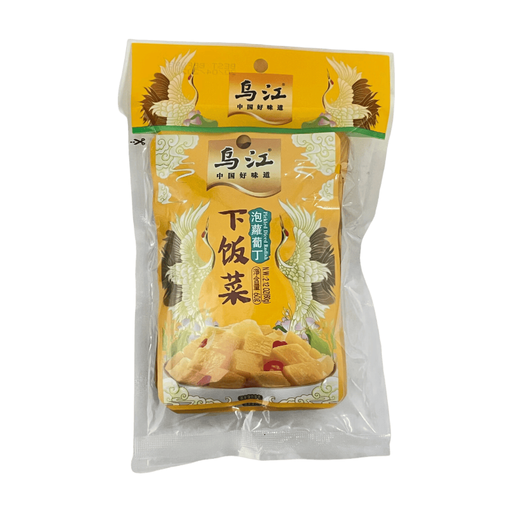
Why it stands out: Ready-to-eat, seasoned radish cubes in convenient single-serving packs.
Pros:
Who It's For: Anyone looking for a quick, hassle-free, and flavourful snack, or a ready-made side for rice, porridge, or noodles.
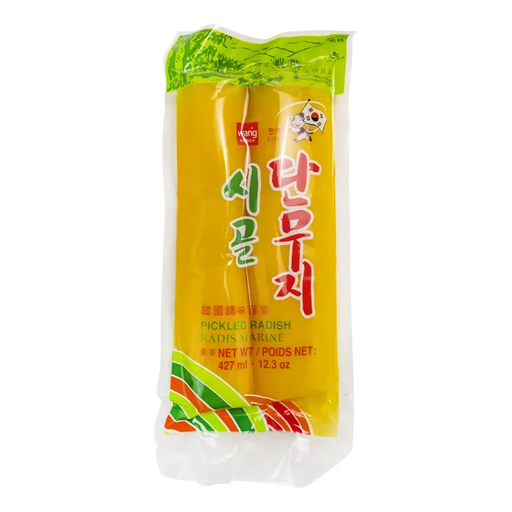
Why it stands out: A classic Korean radish (Danmuji) in a halved form, specially designed for Korean cuisine.
Pros:
Who It's For: Enthusiasts of Korean cuisine looking for authentic Danmuji for kimbap, bibimbap, or as a side for fried chicken.
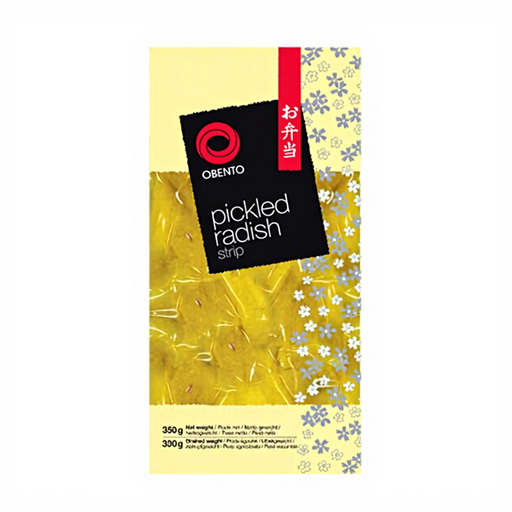
Why it stands out: Ready-to-use radish strips that significantly speed up the preparation of sushi and other dishes.
Pros:
Who It's For: Anyone who regularly prepares sushi or kimbap and values efficiency and ease of use in the kitchen.
If these recommendations don't include the perfect product for your needs, or if you're simply curious about other varieties, you're sure to find what you're looking for in our wider selection.
Explore our entire range of pickled radish and find the perfect ingredient for your kitchen.
Both are pickled daikon radish. The main difference often lies in the preparation: for Takuan, the radish is sometimes sun-dried before pickling, which affects the texture. Danmuji is typically pickled fresh, making it often especially juicy and crisp. In terms of taste, they are very similar.
Pickled radish is extremely versatile. It's a classic filling for radish for sushi (maki) and Korean kimbap. As a side dish (banchan), it's served with almost every meal in Korea, especially with oily or heavy dishes like Jajangmyeon or Korean BBQ, as its sour taste refreshes the palate. It also fits perfectly in bento boxes or simply as a snack.
After opening, the radish should be stored in the refrigerator. It is recommended to keep it in its original packaging and brine to prevent it from drying out and losing flavour. Opened products should generally be consumed within a few days. Please refer to the specific instructions on the product packaging for details.