
Lieferung heute & morgen

Qualitätsgarantie

Willkommens-Angebote freischalten: KOSTENLOSE Lieferung | Bis zu 80 % RABATT | Kostenlose 30-Tage-JoyPlus-Testphase
App herunterladen
A Pikler triangle is more than just a toy; it's a tool that fosters motor skill development and self-confidence in toddlers. However, the market is flooded with models whose quality and safety claims are often difficult to verify. Before you make a decision, it's crucial to understand the most common pitfalls that can lead to disappointment and, in the worst-case scenario, safety hazards.
This guide focuses on the objective criteria that distinguish a high-quality climbing triangle from an unsuitable one, helping you make an informed choice.
Many well-intentioned purchases end with a product that either quickly sits unused in a corner or reveals defects. Pay close attention to these three points to avoid a bad buy:
To distinguish high-quality options from the rest, you should focus on verifiable technical features. These three parameters are decisive for the safety, durability, and play value of a Pikler triangle.
The choice of material has a direct impact on stability and safety. A high-quality wooden climbing triangle should ideally be made from solid wood such as beech or birch. These woods are robust, durable, and resilient. Cheaper models made from plywood or softwoods often do not offer the same level of stability.
Also, pay attention to the surface finish:
The most important mark for the safety of children's toys in the EU is the EN 71 standard. It regulates, among other things:
Also, check the manufacturer's specified maximum load capacity. A value of at least 50 kg is a good indicator of a sturdy construction that can withstand the boisterous play of multiple or older children.
A basic triangle is a great starting point, especially for children aged 2 and up. However, its true value unfolds through expansion options. A climbing triangle with a slide instantly doubles the play value. The slide board can often be used as a ramp or a chicken ladder, thus fostering creativity. When buying, make sure the desired model is explicitly compatible with accessories so you can later assemble a complete small indoor climbing frame.
Instead of presenting an overwhelming list, we have selected one product that meets specific requirements and avoids the pitfalls mentioned above.
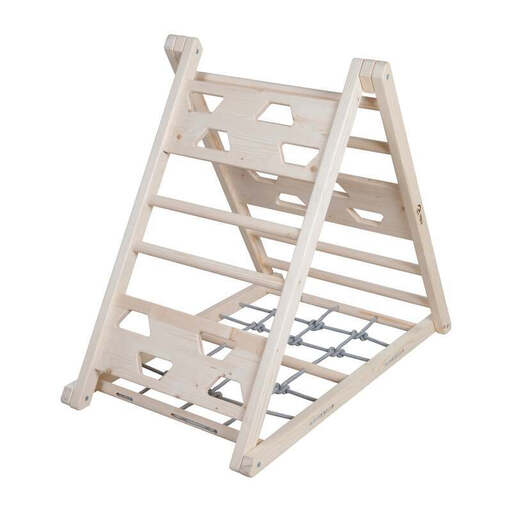
Why This Fits Their Persona: Ideal for parents looking for a durable and versatile wooden motor skills toy. The three different sides (rungs, climbing rope, grip holds) offer various difficulty levels and promote motor skill development over a long period.
The solid wood construction ensures stability (avoids Pitfall 1). As a product from an established German manufacturer, it is subject to strict safety tests (avoids Pitfall 2). According to the manufacturer, it is explicitly compatible with the roba slide board and is therefore expandable (avoids Pitfall 3).
3-in-1 functionality for varied play. Load capacity of up to 50 kg. Systematic design based on Pikler pedagogy to promote balance and coordination.
A climbing triangle is often just the beginning. Many models can be perfectly combined with a wooden slide to create a complete small indoor climbing frame. Discover compatible and tested products in our selection.
Generally, a Pikler triangle can be used as soon as a child can stand independently and wants to make their first climbing attempts, which is often between the 10th and 12th month. Models designed for children aged 2 and up often feature steeper angles or more complex climbing elements. Always follow the manufacturer's age recommendation.
Adding a slide board significantly increases the play value and longevity of the toy. It transforms the climbing apparatus into a multifunctional play station. A separate board also offers flexibility: it can be used as a slide, a ramp for climbing up, or a bridge between two elements. The option to combine is a strong argument for a long-term investment.
Safety is the top priority. Always place the indoor climbing frame on a level, non-slip surface. A soft play mat or a rug underneath can cushion falls. Regularly check all screw connections to ensure they are tight. Especially in the beginning, let your child climb only under direct supervision and adhere to the maximum load capacity specified by the manufacturer.