
Lieferung heute & morgen

Qualitätsgarantie

Willkommens-Angebote freischalten: KOSTENLOSE Lieferung | Bis zu 80 % RABATT | Kostenlose 30-Tage-JoyPlus-Testphase
App herunterladen
A Pikler triangle, often called a climbing triangle, is more than just a toy. It's a thoughtful piece of developmental furniture based on the principles of paediatrician Emmi Pikler, designed to naturally promote the motor skill development of toddlers. However, the market can be overwhelming, and not every product advertised as "Montessori" lives up to its promise. Before you make a decision, it's crucial to understand the common pitfalls that can lead to disappointment and, in the worst cases, safety hazards.
As your Joybuy Product Recommendation Officer, I'm here to help you separate marketing hype from fact. In this guide, we'll highlight the critical features of a quality climbing triangle and show you what to look for to make a safe and long-lasting choice.
Purchasing an indoor climbing frame is an investment in your child's development. This makes it all the more important to avoid typical flaws that compromise play value and safety.
To avoid buyer's remorse, you should base your decision on objective criteria. These three parameters are crucial for the safety and utility of a Pikler triangle.
The durability and safety of a climbing triangle depend directly on the materials used. Look for models made from sturdy solid wood like beech or birch. These woods are more resistant to impacts and wear than softer wood types. A key quality indicator is meticulously rounded edges on all components to minimise the risk of injury. The surface should be treated with a non-toxic, water-based finish that complies with the European standard for toy safety (EN 71-3). This ensures that no harmful substances are transferred to your child, even if they put the rungs in their mouth.
A stable base is paramount. The construction should be designed so that the triangle does not tip over, even during active use. Pay attention to the manufacturer's specified maximum weight capacity—a value of at least 50 kg is a good indicator of a robust build. Reputable manufacturers have their products certified according to relevant safety standards. The GS mark (Geprüfte Sicherheit / Tested Safety) and compliance with EN 71 are important signs that the product has been tested for mechanical and chemical safety.
Consider how the climbing triangle will be used. A foldable model is ideal for homes with limited space, as it can be easily stored away after playtime. Also, check for compatibility with accessories. A climbing triangle with a slide board doubles the fun and also promotes a sense of balance. Some models, like the roba climbing triangle, even offer integrated elements such as a climbing rope or special grip surfaces to vary the motor challenges and make the indoor climbing frame even more exciting. Such sets are often a great choice as a developmental toy for ages 2 and up.
Based on the criteria mentioned, we have identified a few products that are well-suited for different needs and living situations.
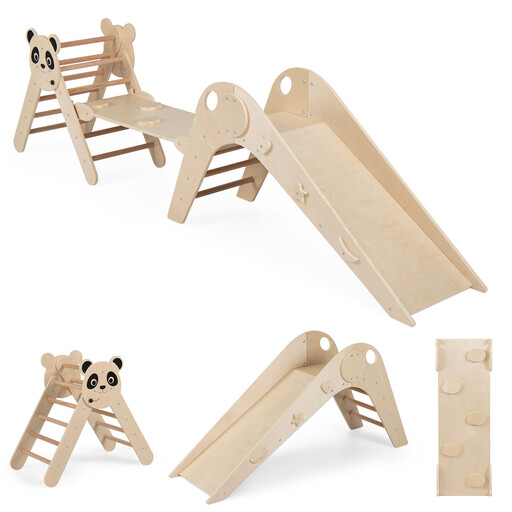
Why this model is a good fit: Ideal for families looking for a space-saving solution without sacrificing the core benefits of a climbing triangle. The appealing design provides extra motivation for children.
The integrated folding mechanism solves the problem of limited space and lack of flexibility in smaller homes. Designed as a set, it offers cohesive play value right from the start.
Easily foldable and storable, making it especially practical for everyday use in the living room or a child's bedroom.
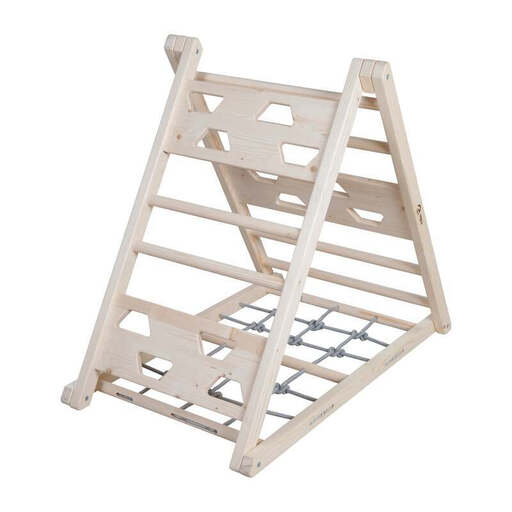
Why this model is a good fit: For parents seeking a multifunctional play structure that goes beyond simple climbing to engage a variety of motor skills.
This model counters the pitfall of limited expandability with its integrated 3-sided function. The solid wood construction and weight capacity of up to 50 kg ensure the necessary stability and material quality.
Offers three different climbing sides (rungs, climbing rope, grip surfaces) in one unit and can also be expanded with a separate slide board.
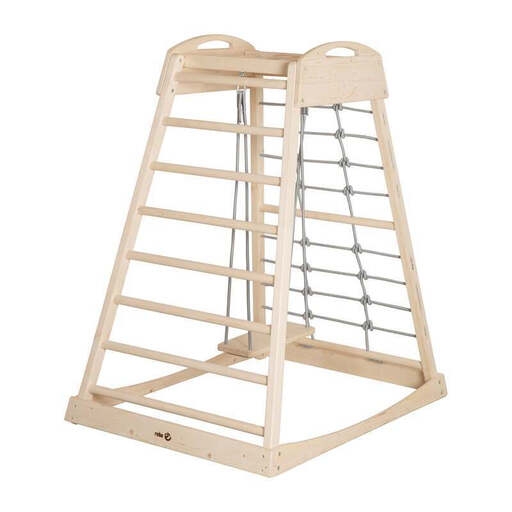
Why this model is a good fit: For families who want to create a complete indoor playground that can be used for years, offering diverse movement incentives like climbing, swinging, and gymnastics.
Designed as a comprehensive play system, it bypasses the pitfall of limited use. The robust solid wood construction and a high weight capacity of up to 70 kg ensure the necessary stability and durability for intensive play.
Combines a climbing frame, gymnastic rings, and a solid wood swing in one unit, offering maximum play variety and motor skill development.
We have compiled a complete, up-to-date list of products that fully meet these strict selection criteria and German safety regulations.
Most manufacturers recommend Pikler triangles for children from the moment they can stand independently, which is often between 10 and 12 months. Some models, especially those with more complex features, are explicitly designated as a developmental toy for ages 2 and up (24 months). It is crucial that the child only uses the equipment under constant adult supervision and that its use is appropriate for the child's individual developmental stage.
Yes, using a non-slip play mat or fall protection mat is strongly recommended. It serves two important functions: first, it prevents the climbing triangle from sliding on smooth floors like parquet or tile. Second, it provides a soft surface that cushions potential falls and increases safety during play.
In addition to the footprint of the triangle itself (approx. 80x90 cm), plan for a safety zone of at least 1.5 meters in all directions. This area should be free of furniture, walls, or other hard objects. For smaller apartments, foldable models are an excellent alternative as they can be stored compactly after use.