
Lieferung heute & morgen

Qualitätsgarantie

Willkommens-Angebote freischalten: KOSTENLOSE Lieferung | Bis zu 80 % RABATT | Kostenlose 30-Tage-JoyPlus-Testphase
App herunterladen
A pill box can make it easier to keep track of taking medication, vitamins, food supplements or fish oil every day. However, not every model suits every need. A small pill box for travelling is useful for individual days, while a weekly pill organiser requires more planning. What matters is not eye-catching marketing claims, but the compartment layout, fastening, material and ease of use.
A slim medication box may seem like a space-saving choice for travel. However, larger capsules, fish oil or several preparations taken at the same time can quickly fill the available space. So pay attention to the internal dimensions and the actual compartment capacity – not just the external dimensions.
A box with seven compartments is often suitable for taking medication once a day. If you take medication at several different times, separating it into morning, midday and evening may be more practical. For example, a pill box with 21 compartments represents seven days with three time slots each. If the labels are difficult to recognise, the risk of mixing up compartments in everyday use increases.
A very firm snap fastening can keep the contents securely closed, but may be difficult to operate for people with limited hand strength. Conversely, a loose lid may open during transport. Check that the fastening is easy to open while still closing securely. Medication boxes should always be kept out of the reach of children and pets.
The right number of compartments depends on your medication schedule:
If you take several large capsules, you should also check the stated capacity. Some models are specifically marketed for larger vitamins or fish oil capsules. However, the actual amount they can hold depends on the shape and size of the preparations.
A BPA-free medication box may appeal to shoppers who value this type of material information. BPA-free does not automatically mean that the box is airtight or suitable for every storage condition. So check the following separately:
For products made from food-grade or medical-grade plastic, follow the manufacturer’s information on intended use. Medication should also not be kept permanently in direct sunlight, high temperatures or damp rooms unless the leaflet states otherwise.
A pill box for travelling should be compact and have lids that close securely. Terms such as “moisture-proof”, “sealed” or “waterproof” often come from the product description used in listings. They should not automatically be taken to mean that the product has verified water resistance. A waterproof pill box is only a reliable choice for damp environments when specific information about its protection rating or intended use is provided.
An integrated pill splitter can be practical for tablets that are suitable for splitting. Not every tablet may be divided, and capsules or liquid-filled preparations are not designed for this. Whether a tablet can be split should be checked in the leaflet or confirmed with a healthcare professional. The box does not replace dosage instructions.
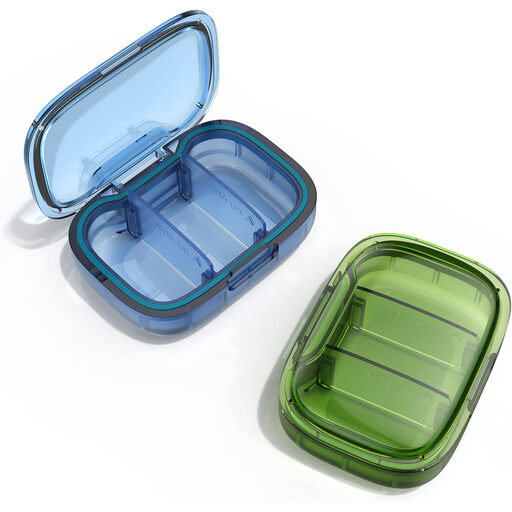
Why this product suits the profile: Two small boxes with three compartments each are suitable for simple daily supplies, vitamins or fish oil in a bag or drawer.
The three-way layout is clearer than a single undivided compartment. The product description states that it has a moisture-protected design; this should not be taken as proof of water resistance.
Twin pack, three separate compartments per box and a design intended for use on the go.
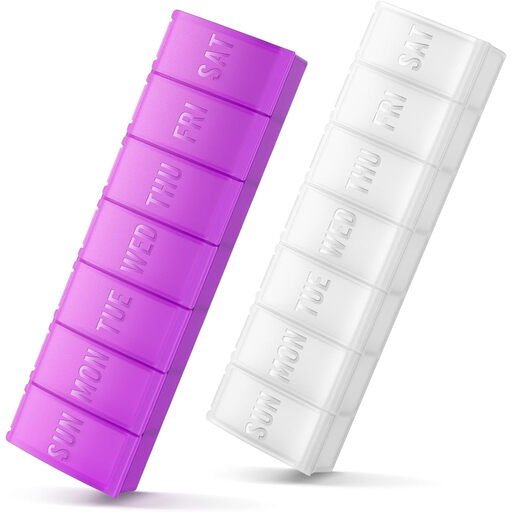
Why this product suits the profile: The 7-day layout, BPA-free material information and permanently applied day labels appeal to users who value clear, verifiable product details.
The separate weekly layout reduces the need to sort medication again each day. Before buying, compare the stated compartment size with your own preparations.
BPA-free plastic material according to the product information, 7-day compartments and easy-open lids.

Why this product suits the profile: The 21 compartments divide seven days into morning, midday and evening. This suits more extensive medication schedules at home, in the office or while travelling.
The time-based layout prevents different daily supplies from being stored together in one compartment. The supplier describes a tightly closing fastening; the box should nevertheless be stored away from moisture and heat.
21 compartments, PP plastic according to the product information and removable daily sections.
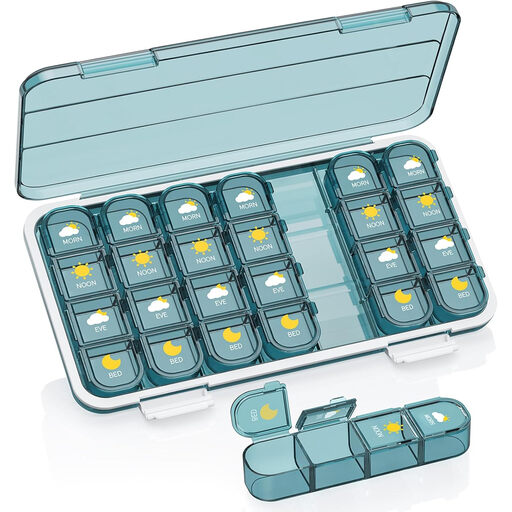
Why this product suits the profile: The separate compartments for four times a day are designed for regular medication schedules and can also hold vitamins or supplements.
The clear time structure avoids the pitfall of an overly general weekly layout. Before filling the box, check that all capsules and tablets fit into the relevant compartments.
7-day organisation, four daily compartments and separate containers according to the product description.
We have put together a complete, regularly updated list of products that fully meet these strict selection criteria and the safety regulations applicable in the EU.
Fill a pill box with clean, dry hands and check the labels before closing it. Keep preparations in their original packaging wherever possible if the leaflet specifies special storage conditions. Check the box regularly for cracks, loose lids, damaged hinges and labels that have become difficult to read.
When using a pill splitter, remember: only split tablets where this is permitted according to the product information. Do not change the dosage yourself. The box must not be freely accessible to children, pets or other people.
Three compartments may be enough for a simple daily supply. If you take medication at three different times each day, a pill box with 21 compartments provides a clearer overview. If you need four medication times, you can choose a 7-day box with four daily compartments.
Its lifespan depends on the material, hinges, fastening and cleaning routine. Replace the box if cracks appear, the lids no longer close securely or the labels are no longer clearly legible. It is not possible to specify a standard lifespan for every model.
A medication box normally has no ongoing running costs. Expenses may arise from replacing it due to wear and tear or buying additional boxes for travel, work and home. The key consideration is whether the compartment size and layout will continue to suit your personal medication schedule.