
Lieferung heute & morgen

Qualitätsgarantie

Willkommens-Angebote freischalten: KOSTENLOSE Lieferung | Bis zu 80 % RABATT | Kostenlose 30-Tage-JoyPlus-Testphase
App herunterladen
A pill box keeps medicines, vitamins and food supplements organised and within easy reach when you are out and about. In practice, however, pill organisers vary considerably in terms of compartment layout, closures, materials and portability. If you focus only on having lots of compartments or eye-catching marketing claims, you may end up buying a medication box that is impractical for everyday use.
This guide explains which features matter before you buy and which models suit different needs.
A particularly small pill box may fit easily into a jacket or handbag, but it often has room for only a few tablets. Larger vitamins or fish oil capsules can also be difficult to remove. So, do not just check the outer dimensions — also look at the size and number of the internal compartments.
Terms such as “waterproof” or “airtight” should not automatically be taken to mean protection in every situation. A closure may keep out splashes, but it does not replace dry medicine storage. Moisture can be problematic for sensitive preparations. A pill box should therefore be filled in a dry environment and not stored permanently in the bathroom.
A large number of compartments can make things more organised, but may also make the box harder to use. For older people or those with limited hand strength, clearly marked days and lids that are easy to open are more important than having as many compartments as possible. Before buying, check that the closure can be operated without excessive force.
For taking medication once a day, a daily pill box with a few sections is usually sufficient. If you take medicines at different times, choose a weekly pill box with separate compartments for each day or time. Models with 7 days and multiple dosing times provide more structure, but they also take up more space.
Look for:
A medication box is designed for organisation. Tablets should only be split in accordance with medical or pharmaceutical advice. If you are unsure whether a tablet can be split or how it should be stored, your pharmacy is the right place to ask.
For plastic models, details such as BPA-free pill box or “BPA-free” are relevant selection criteria. The specific material should be stated in the product description. The VVM models presented here are described as being made from BPA-free plastic; other products are listed simply as plastic or ABS plastic.
The following points are also important:
A travel pill box should be compact, sturdy and protected against accidental opening. For people who regularly travel or spend time away from home, several small containers may be more practical than one large weekly box. An integrated tablet splitter is useful only if the particular tablet is suitable for splitting. Capsules and liquid-filled preparations should not be cut with a blade.

Why this product suits this profile: Two small boxes with three compartments each are suitable for individual days, handbags or travel luggage. They provide a simple basic layout.
The separate compartments help prevent different preparations from getting mixed together. Before buying, compare the capacity with the number of tablets you personally need to carry.
Two pieces in the set and three compartments per box; according to the product description, suitable for medicines, vitamins and fish oil.
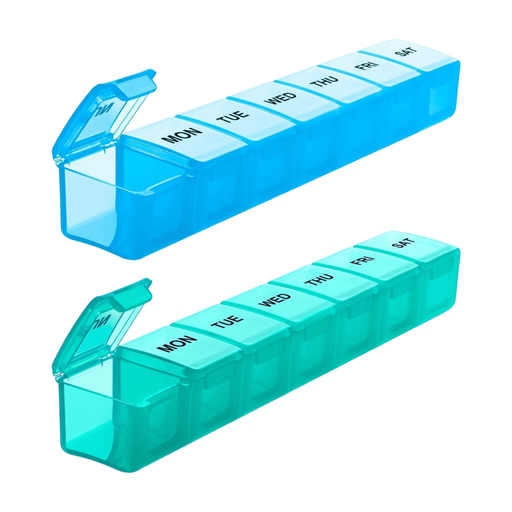
Why this product suits this profile: The weekly layout is suitable for users who want to prepare food supplements or medicines for several days in advance.
The individual daily compartments and printed markings make it easier to identify each dose. Before buying, check that the stated compartment size is suitable for the amount you take.
According to the product information: BPA-free plastic, seven individual daily compartments, flip-top lids and moisture protection.
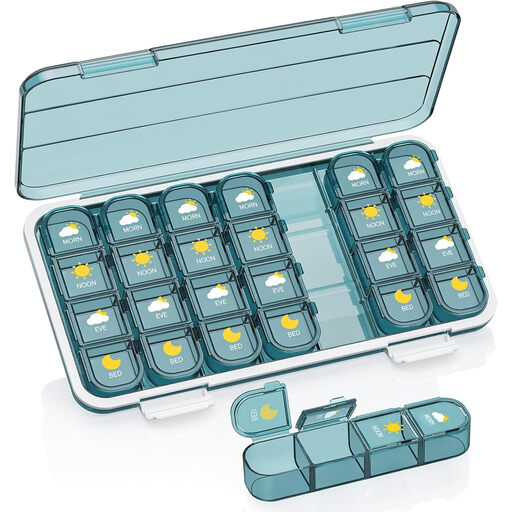
Why this product suits this profile: The layout across seven days and four dosing times is designed for people with more complex daily organisational needs.
The time-based layout prevents all preparations from being placed in a single daily compartment. Before first use, check the labelling against your personal medication schedule.
Seven days, four time periods and separate containers according to the product description; suitable for vitamins, fish oil and food supplements.
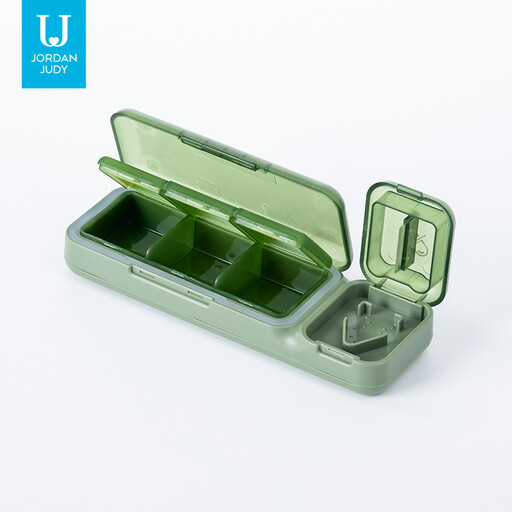
Why this product suits this profile: The compact format is designed for handbags, jacket pockets or travel luggage, combining storage with a tablet-splitting function.
The integrated splitter is intended for tablets that are suitable for splitting, not for capsules or liquid-filled preparations. The blade must be handled carefully and kept dry.
ABS plastic, stainless steel blade, multiple compartments and compact design according to the product information.
We have put together a complete, regularly updated list of products that fully meet these strict selection criteria and the safety regulations applicable in the EU.
First, follow the manufacturer’s care instructions. In many cases, a damp cloth or gentle cleaning with water and soap is sufficient. The box must then dry completely before new tablets are added. A blade or hinge should not be left soaking for extended periods.
There is no single fixed usage period that applies in every case. The condition and functionality are what matter: the lid must close securely, the markings must remain legible, and the compartments must not have cracks or sharp edges. If the box is damaged or the closure becomes loose, the medication box should be replaced.
A travel pill box is practical if it closes securely, is transported in dry conditions and has enough space for the required quantity. For prescription medicines, you should also carry the original packaging and package leaflet. When travelling abroad, you may also need to carry proof that the medicines are for your personal use. Storage should always follow the instructions in the package leaflet.