
Lieferung heute & morgen

Qualitätsgarantie

Willkommens-Angebote freischalten: KOSTENLOSE Lieferung | Bis zu 80 % RABATT | Kostenlose 30-Tage-JoyPlus-Testphase
App herunterladen
A pill box can make it easier to organise your daily medicines, vitamins, fish oil and food supplements. However, the number of compartments is not the only important factor. A pill organiser needs to suit your medication schedule, the size of your tablets and where you intend to use it.
Especially with low-cost offers, certain common marketing claims can lead to unsuitable purchases. Three points deserve particular attention:
First, consider how many medication times you need to organise. A weekly pill organiser with seven compartments is suitable for a simple daily routine. If you take medication at several times during the day, a model with four compartments per day offers a clearer overview.
Wide compartments are useful for vitamins, fish oil and larger food supplements. Small travel boxes with three compartments are more suitable for a limited daily quantity. Ideally, the product description should include specific information about compartment size or capacity. General terms such as “large” or “extra spacious” are of limited value without measurements.
A closure should shut securely but open without excessive force. This is particularly important for older people or anyone with reduced hand strength. Also check:
A waterproof pill box should only be described as such when the seller provides specific information about its water resistance. Even a tightly closing lid is no substitute for dry storage. Medicines should always be stored according to the instructions on the packaging or in the patient information leaflet.
A pill box with tablet splitter can be practical for tablets that are suitable for splitting. However, not every tablet may be divided. Depending on the product, modified-release tablets, gastro-resistant medicines, capsules and liquid-filled dosage forms may not be suitable.
According to the product description, the integrated splitter in the JORDAN&JUDY model is intended for tablets that are suitable for splitting. Before changing how you take a medicine, consult the product information or ask at a pharmacy. A pill splitter is not a substitute for dosage advice.
The following selection categorises different formats according to everyday situations and objectively described features. Product details such as “BPA-free”, “airtight” or “moisture-proof” refer in each case to the seller or product information provided.
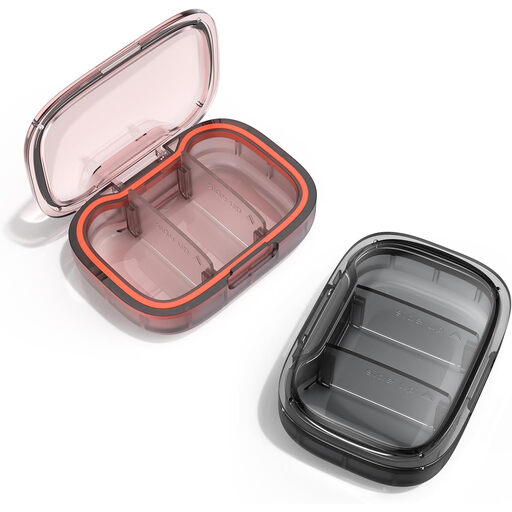
Why this product suits this profile: Two small boxes with three compartments each are suitable for short daily routines, handbags or travel luggage.
The clear three-compartment layout avoids unnecessary complexity. The description mentions moisture protection without claiming complete waterproofing.
Two-pack set, three separate compartments per box and a compact design for use on the go.
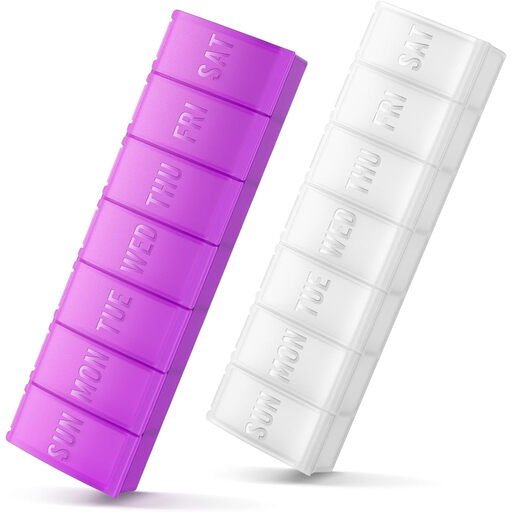
Why this product suits this profile: Seven daily compartments, permanently labelled days of the week and spacious sections are designed for structured weekly planning.
The product description specifies permanently engraved day labels and large compartments. This makes organisation less dependent on small stickers or cramped sections.
BPA-free material according to the product details, seven compartments and a two-pack in white and violet.
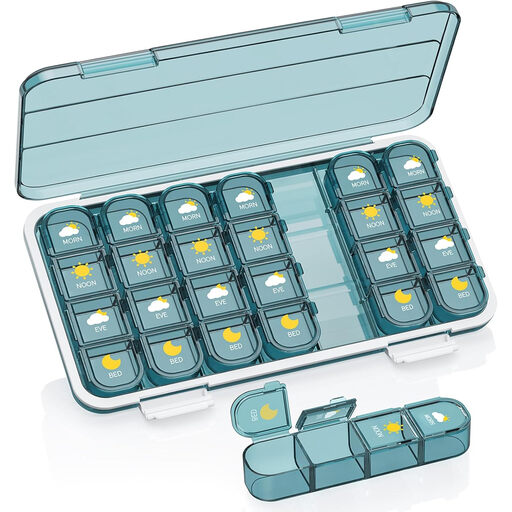
Why this product suits this profile: This format is designed for users who want to organise medicines or food supplements four times a day over seven days.
The four-times-daily layout helps avoid the common confusion between morning, midday, evening and night compartments.
Seven days, four daily time slots and separate compartments according to the product name.
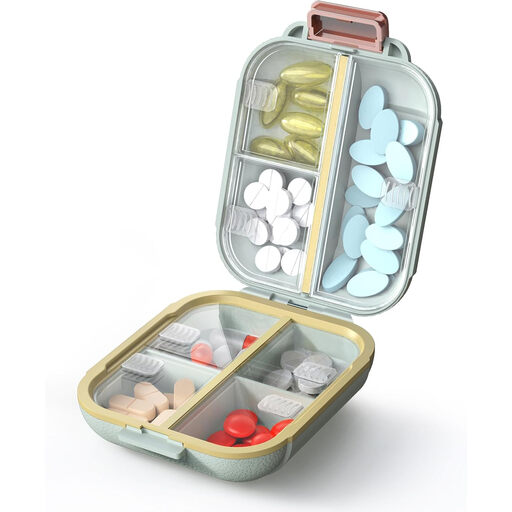
Why this product suits this profile: Seven separate compartments and a lid described as airtight make this box appealing for daily carrying and short trips.
The seven separate sections provide a daily structure without needing to carry a large weekly box. However, “airtight” should not be treated as equivalent to tested waterproofing.
Seven compartments, a compact travel-friendly design and BPA-free material according to the product details.
We have put together a complete, regularly updated list of products that fully meet these strict selection criteria and the safety regulations applicable in the EU.
Sort medicines in a calm environment wherever possible, then check each medication time. A set routine can help:
A medication box is an organisational aid and does not replace the original packaging, the patient information leaflet or medical or pharmaceutical advice.
This depends on the material, closure, cleaning and daily wear and tear. Replace the box if the lid no longer closes securely, the hinges are damaged, the labels become illegible or cracks appear. Without specific information from the manufacturer, it is not possible to give a reliable general usage period.
Only to the extent stated in the relevant product information. “Moisture-proof” does not automatically mean that water cannot get inside. Store the medication box in a dry place and follow the storage instructions for the medicine in question.
For medication taken at four times during the day, a model with several daily compartments, such as the GAONLY organiser with seven days and four time slots, provides a clearer overview than a simple seven-compartment weekly box. Before buying, also check the size of the individual sections.