
Lieferung heute & morgen

Qualitätsgarantie

Willkommens-Angebote freischalten: KOSTENLOSE Lieferung | Bis zu 80 % RABATT | Kostenlose 30-Tage-JoyPlus-Testphase
App herunterladen
The correct dosage of medication is a prerequisite for its effectiveness and safety. However, many people face the challenge of pills being too large to swallow, or a doctor-prescribed dosage requiring a pill to be split. An imprecise cut with a kitchen knife not only leads to uneven halves and crumbs but can also alter the dosage. A good pill cutter is the solution. But the market is flooded with models whose weaknesses often only become apparent with use. This guide highlights the most common pitfalls and what you need to look for to find the right device.
Many budget-friendly models promise ease of use but fail to meet basic requirements. Watch out for these three weaknesses to avoid a bad purchase:
To avoid these problems, you should check three key features before buying. These define the quality and functionality of any medication splitter.
The quality of the blade is non-negotiable. Look for models with a blade made of stainless steel. Only a sharp, durable blade guarantees a clean cut without crumbling. A good design feature is also an integrated blade guard that covers the blade when not in use, thus minimizing the risk of injury.
A reliable grip is crucial, especially for a pill cutter for small pills. Look for models with an adjustable or silicone-lined pill guide. Silicone strips or flexible holders secure the pill firmly and prevent it from slipping during the cutting process. This allows not only for exact halving but also for precise quartering of tablets.
A sturdy housing, often made of ABS plastic, ensures durability. Some models offer useful additional functions beyond just cutting. An integrated storage compartment is convenient for on-the-go use. For people with severe difficulty swallowing, a combined pill crusher that grinds the pills into a fine powder can be useful.
Based on the quality criteria mentioned, we have identified several models that are suitable for different user profiles.
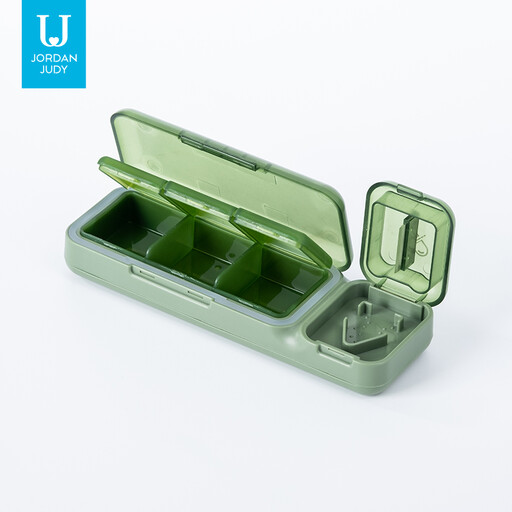
Why This Fits Their Persona: Ideal for individuals who need to manage their medication on the go. The compact design combines a pill cutter with a small pillbox and fits easily into any bag or pocket.
The integrated stainless steel blade ensures a clean cut, while the robust ABS housing provides the durability that many cheap models lack.
2-in-1 Function: Combines cutting and storage. Compact Design: Fits in pockets or handbags.
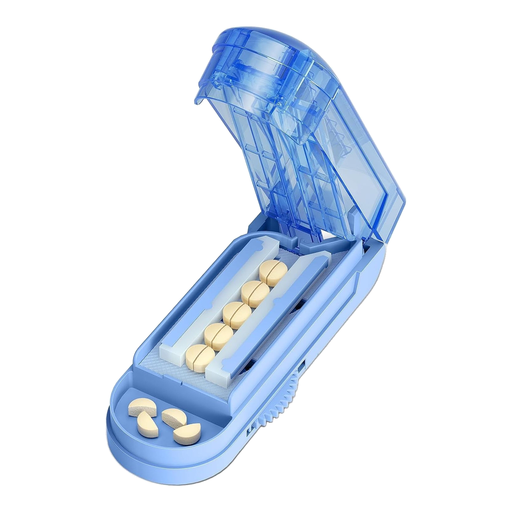
Why This Fits Their Persona: Perfect for caregivers or individuals who need to split many tablets daily. The ability to cut multiple pills at once saves time and effort.
This model solves the problem of unstable gripping with an adjustable slot and anti-slip silicone strips. This ensures that even small or multiple pills are held securely and cut precisely.
Efficient: Cuts multiple pills at once. Precise: Adjustable guide for pill sizes from 3 mm to 12 mm. Safe: Concealed blade with a protective mechanism.
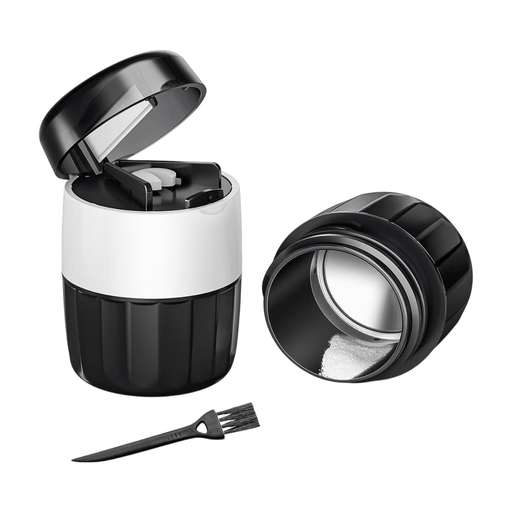
Why This Fits Their Persona: The all-in-one solution for users who need to not only cut but also grind pills. Ideal for people with dysphagia (swallowing disorders) or for administering medication via a feeding tube or to pets.
This device combines a precise pill splitter with a high-quality pill crusher. The stainless steel grinding head prevents plastic particles from mixing with the medication powder—a common problem with cheap grinders.
3-in-1 Function: Cutting, grinding, and storage in one device. High-Quality Grinding Head: The stainless steel grinder ensures a fine powder without contamination.
We have compiled a complete, up-to-date list of products that fully meet these strict selection criteria and applicable safety regulations.
For hygienic use, the pill cutter should be cleaned after each use. Usually, it is sufficient to remove medication residue with a dry cloth or a small, soft brush. The blade and the pill guide, in particular, should be carefully cleared of powder residue. Make sure the device is completely dry before closing it again to prevent the blade from rusting.
No, not every model is suitable for this. To quarter a tablet, it must be repositioned and cut again after the first cut (halving). This requires a very precise and stable holding mechanism. Models with adjustable or non-slip silicone guides have a clear advantage here, as they can also securely hold the smaller, already halved pieces.
As a rule, you should never split medications without first discussing it with your doctor or pharmacist. Special caution is required for:
When in doubt, always seek advice from a healthcare professional before changing how you take your medication.