
Lieferung heute & morgen

Qualitätsgarantie

Willkommens-Angebote freischalten: KOSTENLOSE Lieferung | Bis zu 80 % RABATT | Kostenlose 30-Tage-JoyPlus-Testphase
App herunterladen
A pill organiser can make it easier to manage medicines, vitamins, fish oil and food supplements every day. However, pill boxes vary considerably in their compartment layout, closure, material and portability. If you focus only on an eye-catching product description or a low price, you may end up buying a medication organiser that quickly proves impractical in everyday use.
A small pill box may fit in a handbag or jacket pocket, but that does not automatically mean it offers enough space. Large vitamins, fish oil capsules or several tablets for one dose can be difficult to remove. Check whether the compartment size suits your medication and whether the box is designed for individual daily doses or several doses per day.
Terms such as “waterproof”, “airtight” or “moisture-resistant” should not automatically be treated as meaning the same thing. A tightly closing lid may protect the contents from moisture more effectively in everyday use, but it does not replace dry storage. Pay attention to the specific product description and continue to store medicines according to the manufacturer’s or pharmacy’s instructions.
A closure that stays secure while you are out and about should not also be unnecessarily difficult to open. Seniors and people with limited hand strength in particular can benefit from clearly marked lids and easy-to-reach opening edges. With a weekly pill box, the individual compartments should not open accidentally when the box is in a bag.
First, consider how you want to organise your medication:
The number of compartments alone says little about whether a box is suitable. Internal dimensions, lid height and the ability to distinguish compartments clearly by day or dose time are what really matter.
Many models are made from plastic. Information such as BPA-free pill box or “medical-grade plastic” should be stated directly in the product details. For the products featured here, BPA-free material is explicitly specified in some cases. Even so, shoppers should distinguish between a specific material declaration and a general marketing claim.
Labels, embossed day names or colour-coded sections can make it easier to keep track of your medication. Also look for smooth internal surfaces, as these are generally easier to clean with a dry or slightly damp cloth. The box must be completely dry before it is refilled.
For travel, a sturdy lid, low weight and compact shape are all important. A travel pill box should fit into the bag you plan to use without individual compartments opening easily. A tablet splitter can be practical for certain solid tablets. However, it is not suitable for capsules, softgels or every type of tablet. Any splitting or change to your dosage should only be made after consulting a doctor or pharmacist.
The following selection groups products according to specific usage situations. Information about materials, compartment numbers and features is based on the respective product descriptions.
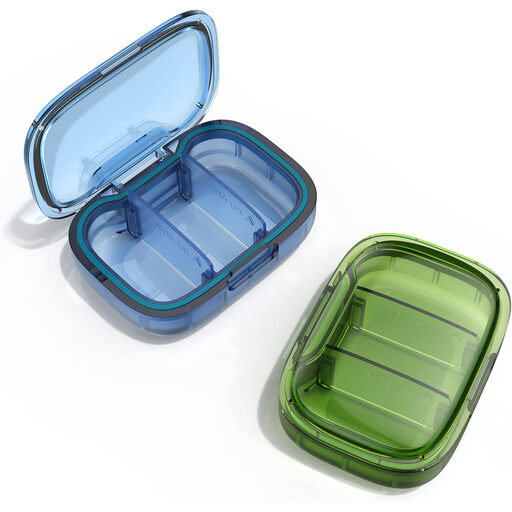
Why this product suits this profile: Two compact boxes, each with three compartments, are ideal for individual daily doses, vitamins or fish oil when you are out and about.
The three-section layout prevents different medicines from being left loose in a bag. The product name indicates moisture protection, but it should not be taken to mean lasting waterproofing.
Twin pack, three compartments per box and a shape suitable for a handbag or travel luggage.
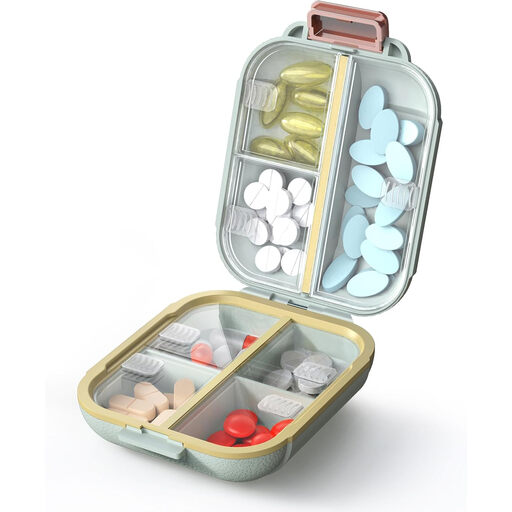
Why this product suits this profile: Seven compartments support weekly planning. According to the product information, this model has an airtight lid and is made from BPA-free material.
The specific number of compartments makes weekly planning clearer than an imprecise claim such as “plenty of storage space”. The lid is described as airtight, but the box should still be stored somewhere dry and protected.
Seven separate compartments, plus BPA-free material and an airtight lid according to the product information.
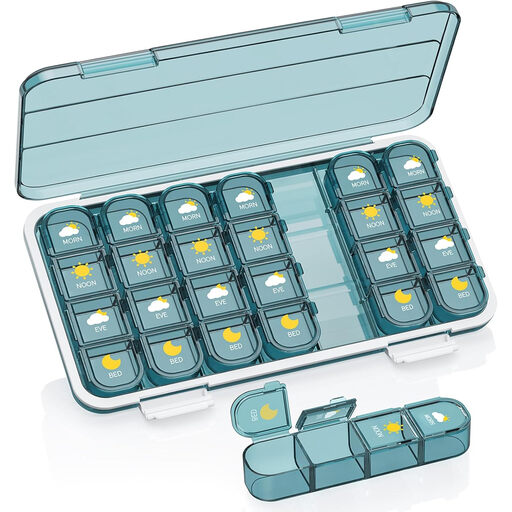
Why this product suits this profile: The combination of seven days and four daily dose sections is designed for detailed medication schedules.
The clear layout reduces the risk of mixing different dose times in a single compartment. Before buying, check whether you genuinely need the larger number of compartments.
Seven-day layout, four separate sections per day and separate compartments for vitamins, fish oil and food supplements.
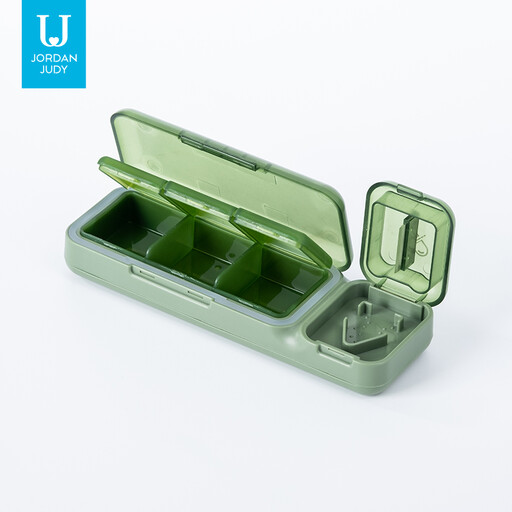
Why this product suits this profile: This compact model combines several compartments with an integrated tablet splitter for use on the go.
The feature is clearly named rather than being presented merely as a general convenience benefit. According to the product information, the splitter is not intended for capsules or softgels; check in advance whether your medicine can be split.
Compact design, several sections and an integrated stainless steel blade according to the product description.
We have put together a complete, regularly updated list of products that fully meet these strict selection criteria and the safety regulations applicable in the EU.
Label any compartments that are empty or difficult to read with the day and dose time. Fill a pill box in a calm environment whenever possible, and compare the contents with your medication schedule. Medicines should not be kept outside their original packaging for longer than intended if the manufacturer or pharmacy advises against it.
Clean the box according to the manufacturer’s instructions, usually with a soft cloth. Avoid harsh cleaning products and moisture inside the box. Replacing it is advisable if the lids no longer close securely, the compartments are damaged or the labels are no longer clearly legible.
This depends on the medicine, its packaging and the storage instructions. Heat, light and moisture can all cause problems. Check the patient information leaflet and ask a pharmacy if you are unsure. A pill box does not automatically extend a medicine’s shelf life.
Useful features include easy-to-read day labels, compartments that are large enough and lids that close securely but can be opened without much force. If medicines need to be taken at several times of day, a box with four compartments per day may be easier to follow than a model with just one compartment per day.
A simple pill box normally has no ongoing costs. Additional expenses only arise when replacing one due to wear or buying extra boxes for travel, home use and different medication schedules. The most important factors are therefore not the initial price, but the suitability of the compartment layout and durable, user-friendly operation.