
Lieferung heute & morgen

Qualitätsgarantie

Willkommens-Angebote freischalten: KOSTENLOSE Lieferung | Bis zu 80 % RABATT | Kostenlose 30-Tage-JoyPlus-Testphase
App herunterladen
A pill organiser should make taking your medication every day more manageable while also working reliably when you are out and about. However, not every pill box suits every need. Small compartments may not be large enough for sizeable vitamins, stiff lids can quickly become awkward in everyday use, and a medication box advertised as “waterproof” is not automatically suitable for damp bathroom environments.
Before buying, it is therefore worth checking the actual product specifications rather than relying on eye-catching marketing terms.
A slim pill case may seem practical when travelling. However, the available space can quickly become limited when storing fish oil capsules, several food supplements or large tablets. It is not just the number of compartments that matters, but also their internal volume and shape.
If you take several preparations in the morning and evening, you should choose a 7-day pill organiser with sufficiently large compartments. For individual daily doses, however, a small pill case with three sections may be enough.
A firm snap closure can prevent a compartment from opening in your bag. However, it may be inconvenient for older people or anyone with limited finger mobility. Look for easy-grip lids, clearly identifiable opening points and smooth-running hinges.
A secure closure should stay shut without requiring excessive force to open.
“Moisture-resistant” and “airtight” can mean different things depending on the product description. A BPA-free plastic pill organiser may be suitable for dry everyday storage. However, it does not replace the instructions on the medicine packaging. Sensitive medicines should be stored according to the manufacturer’s instructions, often still in their original packaging.
As a general rule, a medication box should not be kept permanently in a damp environment such as the bathroom. The compartments should be clean and completely dry before you fill them.
First, consider how many medication times you want to organise:
When choosing a pill organiser for vitamins, the manufacturer’s stated capacity is particularly helpful. For example, the VVM models are described as holding up to 12 fish oil capsules or 13 larger vitamins per compartment. These figures may vary depending on the shape and size of the preparations.
Clearly readable day labels that do not rub off easily are practical. When you are out and about, each compartment should close securely. At the same time, it should be possible to open it without complicated mechanisms.
For regular use, sturdy hinges are an important feature. Statements such as “over 10,000 bends” should be treated as manufacturer specifications and not equated with a guarantee of a specific service life.
Look for clear information about the material. For plastic models, BPA-free material, a smooth surface and easy cleaning are useful selection criteria. You should be able to clean the box with a damp cloth. Aggressive cleaning products can damage labels, seals or plastic surfaces.
Medicines, vitamins and food supplements should only be added once the compartments are completely dry. A pill organiser is not a substitute for child-safe storage: it should be kept out of children’s reach.
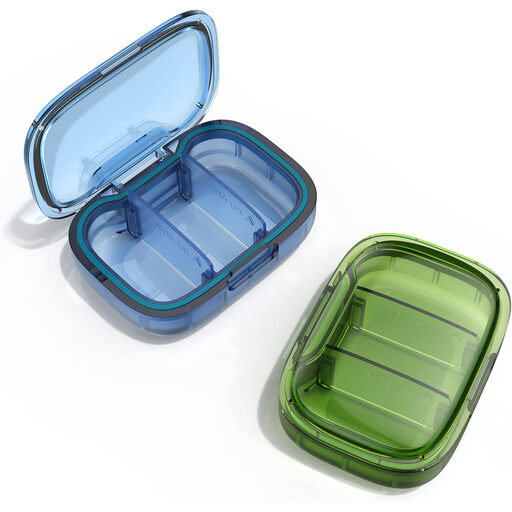
Why this product suits this profile: This two-pack is designed for compact daily organisation and carrying in a bag or purse. It is suitable for users who do not need weekly planning.
Three separate sections prevent different daily doses from becoming mixed together. However, the compact design limits the amount each compartment can hold.
Two boxes in the set; according to the product name, designed for storing vitamins, fish oil and food supplements.
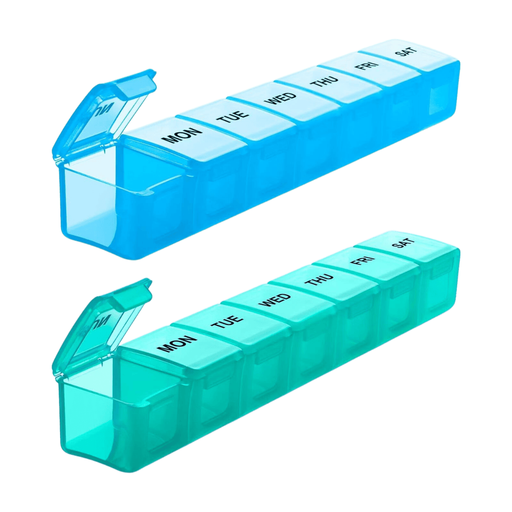
Why this product suits this profile: The large weekly layout is intended for people who want to prepare several preparations regularly while prioritising BPA-free material and clearly identifiable daily compartments.
The product description mentions extra-large compartments, reinforced hinges, snap lids and a moisture-protected design. The box should nevertheless be stored in a dry place.
BPA-free plastic with a stated material thickness of 1.6 mm; seven compartments and two boxes in the set.
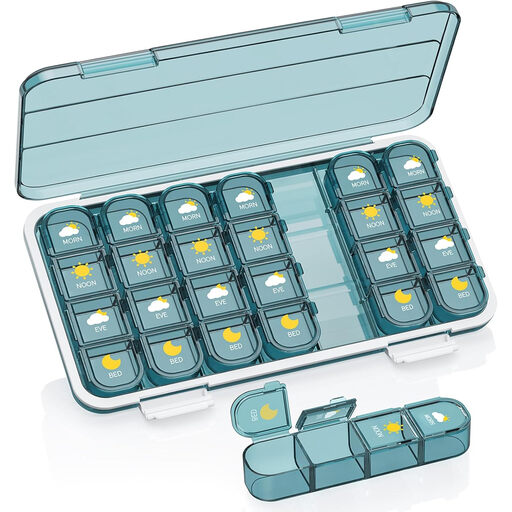
Why this product suits this profile: Four medication sections per day and separate containers are ideal for people with extensive organisational needs, as well as users who want to keep different preparations separate.
The separate compartments help prevent different daily doses from becoming mixed together. Before buying, check that the individual sections are large enough for your preparations.
Seven-day structure, four medication times per day and, according to the product name, a portable design for vitamins, fish oil and food supplements.
We have put together a complete, regularly updated list of products that fully meet these strict selection criteria and the safety regulations applicable in the EU.
Its service life depends on the material, hinges, closure and frequency of daily use. A box should be replaced if the lids no longer close securely, the hinges are damaged, cracks appear or the labels are no longer clearly legible. Manufacturer statements about the number of bends are intended as a guide and do not constitute a general durability guarantee.
A small pill box can be practical for organising medication when you are out and about. However, for prescription medicines, you should carry the original packaging, the package leaflet and any required documentation. Additional rules may apply when travelling by air or going abroad. The pill organiser itself should be kept dry and protected from pressure or impacts during transport.
First, empty all the compartments and clean the box according to the manufacturer’s instructions, usually with a slightly damp cloth. Allow it to dry completely. Then add only the intended amount and check the day label and medication time. Medicines should not be transferred or divided without consulting a doctor or pharmacist if the original packaging contains special storage instructions.