
Lieferung heute & morgen

Qualitätsgarantie

Willkommens-Angebote freischalten: KOSTENLOSE Lieferung | Bis zu 80 % RABATT | Kostenlose 30-Tage-JoyPlus-Testphase
App herunterladen
A pill organiser can make daily life more manageable when you regularly take medication, vitamins, fish oil or food supplements. However, not every pill box is suitable for every schedule. Small compartments, hard-to-read day markings or leaky closures can make everyday use unnecessarily difficult.
As a Joybuy Product Recommendation Officer, I assess product information against clear, transparent criteria and match products to different usage situations. This is not medical advice, but guidance on choosing a suitable storage solution.
A particularly small medication box may look practical in photos, but it might not offer enough space for large vitamins or fish oil capsules. If you want to store several products for each dosing time, pay attention to the compartment size, not just the external dimensions.
The term waterproof pill box does not automatically mean that the product can remain submerged for extended periods. In many cases, the description refers only to a moisture-resistant closure. When travelling, the box should also be kept in a dry wash bag or sealable pouch.
As a general rule, tablets should be stored in accordance with the packaging instructions and the advice of your doctor or pharmacist. Medicines that are sensitive to light, moisture or temperature should not be placed in an ordinary pill organiser without checking first. An integrated tablet splitter is not suitable for every tablet either. Whether a tablet can be split must be confirmed using the package information or with a healthcare professional.
For a single day’s supply, a pill organiser with compartments for morning, midday and evening may be sufficient. If you want to prepare a whole week, you will need a weekly pill organiser with seven or more separate sections. If you take products several times a day, labelled individual compartments or removable daily boxes can make organisation easier.
Look out for:
Descriptions such as BPA-free, PP plastic or ABS plastic identify the material used, but they do not replace checking the specific product information. A vitamin box should be easy to wipe clean. Before refilling it, all compartments must be completely dry to prevent unnecessary moisture from being trapped inside.
For a medication box with hinges, it is also worth checking the stability of the lids. Loose closures may cause compartments to open inside a bag.
A pill organiser for travel should be compact while still meeting your daily needs. Small boxes with three compartments are practical for short business trips or days out. For longer stays, weekly models or modular systems may be more suitable.
A “airtight” or “moisture-resistant” design should be considered an additional product feature, not a substitute for suitable storage. Medication packaging, information leaflets and any special storage instructions should be carried separately when necessary.
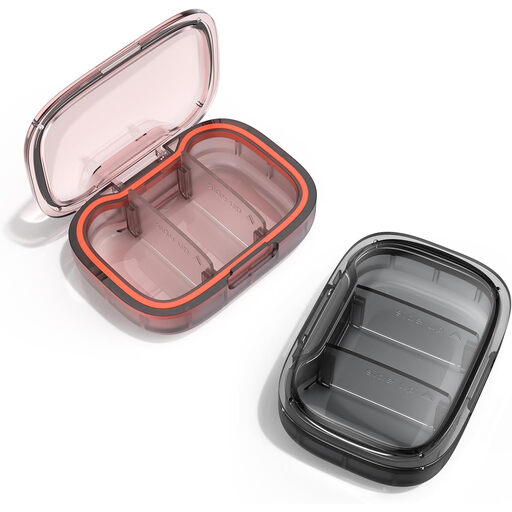
Why this product suits this profile: Two compact boxes, each with three compartments, are suitable for individual daily supplies, short trips or keeping vitamins and fish oil separate.
The layout is clearly specified, making it easier to assess before buying whether three dosing sections will be sufficient.
2-pack, three compartments per box and, according to the product description, a moisture-resistant case.
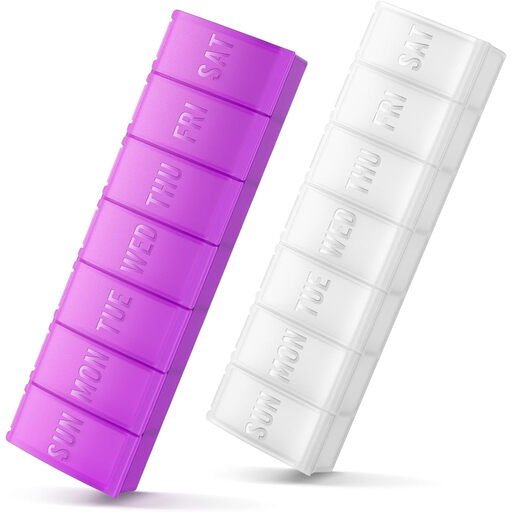
Why this product suits this profile: The 7-day format with large compartments is designed for users who prefer to plan a week’s supply of larger vitamins, fish oil or food supplements.
Permanently attached day markings reduce the risk of labels coming loose or fading quickly.
BPA-free plastic material according to the product information, seven compartments, easy-open lids and a 2-pack.
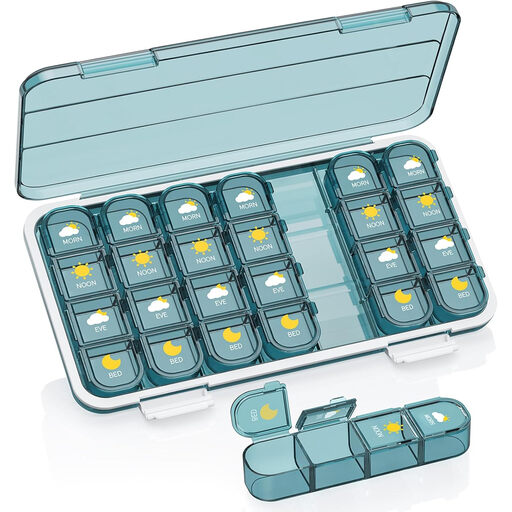
Why this product suits this profile: The layout for four dosing times per day is intended for users with more complex personal organisation needs.
Separate day and dosing sections help avoid a confusing all-in-one box. Suitability should be assessed based on the compartment size required.
7-day layout, four time sections per day and separate compartments for vitamins, fish oil and supplements according to the product description.
Only fill a pill box for the period during which storage is considered suitable according to the package information. Before placing tablets inside, check whether they are damaged or have changed in appearance. The box should be stored somewhere dry and clean, protected from excessive heat and direct sunlight.
Extra care is required with a pill organiser with tablet splitter: the splitter is intended only for suitable solid tablets. Capsules, liquid medicines and tablets with special coatings must not be split without professional advice. A splitter does not replace individual dosage instructions.
For older people or anyone with limited hand strength, large labels and easy-to-operate closures are often more important than having as many compartments as possible. Before buying, assess the opening mechanism using the product images and dimensions.
We have put together a complete, regularly updated list of products that fully meet these strict selection criteria and the safety regulations applicable in the EU.
That depends on your dosing schedule. For a simple daily supply, three compartments are often enough. For weekly planning, seven daily compartments are useful. If you take products several times a day, a box with several time sections per day makes organisation clearer.
There is no single storage period that applies to all medicines. The information on the original packaging, along with advice from your doctor or pharmacist, is what matters. Moisture, heat and light can affect suitable storage conditions. If you are unsure, medicines should remain in their original packaging until they are taken.
A tablet splitter can be practical for suitable tablets that are designed to be divided. However, it is not suitable for capsules or every type of tablet. Before splitting a tablet, check the package information or ask a pharmacist.