
Lieferung heute & morgen

Qualitätsgarantie

Willkommens-Angebote freischalten: KOSTENLOSE Lieferung | Bis zu 80 % RABATT | Kostenlose 30-Tage-JoyPlus-Testphase
App herunterladen
A pill organiser keeps medicines, vitamins, fish oil and food supplements neatly stored. In practice, however, poor purchases are not caused only by size and price. More common issues include an unsuitable compartment layout, labels that are difficult to read or a closure that does not work reliably in everyday use.
A compact pill box may fit in your jacket pocket, but it might not have enough space for several tablets. Conversely, a large medicine box designed for a bedside table is impractical when you are out and about. So consider whether you need a daily medicine box, a 7-day pill organiser or a small travel pill box.
The frequency of your doses is also important. If you take medication several times a day, separate compartments are useful. A box with just one compartment per day can lead to mix-ups.
Descriptions such as “airtight”, “secure” or “high quality” are of limited value without a clear explanation. Instead, look for specific, verifiable details:
A box described as moisture-resistant is not a substitute for suitable storage for temperature-sensitive or particularly vulnerable medicines. Always follow the instructions on the packaging and in the patient information leaflet.
A pill box with a tablet splitter can be practical for certain tablets that are suitable for splitting. However, not every tablet may be divided. Capsules, liquid capsules and medicines with special coatings may not be suitable. If you are unsure, ask a doctor, nurse or pharmacist. A tablet splitter is not intended for changing your dosage independently.
For regular use at home, a 7-day pill organiser is a practical choice. Models with several compartments per day can separate morning, midday, evening and night-time doses. This makes preparation easier, but only if the labels are easy to read.
For short trips, working days or holidays, a small pill box with two or three sections is often sufficient. For food supplements, a vitamin box with larger compartments may be more suitable than a very flat tablet organiser.
Compare the dimensions with the intended storage location. For a handbag or trouser pocket, compact external dimensions and a secure lid are important. A box for a medicine drawer can be larger if this makes the compartments easier to read and fill.
A pill organiser for travelling should not only be compact but also easy to open. Very tight closures may be impractical for older people or those with limited hand strength. If possible, check whether the individual compartments can be closed separately.
Plastic is lightweight and usually easy to wipe clean. For products with metal components, such as a cutting blade, careful maintenance is particularly important. Any moisture should be removed completely after cleaning. Harsh cleaning products can damage surfaces or labels.
A medicine box should be kept dry and clean, and out of the reach of children. Medicines should ideally remain in their original packaging unless the patient information leaflet or a pharmacist recommends another storage method.
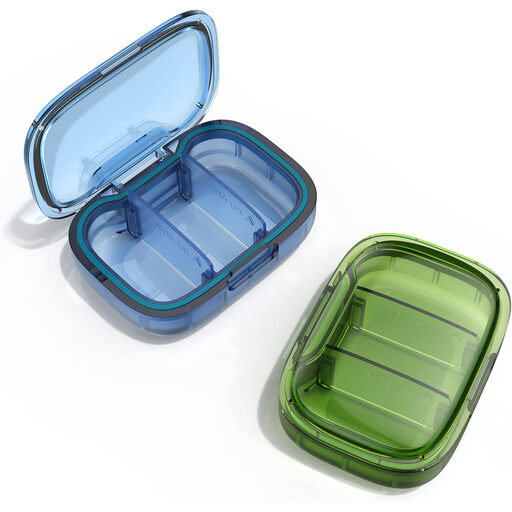
Why this product suits this profile: Two small boxes, each with three sections, are ideal for people who want to carry medicines, vitamins or fish oil separately for individual days and short trips.
The three-compartment layout prevents all your medicines and supplements from being loose in one single section. Its compact shape reduces unnecessary bulk in your luggage.
The product name specifies two boxes, three compartments and a moisture-resistant case. Suitable for a bag or jacket pocket.
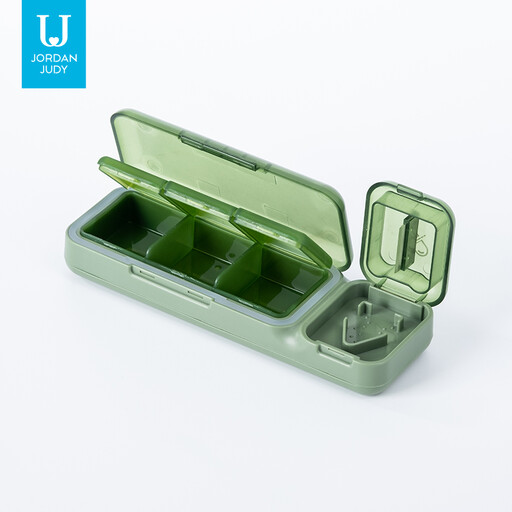
Why this product suits this profile: This model combines several compartments with an integrated tablet splitter, making it suitable for users who prefer a well-organised, portable solution.
The tablet splitter is listed as a dedicated function. This reduces the need for an additional tool, but does not replace medical advice on whether a tablet can be split.
The product details specify ABS plastic, a snap closure and a stainless steel blade. The format is designed for a handbag, rucksack or travel luggage.
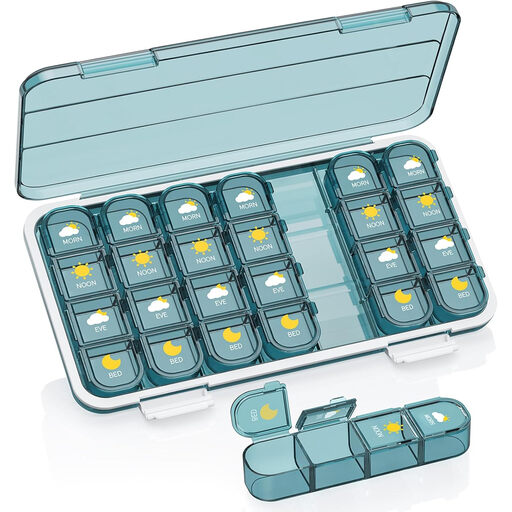
Why this product suits this profile: With four dosing sections per day, this weekly box is designed for regular use and multiple daily doses. It can also be used for vitamins, fish oil and food supplements.
The clear weekly and daily structure helps prevent individual compartments from becoming overfilled. Separate sections make it easier to prepare doses by time of day.
The product name specifies seven days and four dosing times per day. Separate containers are designed for different medicines and supplements.
We have put together a complete, regularly updated list of products that fully meet these strict selection criteria and the safety regulations applicable in the EU.
Fill the box at a set time whenever possible and compare each compartment with your dosing schedule. With a 7-day pill organiser, you may initially want to prepare only a limited period if storage instructions or moisture are a concern.
Also bear the following in mind:
For regular use, a weekly box with separate day and time compartments is practical. If you take medicines several times a day, the box should have a corresponding number of sections for each day. If you only take a few medicines, a smaller pill box may be sufficient.
There is no standard lifespan. It depends on the material, closure, cleaning routine and daily use. Replace the medicine box if the compartments no longer close securely, the labels become illegible or cracks and deformations appear.
That depends on the medicine concerned. Requirements relating to light, moisture or temperature may mean that it needs to be kept in its original packaging. Check the patient information leaflet or ask a pharmacist before transferring medicines to another container.