
Lieferung heute & morgen

Qualitätsgarantie

Willkommens-Angebote freischalten: KOSTENLOSE Lieferung | Bis zu 80 % RABATT | Kostenlose 30-Tage-JoyPlus-Testphase
App herunterladen
A pill organiser keeps medicines, vitamins and food supplements neatly arranged and makes them easier to take with you. In practice, though, not every pill box suits your personal medication schedule. Compartments that are too small, hard-to-read labels or lids that pop open while you’re out can make everyday organisation unnecessarily difficult.
That’s why the Joybuy Product Recommendation Officer focuses on clear, verifiable product features rather than general marketing claims.
Fish oil capsules, larger vitamins and multiple food supplements need more space than small tablets. A compact pill organiser may be easy to carry, but it can quickly run out of room if you have a more extensive medication schedule. So check not only how many compartments it has, but also their size and depth.
A 7-day pill organiser with just seven compartments is best suited to taking everything once a day. If you need different products in the morning, at lunchtime and in the evening, a pill organiser with compartments for different times of day makes it easier to keep track. Otherwise, there’s a risk of mixing up doses for different times.
A loose-fitting lid can pop open in a bag. Medicines and food supplements should also be kept dry and out of direct sunlight. Terms such as “waterproof” or “moisture proof” shouldn’t automatically be taken to mean the product is fully protected if submerged. Check the manufacturer’s exact description and make sure the compartments are dry before filling them.
The compartments should suit your actual daily routine:
A pill box with clearly marked days of the week makes it easier to keep track. Lids that are easy to open can be useful for older people or anyone with limited finger mobility. At the same time, the clasp needs to close securely so the pill organiser won’t open accidentally in your bag.
For plastic boxes, details such as PP plastic, ABS plastic or BPA-free material can help guide your choice. However, these terms don’t automatically mean a box is suitable for every medicine. Medicines should always be stored according to the instructions on their packaging.
For the products featured here, a damp cloth or hand-washing with a mild detergent is generally sufficient. Make sure the compartments are completely dry before filling them again. Only use a dishwasher, microwave, freezer or strong cleaning products if the manufacturer explicitly says they are suitable.
A pill organiser with a tablet cutter can be handy for certain tablets that are suitable for splitting. It isn’t designed for capsules or liquid-filled medicines. Whether a tablet can be split depends on the medicine. If you’re unsure, check the patient information leaflet or ask a pharmacist or doctor. A pill organiser is not a substitute for dosage instructions.
For travel and work, compact dimensions, a secure clasp and a clear compartment layout are usually more important than extra features. A travel pill case should also not be left in a hot car or in direct sunlight for extended periods.
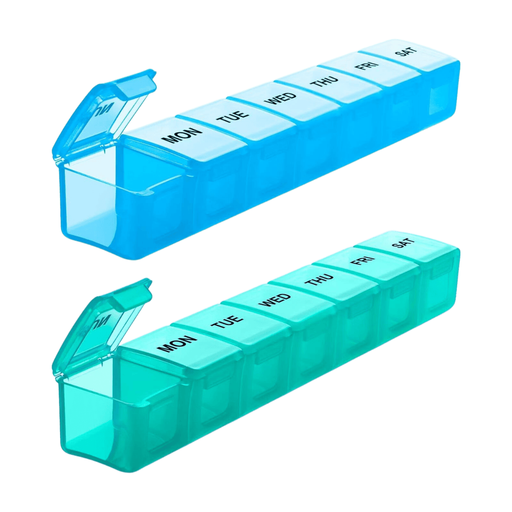
Why this product suits this profile: Two weekly organisers, each with seven daily compartments, make it easy to organise vitamins, food supplements or daily medicines.
The individual daily compartments are clearly separated. The manufacturer states that each compartment can hold up to 12 fish oil capsules or 13 large vitamins.
BPA-free plastic, reinforced hinges, snap closures and a design the manufacturer describes as moisture-protected.

Why this product suits this profile: Its layout of seven days and three times of day suits a regular medication schedule with several doses throughout the day.
The 21 compartments help prevent morning, lunchtime and evening doses from getting mixed together in a single daily compartment.
Food-grade PP plastic, three rows with seven daily compartments each, and a snap closure that the product description says seals airtight.
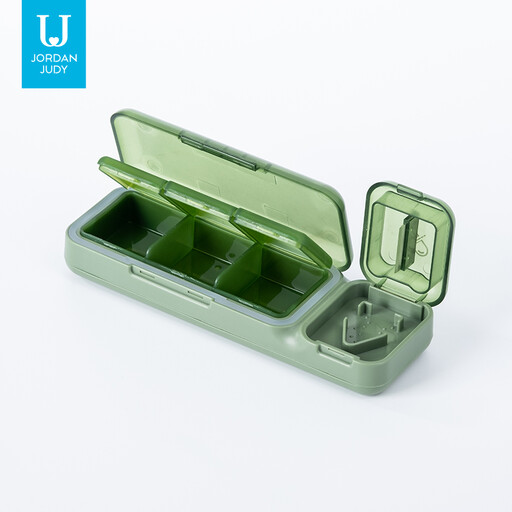
Why this product suits this profile: This compact travel pill case is designed for people who want to carry individual doses in a bag, backpack or handbag.
Several small compartments keep different doses separate. The built-in cutter is only for suitable tablets, not capsules or liquid medicines.
Compact ABS case, snap closure and an integrated stainless steel blade for splitting suitable tablets.
If you’re looking for a 7-day pill organiser with particularly large compartments, Joybuy also stocks the VVM version in a two-pack in white and purple. For planning further ahead, GAONLY models with four or six interlocking sections are another option; the manufacturer says they can be used for up to ten days.
A pill box for vitamins and food supplements with seven compartments is sufficient if you only need one set of doses per day. Whether you’re storing it at work, on your bedside table or taking it on a trip, choose dimensions and a lid mechanism that suit the space you have.
We’ve put together a complete, regularly updated list of products that meet these strict selection criteria and fully comply with the safety regulations in force in the EU.
It depends on your medication schedule. If you take something once a day, an organiser with seven daily compartments is often enough. If you take doses two or three times a day, 14 or 21 separate compartments make it easier to keep track. The key is to choose a layout that helps prevent mix-ups.
There’s no set lifespan that applies to every pill box. Check the lid, hinges, seals and compartments regularly for cracks or warping. Replace any damaged boxes. You should also follow the manufacturer’s instructions for cleaning and storage.
It depends on the medicine. Some need to be kept in their original packaging, protected from light or stored at a specific temperature. Check the patient information leaflet and ask a pharmacist if you’re unsure. A pill organiser helps you keep track of doses but doesn’t replace the required storage conditions.