
Lieferung heute & morgen

Qualitätsgarantie

Willkommens-Angebote freischalten: KOSTENLOSE Lieferung | Bis zu 80 % RABATT | Kostenlose 30-Tage-JoyPlus-Testphase
App herunterladen
A pill organiser can make storing your daily medication more manageable and make it easier to carry vitamins, fish oil or food supplements. However, pill boxes vary considerably in terms of compartment layout, closures, materials and portability. An appealing product description alone says little about whether a model will suit your daily routine.
Before buying, you should therefore check typical weak points: compartments that are too small, difficult-to-use closures and unclear information about moisture protection or materials. The following selection will help you assess medication organisers objectively according to how you intend to use them and the features they offer.
A pill organiser with lots of compartments may initially seem versatile. However, the capacity can be limited when storing large capsules, fish oil capsules or several medicines for each dose. So don’t just look at the number of compartments; consider their actual size and shape too.
With a pill organiser with compartments, it is also important to check whether each compartment closes separately. Individual lids can make sorting easier when you are out and about, while a simple weekly box can be quicker to fill.
The term waterproof pill box or ‘moisture proof’ can describe different levels of protection depending on the supplier. Such a box should not automatically be submerged in water or exposed to high humidity in the bathroom for extended periods. Check whether the closure clicks securely into place and whether the manufacturer provides specific information about moisture protection.
For sensitive medicines and supplements, you should continue to follow the storage instructions on the original packaging. A pill organiser does not automatically replace the light-protected or temperature-controlled original packaging.
Very compact pill organisers save space, but may be impractical for people with reduced finger strength or mobility. Seniors and people with arthritis should look for easy-grip lids, clearly visible labels and a closure that can be opened without excessive force.
For a single dose per day, a small pill box with several daily compartments is often sufficient. If you take medicines at several different times, a model with separate sections for morning, midday, evening and night provides a clearer overview.
A weekly pill box typically contains seven daily sections. Models for seven or ten days can be useful if you want to refill the box less often or are planning a trip. The labels should remain clearly legible over time. Printed information can wear off with frequent cleaning, while engraved or embossed labels may remain visible for longer.
Many products are made from plastic. Information such as BPA-free, ABS or food-grade plastic provides an indication of the materials used, but does not replace checking the rest of the product details. Important points include:
When storing medication daily, you should inspect the box regularly. If a lid no longer closes securely, a hinge is damaged or powder residue has built up, the pill organiser should be replaced.
A travel pill organiser should fit in a bag or hand luggage and should not open accidentally. For short trips, small models with two or three compartments are suitable. For longer journeys, separate daily compartments or a ten-day layout are more practical.
A pill box with tablet splitter can make it easier to split certain tablets. However, it should not be used indiscriminately for capsules, softgels or every type of medicine. Whether a tablet can be split depends on the specific product. If in doubt, check the package leaflet or ask a pharmacy. You should not alter your dosage without professional advice.
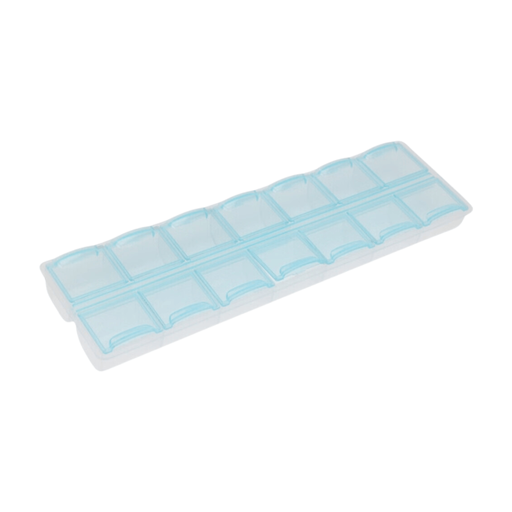
Why this product suits this profile: This straightforward medication box is suitable for people looking for a simple storage solution without extensive additional features. The product name indicates PP material and multiple compartments.
Before buying, you can compare the number and dimensions of the compartments directly with your personal requirements, rather than choosing based solely on an extensive feature list.
PP material and a compartment-style design are listed as product features. The format is suitable for simple organisation at home.
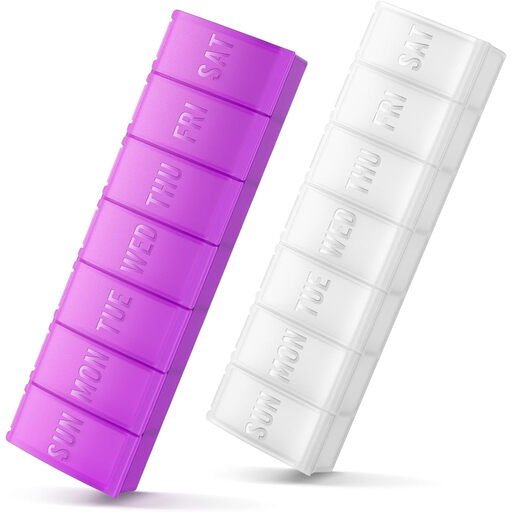
Why this product suits this profile: The seven-section weekly layout and the engraved day labels mentioned in the product description suit people who organise their medication regularly and also want to use the box when travelling.
The permanently engraved day labels reduce the risk of markings becoming illegible after frequent wiping. The compartment size should still be compared with your own medicines and supplements beforehand.
BPA-free, medical-grade plastic material, seven daily compartments and easy-open lids are listed as product features.
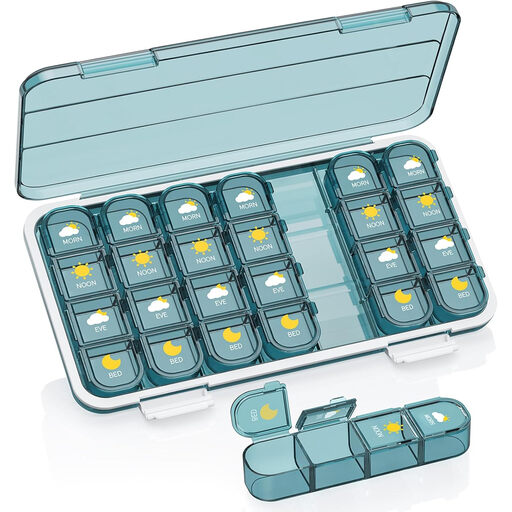
Why this product suits this profile: The layout for four daily dosing times is designed for people who need to organise medicines into several sections each day. Separate cases can make it easier to carry individual days with you.
The clear day-and-time layout helps prevent medicines for different dosing times from being mixed up. However, the portability stated by the supplier should still be checked against your personal luggage requirements.
Seven days, four dosing sections per day and separate containers are listed as features. The model is described as suitable for vitamins, fish oil and food supplements.
We have put together a complete, regularly updated list of products that fully meet these strict selection criteria and the safety regulations applicable in the EU.
Its lifespan depends on the material, hinges, closure and frequency of daily use. It is not possible to give a reliable, standard service life that applies to every product. Check the box regularly for cracks, loose lids and illegible labels. It should be replaced if it is damaged.
This depends on the specific medicine. Some products must be stored in their original packaging, in a dry place, protected from light or at a specific temperature. Follow the instructions in the package leaflet and ask a pharmacy if you are unsure. A medication organiser is primarily an organisational aid and does not provide general approval for every type of storage.
For short trips, small models with several daily or dosing compartments are practical. For longer stays, a 7-day or 10-day box, as well as separate cases, may be useful. Key considerations include a secure closure, suitably sized compartments, clearly legible labels and compliance with the storage instructions for the specific medicine.